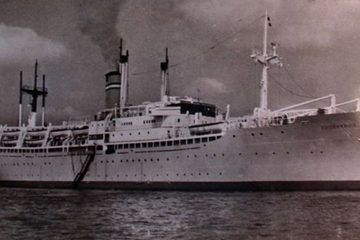
The Zuiderkruis was one of three former American Victory ships acquired by the Dutch Government after the Second World War. Together with the Groote Beer and Waterman, she became part of the Kleine Drie—the “Little Three”—that transported thousands of emigrants from the Netherlands to Australia and other overseas destinations.
Unlike the large Dutch passenger liners, Zuiderkruis was not originally designed for civilian travel. Her transformation from wartime troopship into a vessel carrying families across the world reflected both the adaptability of post-war shipping and the scale of Dutch emigration during the 1950s and early 1960s.
Built as Cranston Victory
The ship was constructed as Cranston Victory by the Oregon Shipbuilding Corporation in Portland, Oregon. Her keel was laid on 13 March 1944, she was launched on 5 May and completed later that month.
She was a VC2-S-AP3 Victory ship, one of a class developed by the United States as a faster and more advanced successor to the Liberty ship. Victory ships were principally designed as cargo vessels, but Cranston Victory was among 97 completed or adapted to carry troops.
The troopship configuration allowed her to accommodate approximately 1,600 military personnel. Large spaces between decks contained tiered bunks, while additional galleys, washrooms, medical facilities, ventilation and heating were installed.
Operated for the United States War Shipping Administration by the South Atlantic Steamship Company, Cranston Victory transported American military personnel during the closing stages of the war and the subsequent repatriation of troops.
Acquisition by the Netherlands
Following the war, the ship was placed in the United States reserve fleet. The Dutch Government purchased her in March 1947 and renamed her Zuiderkruis, meaning Southern Cross.
The name was particularly appropriate for a ship destined to travel frequently through the Southern Hemisphere. It also complemented the astronomical names given to her two Dutch sister ships: Groote Beer, the Great Bear, and Waterman, Aquarius.
Zuiderkruis remained government-owned and came under the management of the Koninklijke Rotterdamsche Lloyd. She was initially used to transport Dutch military personnel to the Netherlands East Indies and New Guinea. On her return voyages, she carried servicemen, repatriates and families to the Netherlands.
These voyages took place during the conflict surrounding Indonesian independence and the gradual dismantling of Dutch colonial rule. After the transfer of sovereignty in December 1949, the requirement for military transport declined. The ship was consequently prepared for a very different task.
Conversion into an emigration ship
In 1951, Zuiderkruis underwent extensive reconstruction at the Nederlandsche Dok en Scheepsbouw Maatschappij in Amsterdam. The work formed part of the programme to convert all three Dutch Victory ships into single-class emigration vessels.
Dutch shipping engineer Cornelis Bijvoet, technical adviser to the Ministry of Shipping, played an important role in planning and supervising the conversions.
An additional passenger deck was constructed, while the bridge was raised and moved forward. The large troop accommodation spaces were divided into cabins generally holding between five and eight passengers. Washbasins with hot and cold water were installed, although some larger dormitories remained for people travelling alone.
Following conversion, Zuiderkruis could accommodate approximately 830 passengers. Facilities included:
- dining rooms and lounges;
- a cinema;
- recreation and writing rooms;
- children’s rooms and a nursery;
- hospital and medical accommodation;
- laundries and ironing facilities;
- baby washrooms;
- a hairdresser, shop and bar;
- open deck and sports areas.
The accommodation was practical rather than luxurious, but it was a substantial improvement over the ship’s military configuration. A 1957 accommodation plan preserved by Museums Victoria illustrates the cabins, public rooms and passenger facilities shared by the three converted Victory ships.[1]
Emigration voyages to Australia
Zuiderkruis began carrying emigrants in 1951. One early voyage departed Rotterdam on 25 August, travelled by way of Curaçao, the Panama Canal and Tahiti, and reached Wellington in New Zealand on 27 September. Australian ports were also included in the ship’s emigrant services.
During the 1950s and early 1960s, Zuiderkruis carried passengers to Australia, New Zealand, Canada, the United States and South Africa. Australian voyages generally called at Fremantle before continuing to Melbourne and Sydney.
The routes varied. Some voyages passed through the Mediterranean and Suez Canal, while others crossed the Atlantic, travelled through the Panama Canal and continued across the Pacific. The Panama route could include calls at Curaçao, Tahiti and New Zealand before the ship reached Australia.
A 1955 edition of the Australian Government publication Good Neighbour included a photograph of emigrants from the Netherlands disembarking from Zuiderkruis and preparing to begin their new lives in Australia.[2]
Life aboard the Zuiderkruis
A voyage to Australia generally lasted several weeks. Although the ship provided the principal facilities required by families, accommodation remained relatively confined. Cabins holding six or eight passengers offered limited privacy, while single passengers could be placed in larger dormitories.
Life aboard was organised around communal meals and shipboard activities. Films, concerts, religious services, children’s programmes, deck games and celebrations helped passengers manage the long periods at sea. Friendships formed during the voyage often provided support during the first years in Australia.
The ship was also a workplace. Hundreds of passengers had to be provided with meals each day, while crew members maintained the cabins, public rooms, machinery and medical facilities.
Bert Broekman worked as a young cook aboard Zuiderkruis in 1955. On the same voyage, his brother Jan, sister-in-law Annie and their young son Henk were emigrating to Australia. Bert would return to the Netherlands with the ship, but for his relatives the departure from Amsterdam marked a permanent separation from their homeland.
Their voyage followed the Panama route. An outbreak of measles among the children prevented passengers from going ashore at Tahiti. After calling at Wellington, Zuiderkruis continued to Fremantle and Melbourne.
A ship remembered through family stories
Several family histories preserved by the DACC record voyages aboard Zuiderkruis.
The Hennik family arrived at Fremantle on 17 February 1959. From there, they travelled by train to the Woodside Migrant Reception Centre in South Australia. Their surviving shipboard document contains a passenger list and signatures collected from members of the crew.
In December 1960, the Douwes family—parents and ten children—departed Amsterdam aboard Zuiderkruis. Their voyage took them through the Panama Canal and Tahiti, then onward through New Zealand to Sydney. Maria Douwes later recorded the family’s departure and voyage in her book Back to Australia.
These accounts demonstrate why Zuiderkruis remains significant beyond her technical history. To the passengers, she was the setting for the final farewell to the Netherlands and the first shared experience of their new lives as emigrants.
Later passenger service
By the beginning of the 1960s, Dutch emigration by sea was declining. The Netherlands had experienced a strong economic recovery, while increasing numbers of international travellers were choosing air transport.
Zuiderkruis underwent further alterations around 1960 to improve her passenger accommodation. However, the market for ships of her type continued to contract.
Unlike Groote Beer and Waterman, which were sold into Greek ownership, Zuiderkruis remained in Dutch service. In 1963, she was withdrawn from emigrant transport and transferred for use by the Royal Netherlands Navy at Den Helder. She served as an accommodation and stores ship at the naval base.
In 1969, the former Cranston Victory was sold for demolition and scrapped at Bilbao, Spain.
Her career had taken her from wartime America to the Netherlands East Indies, Australia, New Zealand and other migration destinations. For the Dutch Australians who crossed the world aboard her, Zuiderkruis remained associated with one journey above all: the voyage from the Netherlands to a new homeland.
Selected passenger stories
Place the three existing family articles after the ship history as linked stories rather than reproducing them in full:
- The Broekman family and the SS Zuiderkruis
- Hennik family on the Zuiderkruis
- The migration of the Douwes family on the Zuiderkruis, 1960–1961
Selected passenger stories
- The Broekman family and the SS Zuiderkruis
- Hennik family on the Zuiderkruis
- The migration of the Douwes family on the Zuiderkruis, 1960–1961
Related DACC articles
- The Dutch Victory ships: Groote Beer, Waterman and Zuiderkruis
- SS Groote Beer – From troop transport to Dutch emigration ship
- SS Waterman – From Victory troopship to Dutch emigration ship
- Cornelis Bijvoet, shipping engineer and architect of Dutch emigration ships
Sources
- Museums Victoria – Accommodation Plan: SS Groote Beer, SS Waterman and SS Zuiderkruis, 1957
- Good Neighbour – Dutch newcomers disembarking from Zuiderkruis, July 1955
- Library of Congress – Victory ship design and development
- DACC – Cornelis Bijvoet, shipping engineer and architect of Dutch emigration ships