This page brings together contemporary Australian and Dutch newspaper reports relating to the Dutch dredging workers and their families who travelled to Australia in 1950.
The reports document the formation of Australian Dredging and General Works, the recruitment of skilled Dutch workers, the transport of dredging vessels and equipment to Melbourne, the two organised KLM flights, and the accommodation provided for workers and their families in Williamstown. Later articles describe the company’s expanding Australian activities and the experiences of some of the Dutch employees.
Several Dutch newspapers described the arrangement as verpakte emigratie—“packaged migration”—because employment, transport and accommodation were organised as part of the industrial project. The reports therefore provide valuable evidence about both Dutch commercial activity in Australia and an unusual form of company-organised post-war migration.
The articles are presented chronologically and have been retained as primary historical sources. The language, terminology, figures and expectations expressed in them reflect what was reported at the time. Some details differ between reports or have subsequently been clarified through KLM seating plans, archival research and information supplied by families.
For the reconstructed history of the project, the passengers and their settlement in Australia, see:
From Sliedrecht to Williamstown: Dutch dredging workers and their families in post-war Australia
The DACC is preserving these reports as part of its growing archival collection concerning Dutch migration, maritime expertise and business activity in Australia. Additional newspaper reports, original documents, photographs or family information relating to the project would be very welcome.
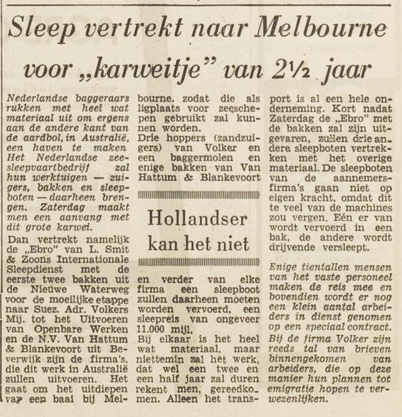
“Sleep vertrekt naar Melbourne voor ‘karweitje’ van 2½ jaar” — Het Vrije Volk, 3 February 1950
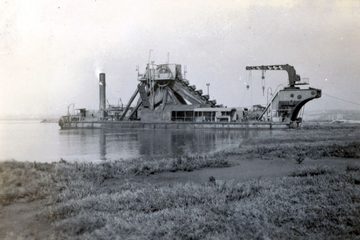
This report provides further details about the dredging fleet assembled for the Melbourne project and the considerable challenge of towing the equipment to Australia. It also records the strong interest among Dutch workers in joining the undertaking and notes that employees would be engaged under special contracts.
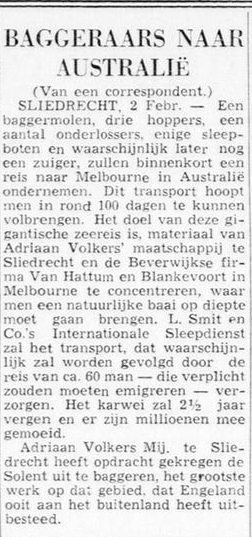
“Baggeraars naar Australië” — De Telegraaf, 3 February 1950
This early announcement outlined the scale of the proposed Australian operation. It reported that a bucket dredger, three hopper vessels, bottom-dumping barges, tugboats and possibly a suction dredger would be transported to Melbourne. Approximately 60 men were expected to follow. The project, involving Adriaan Volker of Sliedrecht and Van Hattum & Blankevoort of Beverwijk, was expected to take about two and a half years.
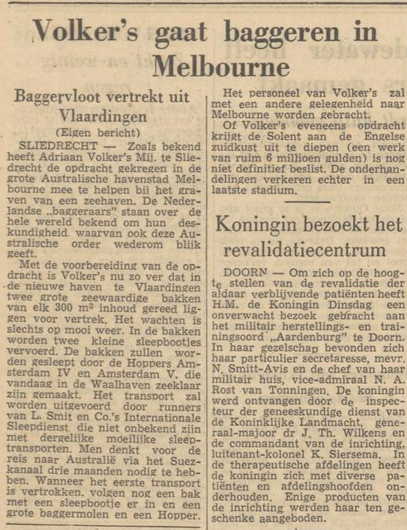
“Volker’s gaat baggeren in Melbourne” — De Telegraaf, 15 February 1950
This article describes preparations for the first maritime transport from Vlaardingen. Two seagoing barges, each carrying a small tugboat, were to be towed by the hopper vessels Amsterdam IV and Amsterdam V. The voyage through the Suez Canal was expected to take approximately three months, with additional dredging vessels and equipment to follow.
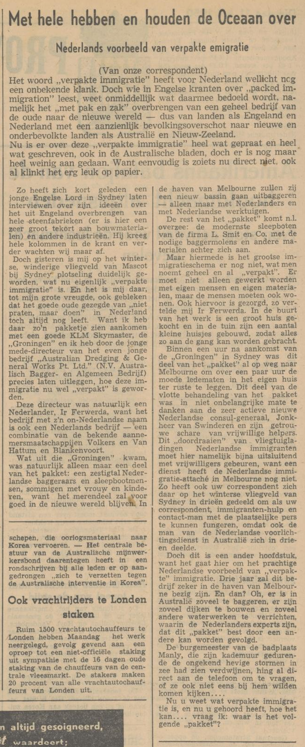
“Met hele hebben en houden de Oceaan over: Nederlands voorbeeld van verpakte emigratie” — unidentified Dutch newspaper, 1950
This report presents the Australian dredging undertaking as a Dutch example of verpakte emigratie—“packaged migration”. It explains that the project transported not only workers but also Dutch management, machinery and equipment. Accommodation was arranged in Australia, while Dutch diplomatic and community representatives assisted the new arrivals. The article shows how a commercial contract was understood at the time as a possible model for organised migration.
“Dutch Community in Williamstown” — Williamstown Advertiser, 5 May 1950
This Australian report announced that Williamstown would soon receive its own small Dutch community. It described the welcome given by Williamstown Council to company representatives Marinus Stigter and Hans Ferwerda, the harbour work to be undertaken and the company’s plans to provide accommodation and residential land for its Dutch employees.
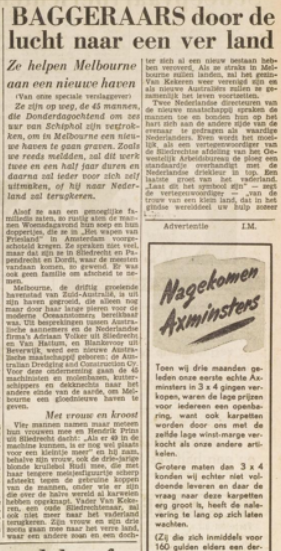
“Baggeraars door de lucht naar een ver land” — Het Vrije Volk, 23 June 1950
Published immediately after the departure of the first KLM flight, this report records that 45 Dutch workers left Schiphol on 22 June 1950, accompanied by four wives and one child. It provides a contemporary account of the human side of the project, including the circumstances of several workers and families preparing to begin their new lives in Australia.
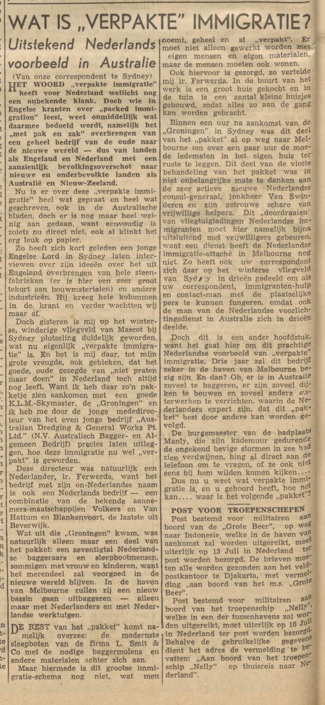
“Wat is ‘verpakte’ immigratie?” — unidentified Dutch newspaper, 10 July 1950
Writing from Sydney, the correspondent explains the idea of “packaged immigration” through the example of the Melbourne dredging project. The report describes how workers, machinery, management and accommodation were brought together as one organised undertaking. It also records the assistance provided by the Netherlands Consul-General, Jonkheer Van Swinderen, and Dutch volunteers in helping the arriving migrants settle into their new surroundings.
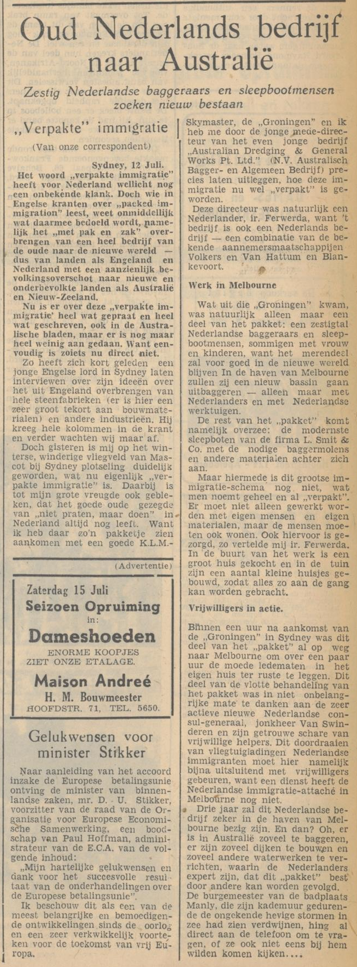
“Oud Nederlands bedrijf naar Australië” — Nieuwe Apeldoornsche Courant, 14 July 1950
This article describes how approximately 60 Dutch dredging and tugboat workers were being sent to Australia through Australian Dredging and General Works, established by Adriaan Volker and Van Hattum & Blankevoort. It emphasises the expectation that many of the workers and their families would remain permanently, presenting the project as an example of practical migration through employment and industrial investment.
“Dredging of Newcastle Harbour” — Australian newspaper, 13 June 1951
This report documents the company’s growing interest in work beyond Melbourne. Two Dutch directors of Australian Dredging and General Works inspected Newcastle Harbour in connection with possible dredging activities. The article provides early evidence that the company was seeking additional Australian projects after establishing its initial base in Williamstown.
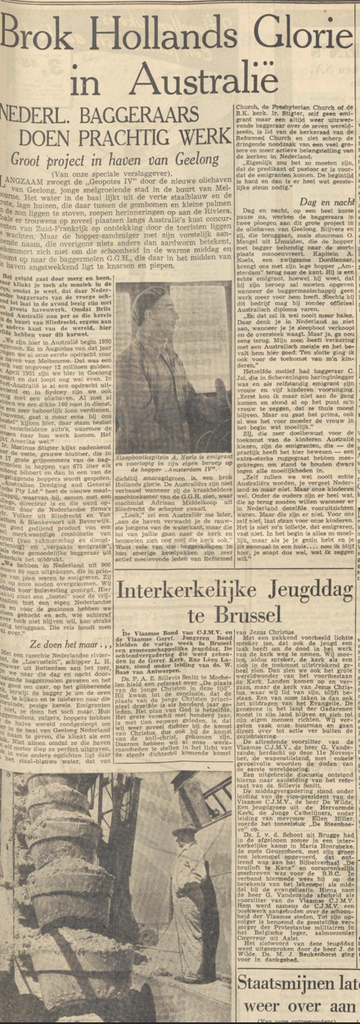
“Brok Hollands Glorie in Australië: Nederlandse baggeraars doen prachtig werk” — Trouw, 17 November 1953
This extensive retrospective report describes the Dutch dredging operation after more than three years in Australia. It discusses work at Geelong and elsewhere, the selection of approximately 60 people from some 900 applicants, company-paid travel, accommodation for unmarried workers, houses for families and the provision of a return journey for those who did not remain in Australia. It also identifies several individual employees and offers valuable insight into their working and living conditions.
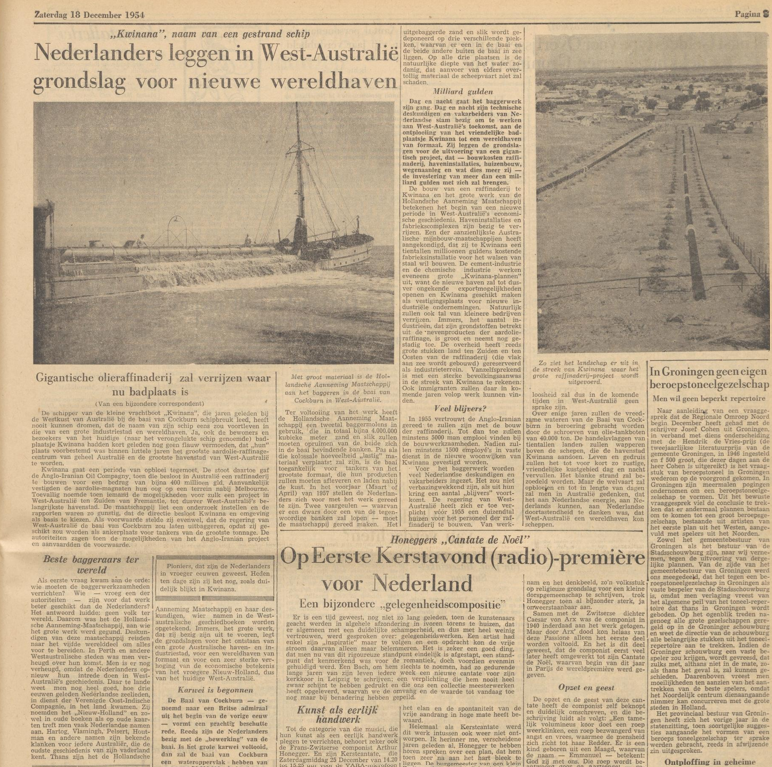
“‘Kwinana’, naam van een gestrand schip: Nederlanders leggen in West-Australië grondslag voor nieuwe wereldhaven” — unidentified Dutch newspaper, 18 December 1954
This article describes the development of the new industrial harbour and oil-refinery complex at Kwinana in Western Australia and the contribution of Dutch dredging expertise. It has been included because it illustrates the wider expansion of Dutch maritime engineering in post-war Australia. It should not, however, be treated as evidence that Australian Dredging and General Works itself undertook the Kwinana work; the report refers to another Dutch contracting organisation.