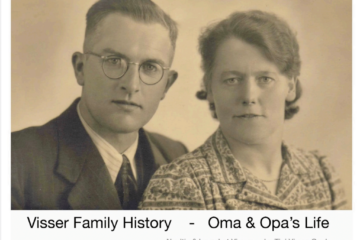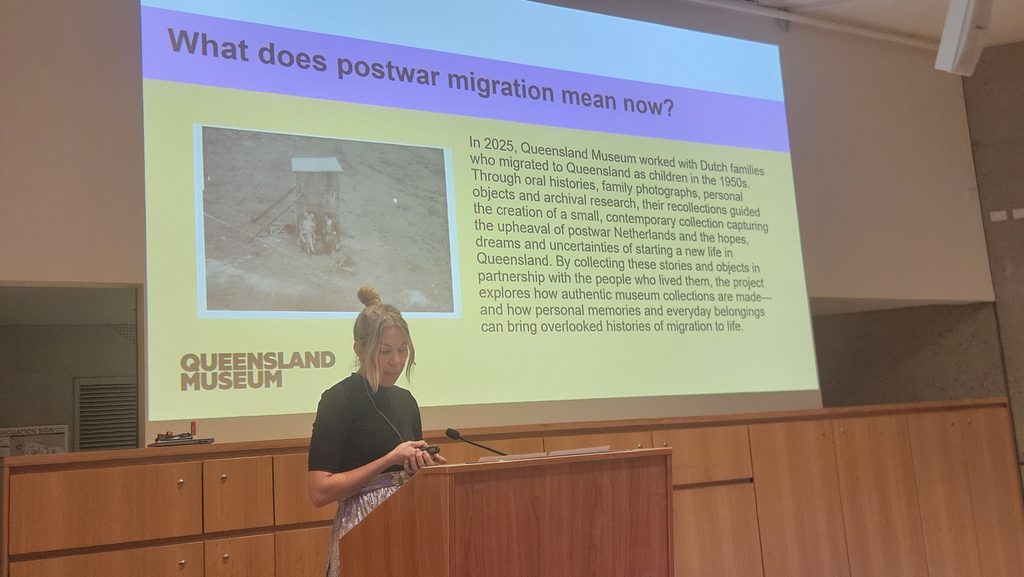
On 26 November 2026, Dr Liz Bissell, Senior Curator of Queensland Stories at Queensland Museum, presented a lunchtime lecture entitled ‘Suitable Migrants’: Dutch Migration to Queensland 1947–1970, at Queensland Museum Kurilpa in Brisbane.
The presentation explored the experiences of Dutch migrants who settled in Queensland after the Second World War, examining the contrast between government migration policies, the expectations of migrants and the realities of establishing a new life in Australia.
The lecture also highlighted a Queensland Museum collecting project undertaken in 2025, which brings the experiences of Dutch migrant families into the state’s cultural heritage collection.
The promise of a new life
Following the Second World War, approximately 160,000 Dutch people migrated to Australia, with thousands eventually settling in Queensland.
The Australian Government regarded the Dutch as particularly suitable migrants. Their perceived ability to assimilate into Australian society, their European background and their skills made them attractive within the immigration policies of the period.
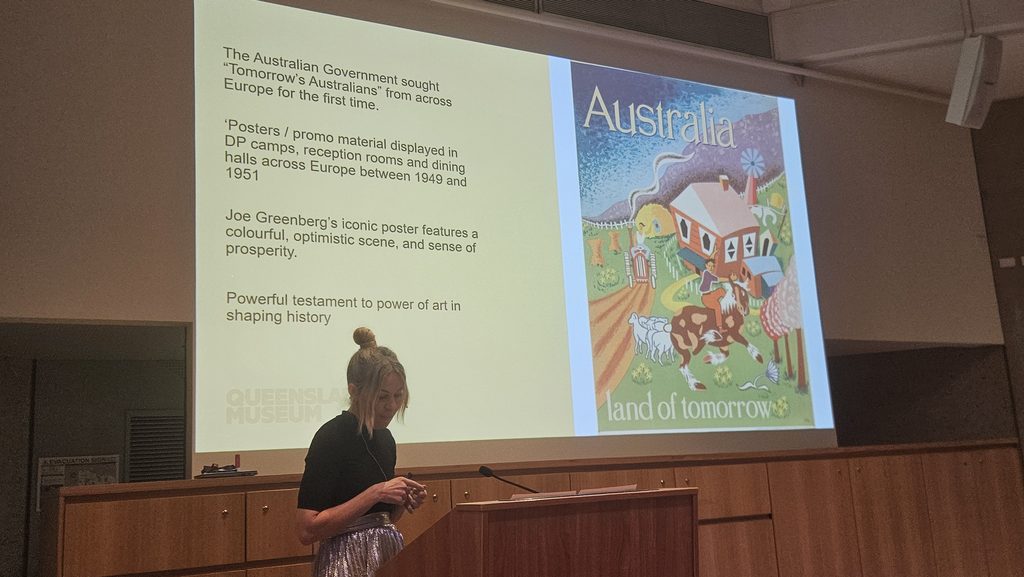
Promotional campaigns presented Australia as a country of opportunity, prosperity and security. One example discussed during the lecture was Joe Greenberg’s colourful immigration poster Australia – Land of Tomorrow. Such promotional material was displayed across Europe between 1949 and 1951.
For many Dutch families, the prospect of leaving behind the destruction, housing shortages and uncertainties of post-war Europe was appealing. However, the reality of migration did not always match the promises.
Beyond the success story
Dutch migration to Australia is frequently portrayed as a successful example of post-war immigration and integration. While many families ultimately established prosperous and fulfilling lives, this narrative can obscure the difficulties they experienced during their early years in Australia.
The presentation included contemporary accounts of unemployment, financial hardship, homesickness, loneliness and cultural isolation.
One newspaper letter, published under the heading ‘Migrant can’t get a job’, described the desperate circumstances of a Dutch migrant who had been unable to find employment for three months and was facing homelessness.
Other accounts revealed frustration with Australian social customs, the absence of familiar European café culture and the difficulties of adjusting to a very different environment.
Such experiences provide an important counterbalance to the official migration narratives of the period.
Collecting history in partnership with migrant families
Between July and November 2025, Queensland Museum undertook a collaborative collecting project involving:
- Eleven participants from six Dutch migrant families.
- Twelve objects collected for the museum.
- Oral history interviews with first and subsequent generations.
- Family photographs, documents and personal recollections.
- Family participation in selecting objects and stories that were meaningful to them.
An important aspect of the project was that the original migrants interviewed had arrived in Australia as children. Their recollections provide insights into childhood migration, while also revealing how they experienced the anxieties, sacrifices and aspirations of their parents.
Rather than museum curators alone determining what should be preserved, the families themselves helped identify the objects and memories that best represented their experiences.
A knitted toy that crossed the world
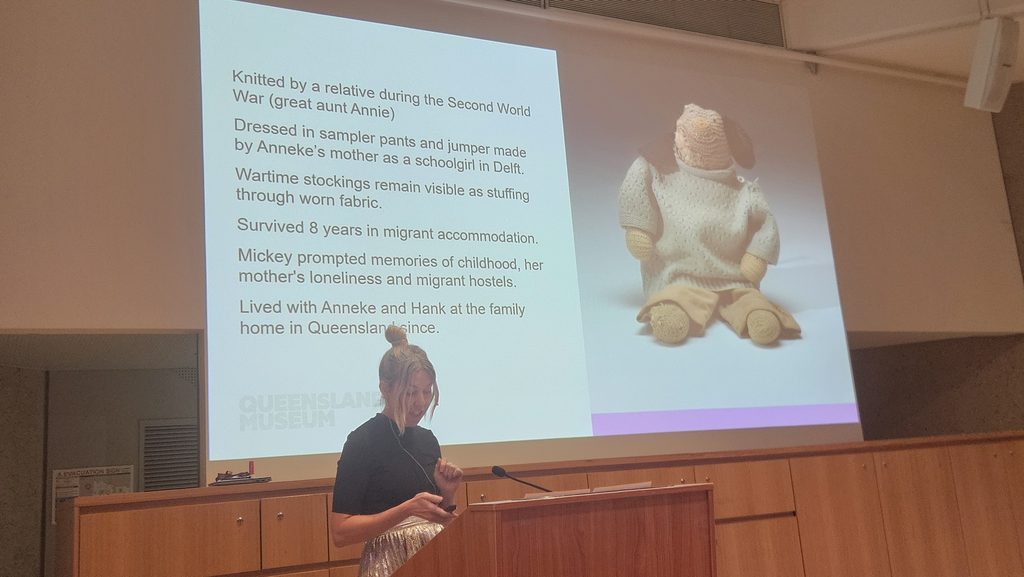
One particularly moving example presented by Dr Bissell was a knitted Mickey Mouse toy belonging to a Dutch migrant named Anneke.
The toy was knitted by her great-aunt Annie during the Second World War. Its clothes had been made by Anneke’s mother as a schoolgirl in Delft, and wartime stockings used as stuffing remain visible through the worn fabric.
Mickey accompanied Anneke on the voyage to Australia and survived eight years of the family’s life in migrant accommodation.
The toy became a starting point for recollections of childhood, the loneliness experienced by her mother and the family’s years in migrant hostels.
Having remained with the family in Queensland for decades, the toy was donated to Queensland Museum. Its significance lies not in its monetary value but in its ability to connect wartime experiences in the Netherlands with migration and settlement in Australia.
A cradle spanning generations
Another object presented during the lecture was a wicker baby’s cradle purchased in the Netherlands before a family’s migration in 1955.
The cradle travelled to Australia aboard the Dutch migrant ship Johan van Oldenbarnevelt. It was subsequently used by eleven children, grandchildren and a great-grandchild.
Following the Brisbane floods of 1974, a replacement timber stand was made for the cradle by the father of the family, Cornelis.
The object thus connects several generations of family life with significant events in both Dutch and Queensland history.
Other items presented during the lecture included ship menus, traditional Dutch carpet beaters, family photographs, letters and childhood memorabilia.
What does post-war migration mean now?
The project raises broader questions about how migration history is preserved and interpreted.
Official immigration records provide information about government policies, passenger movements, employment and settlement. However, they rarely capture the emotional experiences of migration or the significance of everyday family life.
Personal belongings, oral histories and family archives can reveal dimensions of migration that might otherwise disappear from the historical record.
They also connect individual experiences with major historical developments, including the Second World War, the Nazi occupation of the Netherlands, forced labour, post-war reconstruction and international mass migration.
As Dr Bissell noted in her presentation, drawing on the work of sociologist Les Back, such collecting can help:
“link the smallest story to the largest social transformation.”
Queensland Museum’s project demonstrates how ordinary domestic objects can become important historical evidence when their stories are documented and preserved alongside them.
Preserving Dutch-Australian heritage
The project has considerable relevance to the work of the Dutch Australian Cultural Centre (DACC), which collects and preserves the history of Dutch migration to Australia through family histories, photographs, archival documents and personal accounts.
There are also important connections with the history of Queensland’s migrant reception centres and hostels, including the former Wacol Migrant Centre at Camp Columbia.
Following the lecture, DACC President Paul Budde discussed with Dr Bissell the possibility of organising a Dutch community get-together in March 2027.
Such a gathering could provide an opportunity for Dutch migrants and their descendants to learn more about the museum’s work, exchange experiences and discuss the preservation of Dutch-Australian cultural heritage.
Queensland Museum also intends to display objects from the collecting project in its foyer at South Brisbane. The timing of this display has yet to be announced.
As the generation that experienced post-war migration firsthand grows older, cooperation between cultural institutions, heritage organisations and migrant families becomes increasingly important in ensuring that these stories are preserved for future generations.
Sources and further reading
- Dr Liz Bissell – Queensland Museum staff profile
- Queensland Museum – Lunchtime lectures
- SBS Dutch – The promise and reality of Dutch migration to Queensland, 26 November 2026
- SBS Nederlands – Van beloofd land tot harde werkelijkheid: de Nederlandse migratie naar Queensland
- Queensland Museum – Social history collection
- National Museum of Australia – Postwar immigration drive
- DACC – Project Migrant: Australian and Dutch emigrants
- Camp Columbia Heritage Association
Primary source: Lecture by Dr Liz Bissell, Queensland Museum, 26 November 2026. Presentation slides and personal observations by Paul Budde.