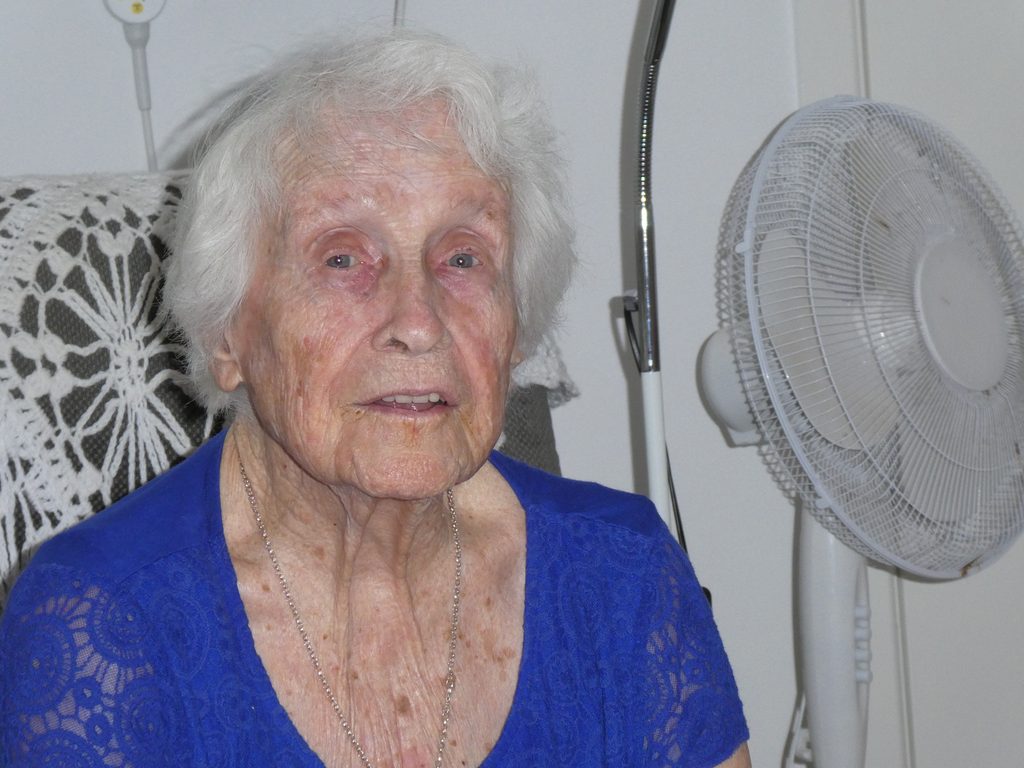
Johanna Maria van Bommel was born in January 1927 in Sabang, a small island NW of Sumatra, Indonesia. She is now 95 years old, widowed and living in a low-care unit of the Prins Willem Alexander retirement village in Birkdale, Qld. She moved here in 2018.
I talked with Jo about her long life, and the challenges she survived. Her father, Johannes Josephus Maria van Bommel, was a teacher in government service and had been sent to what was then Netherlands East India. They moved often, whenever the government decided that her father was needed somewhere else.
Childhood in the Netherlands East Indies and Holland
Jo was an only child and was about 1 year old when her family moved to Salatiga in central Java, where her father became headmaster of a school. A few years later, when Jo was 6, they moved to Patti, on the north coast of central Java, where she went to primary school. About a year later her father had a minor car accident and decided to go on leave of absence in Holland. Jo and her mother, Theodora Ulrica Lubbers, came along.
After a year Jo’s father returned to Indonesia, but Jo stayed in Holland where her mother was having surgery. They lived in Kijkduin, a suburb of The Hague. Here Jo went to primary school, and the lessons included learning to knit a sock. In Indonesia she hadn’t learned to knit and her sock came out rather strange looking, definitely not fit for a human foot.
Jo’s mother grew up in Winterswijk, where Jo’s grandfather, Rainier Lubbers, was headmaster at a school. Theodora had also been a teacher in Holland and had met Johan because he worked at Rainier Lubbers’ school in Aalten.
Johan van Bommel also grew up in Gelderland, where his father, who originated from Rotterdam, was chief horticulturalist for a large estate, Staverden, situated between Ermelo and Elspeet. It is still a popular destination for walkers and hikers.
During their time in Holland, Jo and her mother visited the family in Gelderland where she met Oma Lubbers and Opa van Bommel that were still alive, and some of her aunts, uncles and cousins. They returned to Indonesia when Jo was 10, and joined her father in Bengkulu, on the coast of south Sumatra.
War, internment and loss
In Bengkulu her parents divorced and Theodora became director of a boarding school. After WW2 started, Johan who had been a sergeant in military service in Holland, had to join the KNIL before the Japanese invaded. Jo and Theodora went to live in Bandung. In 1942 the Japanese occupiers placed Johan in a camp at Tjimahi and from there sent him to Timor where he had to work as a slave.
Jo and her mother were placed in the Japanese camp Karias near Bandung, then moved to Buitenzorg (near Djakarta), and Jo later moved to Camp Makasar in Djakarta. In the Buitenzorg camp Jo met a well-known Dutch artist, Corry Vonk.
In the camps Jo first worked in the kitchen and the hospital, and later as a manual labourer, building and maintaining cabins, roofs, and more. Theodora was not well enough to work.
Before they went into the camp, Theodora had had a bad fall at home, from which she had not recovered, and in the camp she was placed in a make-shift hospital, where she died in January 1945. She was buried in the camp at Buitenzorg. Jo was not yet 18, and in those days the age of maturity was 21, so she was then assigned a guardian.
Once the war was over, the camp continued to be run by Japanese, until Gurkas took over. Many areas outside the camp were dangerous for Dutch people due to the Indonesian liberation movements. Eventually Jo was taken back to her home in a safe area of Bandung, where she found her father, who had also survived and was working as a teacher again.
Before the Japanese occupation, Jo spent two years at the girls’ Lyceum in Bandung, but after the war she was 18 and too old to go back to school. Instead, she did some work in the local hospital, where she was trained to administer injections.
Her father resumed his teaching job and married Ambrosine de Munk Mortier (Bobby). The following year Jo got bitten by a stray dog and had to undergo a series of rabies shots. Things were getting less safe for Dutch people in Indonesia, and the family decided to go back to Holland in 1947, where Johan got a job as headmaster of a school in Heerenveen, Friesland.
Marriage and family life in Holland
Before leaving Indonesia, Jo had met Jan van den Wassenberg, who was working for the Dutch army. Jan was trained as a mechanic and worked as a manager of transport for the moving stock in Bandung. Jan returned to Holland at the same time as Jo, but on a different ship, and went to live in his hometown of Rosmalen, Brabant. In 1948 the two got married and in 1949 their first child, a son, Theodorus (Ted) was born.
Because of the housing shortage they first lived with his parents in Rosmalen, and later a friend offered them a converted chicken coop that had two rooms. Jan was a sergeant in the Dutch army and wanted to work on airplanes, but the army sent him back to Indonesia for about 1.5 year, where he was showing films to the KNIL stationed there. They lived in Bandung, where son number two, Gert Jan (Johnny), was born.
Back in Holland, they lived in Rosmalen again, and Jan trained as aircraft engineer with the military at Deelen airbase. After they had another baby, a girl they named Marion, and when number four was on the way, they were assigned a house in Helmond. Baby number four was also a girl, Josette.
A new life in Queensland
The family spent four years in Helmond and then decided to emigrate to Qld, because they hated the cold winters and they needed a bigger house. In 1957, when Jo was 30, they arrived with their four kids in Wacol, the migrant camp SW of Brisbane.
Jan applied for a job as aircraft engineer, only to discover his expertise was with the wrong planes. He then got a job at a plaster board factory in Booval. However, as part of his application, the airline gave him an IQ test, and when they got the results, they offered to retrain him. He was employed by them and trained three weeks at a time in Melbourne over a three-year period.
In 1960, Jo had another baby, Pieter, and in 1963 she had triplets, two boys and one girl (Ronald, Louise and Raymond). They now had eight kids, of which the oldest was 13. Jan had built them a house in Goodna, but when Brisbane was flooded in 1974, they got flooded too. Their house was not salvageable and they went to live in a house in Wooloongabba belonging to friends that were overseas. Jo was working at a local mental hospital and Jan was still with the airline, but the flooding experience made them decide to go back to Holland.
The four oldest kids were already working and stayed in Brisbane, so Jan and Jo arrived in Holland with the four youngest children. Holland still had a housing shortage, and after three years there, the family came back to Australia.
After their return in 1977, they lived at Bald Hills while Jan worked on aircraft at Archerfield. However, after only a year he gave up this job because he felt that he couldn’t do it well enough due to arthritis.
The strawberry farm and later years
Jo and Jan then bought a strawberry farm (which included a house) in Victoria Point on the coast. They acquired a menagerie consisting of two cows, some chooks, and an angora goat which they took to shows. Soon they bought more goats of three different kinds, and they had to build enclosures for the goats. The cows lived in the paddocks happily keeping the grass down.
They sold strawberries to a market in Cleveland. The cow’s milk and eggs were for home consumption, as were some of the goats, but the goats reproduced abundantly and goat kids were sold too.
In the early 1980s the children all had left home and the work on the farm was getting too hard. They had a new house built for the two of them in Redbank Plains, a suburb of Ipswich and moved there after selling the farm. Jan now became very actively involved with the NESWA (Netherlands Ex-Servicemen and Women’s Association in Australia) and was Vice President for a number of years.
In the early 2000s, they bought a bus and drove around Australia for three months, visiting sights and people they knew. When they were in Melbourne Jan got sick and was in hospital a few days. They then drove home to Brisbane where Jan got more medical care. He had developed emphysema from smoking and exposure to aircraft fumes and died November 2006.
Jo remained in the house at Redbank Plains till 2018 when she moved to PWA village. About two years earlier, when she was 88, she had a triple bypass and the experience convinced her it was time to move. She knew some residents at PWA village and most of her children and grandchildren are living in the greater Brisbane area, except Marion who lives in France.
Jo’s offspring have jobs as engineers, teachers, office and computer workers, mechanics, and a fisheries inspector. Louise works at a bank where she was present during a robbery. It didn’t discourage her and she still works there.
Jo now has 16 grandkids and 24 great grandkids, as she says, she has a tribe. She keeps in touch with them via Skype. And although she has experienced some tough times, there were good times too and she does not regret having migrated to Australia.
21 August 2022
Johanna Wassenberg died on 30 April 2024, aged 97.