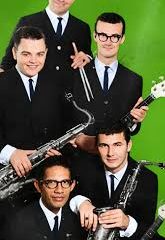
Johnny Young was one of Australia’s most influential singers, songwriters, television producers and popular entertainers.
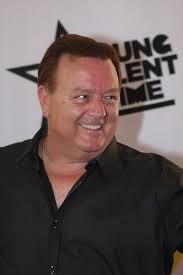
To generations of Australians, he is best remembered as the host of Young Talent Time, the long-running television program that helped launch the careers of Tina Arena, Dannii Minogue, Debra Byrne and many other young performers.
Less well known is that Johnny Young was born in Rotterdam as Johnny de Jong and migrated between the Netherlands and Australia several times during his childhood. His journey from a Dutch post-war migrant family to the centre of Australian popular culture is a remarkable Dutch–Australian success story.
Born in Rotterdam
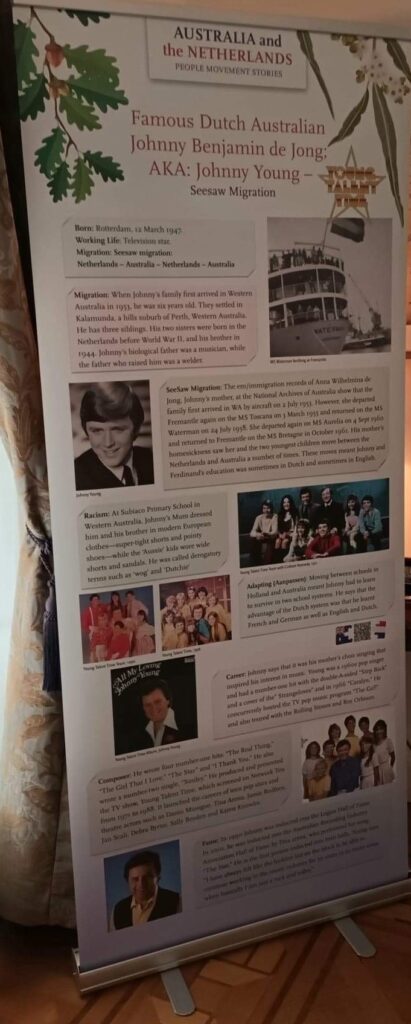
Johnny Young was born in Rotterdam on 12 March 1947. Dutch migration records held by the Huygens Institute identify him as Johnny Benjamin de Jong. Australian biographies generally give his full birth name as Johnny Benjamin Arthur de Jong.
He was the son of Anna Wilhelmina de Jong and Fokke Jan de Jong and grew up with three older siblings: Cornelia, Antonia and Ferdinand. The family’s migration history has been reconstructed by the Huygens Institute using Dutch emigration cards and records held by the National Archives of Australia. These records reveal that Johnny’s migration was not a simple one-way journey. His family moved between the Netherlands and Australia several times before finally establishing its life in Western Australia.
Migration to Australia by KLM
The De Jong family first migrated to Australia on 2 July 1953, when Johnny was six years old. While most Dutch migrants of this period travelled by sea, the family flew aboard KLM flight CH306 with 67 other Dutch emigrants. Their assisted passage was organised under the Netherlands–Australia Migration Agreement, which supported the large movement of Dutch families to Australia during the post-war period.
After arriving in Western Australia, the family spent its first month at Holden Camp in Northam. The former military camp was used as temporary accommodation for migrants while they obtained employment and permanent housing. The De Jong family subsequently settled in the Perth area, where Fokke worked as a welder on major industrial projects, including the Kwinana Oil Refinery.
Returning aboard the Waterman
The family’s settlement was not straightforward. In March 1955, Anna and the boys returned to the Netherlands aboard the Toscana.
Before migrating to Australia again, Johnny, his brother and his mother underwent further medical examinations. On 24 July 1958, they departed for Australia aboard the Dutch emigrant ship Waterman. The Waterman was one of three Dutch Victory ships converted for post-war passenger and emigrant transport. Together with the Groote Beer and Zuiderkruis, it carried thousands of Dutch migrants to Australia, Canada, New Zealand and other destinations. Johnny Young’s voyage provides another personal connection to the DACC history of the Waterman and the Dutch emigration ships.
The migration records show further movement between the two countries. A journey to the Netherlands aboard the Aurelia was recorded in September 1960, followed by another migration to Australia aboard the Bretagne in October 1961. These repeated journeys illustrate that post-war migration was not always a single, irreversible departure. Some families struggled with settlement, returned to the Netherlands and later decided to try Australia again.
Becoming Johnny Young
Johnny received Australian citizenship after his father was naturalised in September 1959. It was during these years that Johnny de Jong became known as Johnny Young. His musical ability emerged early. After leaving school, he worked as a radio disc jockey and became involved in Perth’s developing pop-music scene. By the age of 18, he was hosting the television music program Club Seventeen. He performed with several groups, including the Nomads, the Strangers and Johnny Young & Kompany.
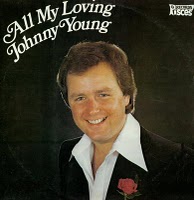
His breakthrough came in 1966 with “Step Back”, released as a double A-side with “Cara-Lyn”. It became a number-one hit and one of the major Australian singles of the 1960s. Young toured with the Rolling Stones and appeared with international performers including Roy Orbison. His recording of the Beatles’ “All My Loving” also became closely associated with him and would later acquire a special place in Australian television history.
Writing Australian classics
Young’s influence extended well beyond his own career as a performer.
While spending time in London with his friend Barry Gibb of the Bee Gees, he increasingly concentrated on songwriting. After returning to Australia, he wrote several songs that became landmarks of Australian popular music.
The best known was “The Real Thing”, recorded by Russell Morris and produced by Ian “Molly” Meldrum. Released in 1969, its innovative production helped make it one of the defining Australian recordings of the era.
Young also wrote “The Girl That I Love” for Russell Morris, “The Star” for Ross D. Wyllie, “I Thank You” for boxer and singer Lionel Rose and “Smiley” for Ronnie Burns. “Smiley” reflected the anxieties surrounding the Vietnam War and the conscription of young Australians.
Through these songs, the Dutch-born performer became an important contributor to the emergence of a distinctive Australian popular-music industry.
Eighteen years of Young Talent Time
Johnny Young achieved his greatest public recognition through Young Talent Time, which began on 24 April 1971.
Inspired partly by The Mickey Mouse Club, the program combined performances by a regular Young Talent Team with a weekly junior talent quest. Young created, produced and hosted the show throughout its original run.
It became one of Australia’s most enduring family television programs. More than 800 episodes were broadcast over 18 years, and approximately 40 young performers became members of the team.
Among those whose careers were fostered by the program were Tina Arena, Dannii Minogue, Debra Byrne, Jamie Redfern, Jane Scali, Sally Boyden, Karen Knowles and Philip Gould.
Each program traditionally ended with Johnny and the Young Talent Team singing “All My Loving”. For many Australian families, the song became inseparable from Sunday-evening television.
The program ended in 1988, but its influence continued through the performers it had nurtured and the place it occupied in the childhood memories of millions of Australians. The National Film and Sound Archive’s Young Talent Time collection preserves performances and other footage from the show.
National recognition
Johnny Young was inducted into the TV Week Logie Hall of Fame in 1990.
In 2010, Tina Arena inducted him into the ARIA Hall of Fame. He was the first person to be inducted into both the Logie and ARIA halls of fame, recognising his contribution to Australian television as well as music.
A revival of Young Talent Time was broadcast in 2012, with Young participating as a judge and adviser.
Johnny Young died on 14 August 2026 at the age of 79, following a brief battle with pancreatic cancer. He was survived by his wife Marisha, daughters Anna and Fleur, sister Cornelia, seven grandchildren and two great-grandchildren. His son Craig had died from pancreatic cancer in 2014 at the age of 48.
A Dutch–Australian cultural legacy
Johnny Young’s life represents far more than the success of an individual entertainer. His childhood journey—from post-war Rotterdam to a migrant camp at Northam, back to the Netherlands and then again to Australia—reflects the uncertainty and determination experienced by many Dutch migrant families. From those beginnings, Johnny de Jong became Johnny Young: pop idol, songwriter, producer, mentor and one of the most familiar faces in Australian television.
His Dutch origins were rarely central to his public identity. His career nevertheless demonstrates how post-war Dutch migrants and their children became deeply embedded in Australian cultural life. Through his music and his encouragement of successive generations of young performers, Johnny Young helped shape Australian popular culture for more than half a century.
See interview: Interview with Max Kay from Scotland and Johnny Young from the Netherlands