The first Dutch-Indonesian intelligence party sent from Australia into the Japanese-occupied Netherlands East Indies
Party LION was one of the earliest and most tragic Dutch intelligence operations mounted from Australia after the Japanese conquest of the Netherlands East Indies.
In June 1942, three men left Darwin on a clandestine mission to Central Celebes, now Sulawesi. Their task was to gather intelligence about Japanese military activity and, if possible, establish contact with Dutch-led guerrilla forces believed still to be resisting the Japanese occupation.
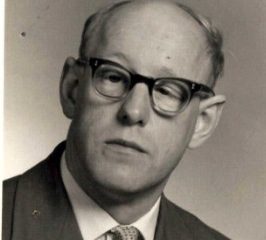
The party was led by reserve First Lieutenant Rob Hees, a Dutch civil engineer who knew Central Celebes well. He was accompanied by KNIL telegraphist Bernard Belloni and naval militiaman Hans Brandon.
Party LION belonged to the earliest phase of Dutch-Australian clandestine cooperation. It was the first party sent by the Netherlands East Indies Section of the Allied intelligence organisation operating from Australia, preceding the later development of NEFIS III.
The three men faced an extraordinary journey through enemy-controlled waters to reach Celebes. For a brief period, Australia received indications that the party was still operating.
Then contact disappeared.
Only after the war did the full story emerge. Hees, Belloni and Brandon had been betrayed, captured by the Japanese and eventually executed.
Their mission illustrates the extraordinary risks taken during the experimental first phase of intelligence operations from Australia into the occupied Netherlands East Indies. It also reveals problems that would confront later parties: unreliable communications, dependence on local contacts, limited knowledge of conditions under occupation and the enormous difficulty of extracting agents once they had been inserted.
Party LION therefore belongs near the beginning of the story told throughout this Research Portal. Before NEFIS III developed a more organised system of training, communications and clandestine operations, men such as Rob Hees, Bernard Belloni and Hans Brandon were already attempting to rebuild an intelligence network from Australia inside the Japanese-occupied archipelago.
Rob Hees escapes to Australia
Rob Hees was not originally an intelligence officer.
Born in 1901, he was a civil engineer who worked for the Department of Public Works in Makassar on Celebes. His work had given him considerable knowledge of Central Celebes and of the people and conditions in the region — experience that would later make him an obvious candidate for an intelligence mission.
Following the surrender of the Netherlands East Indies to Japan in March 1942, Hees was determined not to become a prisoner of war. Together with KNIL personnel, he sought a way to escape from Celebes and reach Australia.
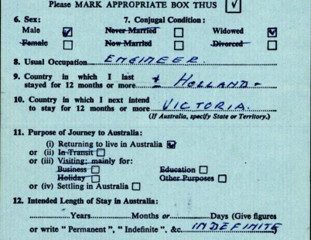
On 25 March 1942, Hees left Malili aboard a 17-ton diesel vessel with KNIL Sergeant Gerritsen, Brigadier Verbraak and seven Indonesian crewmen. They reached Darwin on 4 April.
Hees subsequently travelled to Melbourne, where the headquarters of the Netherlands armed forces in Australia had been established. On 19 April he submitted a report on conditions in Celebes and the prospects for continued resistance.
Significantly, Hees believed that guerrilla warfare against the Japanese remained possible. Based on his knowledge of the region, he considered much of the local population potentially supportive of such resistance.
On 1 May 1942, Hees was formally appointed a reserve first lieutenant of engineers.
Within weeks, developments in Central Celebes appeared to confirm that organised resistance was continuing.
A message from occupied Celebes
On 9 June 1942, an extraordinary message reached Darwin.
It came from First Lieutenant J. A. de Jong, who had refused to surrender to the Japanese and was reported to be operating with approximately 150 men in the region around Lake Poso in Central Celebes.
For the Dutch authorities in Australia, the message offered an important opportunity. If an organised resistance group was still operating inside Celebes, it might provide the nucleus for an intelligence network behind Japanese lines.
The challenge was establishing contact.
Small intelligence parties were therefore being organised in Australia to return to the occupied Netherlands East Indies. Equipped with portable radio transmitters, these parties were expected to gather information about Japanese forces, establish contacts with people in occupied territory and transmit intelligence back to Allied headquarters.
The work was extraordinarily dangerous. Lieutenant Commander J. J. Quéré, who was involved in organising these early parties, insisted upon using volunteers and personally warned prospective participants about the risks involved.
Hees was particularly well suited to the proposed Celebes mission. He knew the region from his pre-war engineering work, understood local conditions and had himself escaped from the area only a few months earlier.
He volunteered to return.
The operation was given the codename LION.
Party LION: three men return to Celebes
Party LION consisted of just three men.
Rob Hees was its leader. His knowledge of Central Celebes made him particularly valuable for the mission.
He was accompanied by Bernard Belloni, a telegraphist first class, and J. A. “Hans” Brandon, a naval militiaman. Belloni’s role was especially important: if the party succeeded in reaching the interior, its radio would provide the vital link between the men in occupied territory and Allied intelligence in Australia.
The principal objective of LION was to gather intelligence in the south-eastern arm of Celebes, particularly around the important airfield at Kendari, which was being used by the Japanese military. A secondary objective was to locate and establish contact with Lieutenant De Jong’s guerrilla group near Kolonodale.
On 24 June 1942, Party LION left Darwin aboard the Samoa, a small motorised prau.
It was an extraordinarily hazardous undertaking. Rather than being inserted by submarine or aircraft, as became possible for some later intelligence parties, Hees and his companions had to make the long sea journey from northern Australia through waters controlled by the Japanese.
The Samoa carried the three intelligence personnel, their equipment and an Indonesian crew. Their destination was the coast of Celebes, approximately 1,700 kilometres away.
For three men in a small vessel, there was little margin for error. They had to evade Japanese naval and air patrols, reach the correct coastline, establish themselves ashore and then find people willing to help them — all while carrying the radio equipment upon which contact with Australia depended.
Yet the party succeeded in reaching Celebes.
The greater danger began once they went ashore.
Landing on Celebes
Party LION initially went ashore near Wotoe, on the Gulf of Bone in Central Celebes.
The situation was immediately more difficult than Hees and the planners in Australia had anticipated. The party could not assume that local inhabitants would support representatives of the former Dutch administration, and its presence risked being reported to the Japanese.
Hees therefore decided that the party could not safely remain in the Wotoe area.
The Samoa continued around the southern part of Celebes towards Kolonodale, closer to the region where Lieutenant De Jong and his guerrillas were believed to be operating.
Despite these difficulties, LION briefly succeeded in establishing radio contact with Australia.
On 11 July, weak signals from the party were received in Australia. The communication was poor and did not provide the reliable intelligence link that had been hoped for.
It was the last radio contact Australia received from Party LION.
The following day, or possibly on 13 July, the three men fell into Japanese hands.
Betrayed
Party LION’s greatest vulnerability was its dependence upon people it encountered after reaching Celebes.
Hees needed local assistance if he was to locate Lieutenant De Jong’s guerrillas and establish an intelligence network. According to the detailed postwar reconstruction of the mission, one of the people approached was a man named Aboebakar, who was asked to carry a message to De Jong.
Instead, information about the party reached the Japanese.
On 12 or 13 July 1942, only a few weeks after leaving Darwin, Hees, Belloni and Brandon were captured.
The precise circumstances were reconstructed only after the war. The surviving account indicates that Japanese personnel approached the party using the vessel Urania. Hees and his companions were taken prisoner and their clandestine mission came to an end.
For Australia, however, there was initially no certainty about what had happened.
The weak radio signal received on 11 July had demonstrated that LION had reached Celebes and that Belloni had at least attempted to establish communications. When no further messages arrived, the intelligence organisation in Australia could only conclude that something had gone seriously wrong.
The disappearance of LION demonstrated one of the fundamental weaknesses of these early intelligence operations. Once a small party had been inserted into occupied territory, headquarters in Australia had very limited ability to determine what had happened if radio contact ceased.
For Hees, Belloni and Brandon, capture began a final period about which Australia would learn little until after the Japanese
Captivity and execution
Hees, Belloni and Brandon remained Japanese prisoners for approximately two months.
During his captivity, Hees managed to leave an account of what had happened to the mission. The surviving family history records that this information ultimately reached O.M. ir. Bakhoven, a former Public Works colleague in Makassar.
There was no prospect of the three men being treated simply as ordinary prisoners of war. They had returned secretly to Japanese-occupied territory as members of an Allied intelligence party.
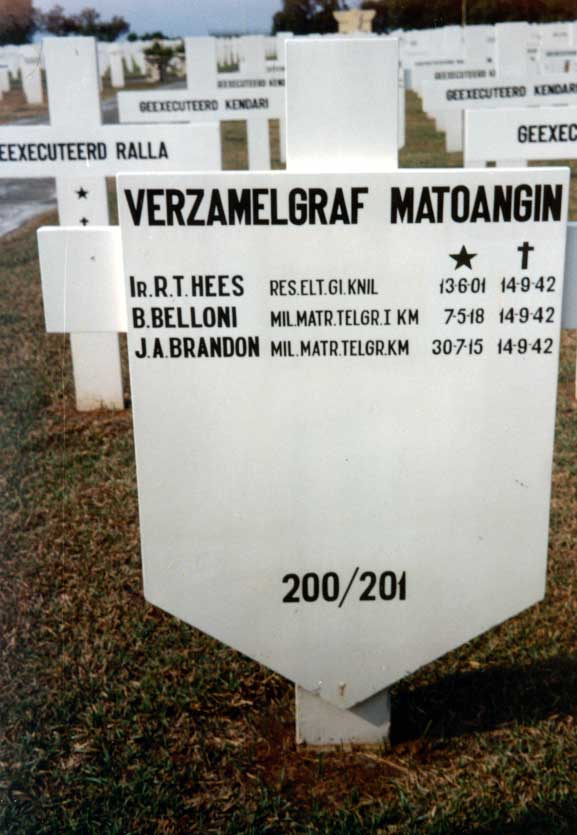
On 14 September 1942, Rob Hees, Bernard Belloni and Hans Brandon were executed by beheading.
Other captured military personnel were executed with them.
The deaths of all three members of Party LION made it one of the first of a succession of disastrous intelligence missions sent from Australia into the Japanese-occupied Netherlands East Indies.
For the planners in Australia, however, the full fate of the party remained uncertain until information became available after the war.
LION had demonstrated both the necessity and the extraordinary difficulty of rebuilding intelligence networks inside occupied territory. The party had successfully travelled from Darwin to Celebes and had briefly established radio contact with Australia, but once betrayed it had no effective means of escape or rescue.
The same problems — communications, local contacts, security and extraction — would recur in later operations.surrender.
The guerrillas LION was trying to reach
The tragedy of Party LION was compounded by what happened to the guerrilla force it had been sent to contact.
Lieutenants De Jong and Van Daalen had continued armed resistance in Central Celebes after the general Dutch surrender. Their men operated in difficult terrain around Poso and Kolonodale and for a time succeeded in resisting Japanese attempts to eliminate them.
De Jong’s ability to establish radio contact with Australia had been one of the principal reasons for sending Party LION to Celebes. Australia also attempted to support the guerrillas by air, although supplies dropped for them apparently failed to reach the group.
By the time Hees and his companions were attempting to make contact, however, Japanese forces were increasing the pressure on the resistance.
The guerrilla groups were gradually reduced by combat losses, capture and desertion. De Jong and Van Daalen were finally captured on 9 August 1942. They were subsequently taken to Menado and executed on 25 August.
One member of the resistance, Sergeant Klinkhamer, escaped capture and remained hidden in the mountainous interior for almost three years.
Party LION had therefore been attempting to establish contact with a resistance movement that was itself fighting for survival. The opportunity that Dutch intelligence planners in Australia had identified in June 1942 was disappearing almost as quickly as they could respond to it.
An early and costly experiment in secret intelligence
Party LION belonged to the experimental beginning of Allied clandestine operations from Australia into the Japanese-occupied Netherlands East Indies.
It preceded the later NEFIS III organisation. LION was organised through the Netherlands East Indies Section of the Allied intelligence organisation operating in Australia, at a time when procedures for inserting, supplying, communicating with and extracting intelligence parties were still being developed.
The operation demonstrated how formidable the task would be.
LION successfully travelled approximately 1,700 kilometres from Darwin through enemy-controlled waters and reached Celebes. Belloni also succeeded in transmitting a radio signal that was detected in Australia on 11 July, although its contents could not be deciphered.
Beyond that, the mission failed to achieve its objectives.
The party did not reach the Kendari area to conduct the planned reconnaissance and failed to establish contact with De Jong’s guerrillas. Its presence became known to the Japanese, its members were captured and the entire three-man intelligence team was subsequently executed.
The circumstances also exposed problems that would recur in later clandestine operations. Small parties depended heavily upon local contacts and upon the reliability of the people assisting them. Radio communications were fragile. Knowledge in Australia about conditions inside occupied territory was incomplete. Most importantly, once an intelligence party was compromised, there was often little headquarters in Australia could do to rescue it.
LION was therefore not simply an isolated tragedy. It was part of a difficult learning process that continued through subsequent NEI Section operations and, later, under NEFIS.
The losses remained severe, but training, communications, operational planning and methods of insertion and extraction gradually became more sophisticated as experience accumulated.
Recognition and remembrance
The fate of Party LION became fully known only after the liberation of the Netherlands East Indies and the investigation of Japanese wartime atrocities.
Rob Hees was posthumously awarded the Bronze Lion (Bronzen Leeuw), one of the Netherlands’ highest decorations for bravery, in recognition of his wartime service and the extraordinary risks he had accepted in returning to Japanese-occupied Celebes.
The remains of Hees, Bernard Belloni and Hans Brandon were eventually reinterred at the Netherlands Field of Honour Ancol (Ereveld Ancol) in Jakarta.
Their shared grave provides a lasting memorial to the three members of Party LION.
The mission had failed in its immediate objectives, but the courage of its members should be understood in the circumstances of mid-1942. Only months after the collapse of the Netherlands East Indies, they voluntarily left the relative safety of Australia and travelled back through Japanese-controlled waters into occupied territory.
They did so at a time when the Allied intelligence organisation in Australia was still being improvised and when very little reliable information was available about conditions inside the occupied archipelago.
Hees, Belloni and Brandon were among the earliest Dutch and Netherlands East Indies personnel to undertake this new form of clandestine warfare from Australia.
Party LION in the wider intelligence story
Party LION occupies an important place in the history of Dutch and Indonesian intelligence operations from Australia during the Second World War.
It was not a NEFIS III operation. It belonged to the earlier Netherlands East Indies Section, established as Dutch and Allied authorities in Australia attempted to rebuild intelligence links with the occupied archipelago after the Japanese conquest.
The operation demonstrates just how experimental those first missions were. A civil engineer with detailed regional knowledge, two naval servicemen, portable radio equipment and a small vessel were sent from Darwin across enemy-controlled seas in an attempt to create an intelligence presence inside Celebes.
They succeeded in reaching the island and briefly established radio contact with Australia. Beyond that, almost everything went wrong.
The party could not carry out its planned reconnaissance around Kendari. It failed to reach De Jong’s guerrillas. Its dependence upon local contacts contributed to its discovery, and once the three men were captured there was no realistic possibility of rescue.
LION was followed by other NEI Section operations, including TIGER, FLOUNDER and WALNUT. Many suffered similarly severe losses. The experience accumulated during this costly early period subsequently became part of the operational background from which the more developed NEFIS intelligence and special-operations system emerged.
Rob Hees, Bernard Belloni and Hans Brandon therefore belong not only to the history of one unsuccessful mission. Their story forms part of the beginning of the secret intelligence war conducted from Australia into the Japanese-occupied Netherlands East Indies.
It is a story of courage, improvisation and failure — but also of the extraordinary risks accepted by those who volunteered to return.
Detailed Dutch research and reference index
The article above provides an English overview of Rob Hees and Party LION. More detailed research into the mission is available in the original Dutch-language study reproduced below.
The study, De verkenningsmissie, Party Lion, van Rob Hees (1901–1942), draws on family research and historical records to reconstruct Hees’s life, the preparation and course of Party LION, and the fate of its members.
Following the document is an extensive reference index of people, military and intelligence organisations, operations, ships, aircraft and locations connected with the story. These lists have been retained as a research aid for readers wishing to investigate individuals or particular aspects of the operation in greater detail.
The following people, places, events and organisations are mentioned in the document.
1. People
- Rob Hees (1901–1942) – Leader of Party Lion, reserve 1st lieutenant KNIL, civil engineer.
- Bernard Belloni – KNIL telegraphist, Party Lion member.
- Hans (J.A.) Brandon – Naval militia member, Party Lion.
- J.A. de Jong – Guerrilla leader in Central Celebes.
- Van Daalen – Guerrilla leader operating with de Jong.
- Adjutant Sakai – Japanese Kempeitai officer involved in execution of Goldfish I personnel.
- J.J. Quéré – Lieutenant at sea, organiser of NEFIS parties.
- O.M. ir. Bakhoven – Public Works official in Makassar, recipient of Hees’ last account.
- J.T.K. Poll – Binnenlands Bestuur (BB) official who provided the boat for escape from Celebes.
- H.J.B.J. Lubbers – Medical officer who spoke to Hees in captivity.
- H.M. Staverman – Sergeant ARO, executed in Whiting mission.
- L.G. Sifflet – Australian sergeant, executed in Whiting mission.
- Raden Wirjomihardjo Iswahjoedi – Sergeant, Tiger II.
- Sadimoen – Sailor 1st class, Tiger II.
- H.P. Nijgh – Lieutenant at sea 2nd class, Flounder.
- Malauw – Sergeant, Flounder.
- Hetharia – Corporal, Flounder.
- Pattiwael – Soldier 1st class, Flounder/Whiting.
- Pangariboen – Soldier 1st class, Flounder.
- Rering – Fusilier, Flounder.
- Laratmasehen – Fusilier, Flounder.
- Matratan – Fusilier, Flounder.
- W. Bergsma – Lieutenant at sea 2nd class, Tiger I.
- J. Tapilatoe – Sailor 1st class, Tiger I.
- Soetarno – Naval telegraphist, Tiger I.
- B. Brocx – Lieutenant at sea 3rd class, Tiger II.
- D. Lapod – Sergeant ARO, Tiger III.
- Raden Mas Soejitno – Corporal, Tiger IV.
- Oentoeng – Sailor 2nd class, Tiger V.
- Sri Nojo Papilaja – Corporal, Tiger VI.
- C.R. Sheldon – Major, Australia, Walnut I.
- N.P. Monsted – Danish reserve 1st lieutenant, Walnut II.
- J.A. Blok – Sergeant, Walnut II.
- Plumridge – Australian telegraphist, Walnut II.
- J.H. Dahlberg – Australian sergeant, Walnut II.
- G.W. Mitchell – British India personnel, Walnut II.
- Clements – Prau crew member, Walnut II.
- Christoffel Tifents – Prau crew, Walnut II.
- Simon Paitkain – Prau crew, Walnut II.
- Achmed Leksailaisa – Prau crew, Walnut II.
- Salmon Farsin – Prau crew, Walnut II.
- Manoppo – Sergeant (KM), Apricot.
- H.J. de Haas – Second lieutenant, Goldfish I.
- Soeprapto – Sergeant, Goldfish I.
- H. Brouwer – Sergeant, Potato.
- J.H.M. Arroo – Sergeant, Potato.
- J.M.R. van der Bijl – Sergeant, Potato.
Bernard Belloni – listed above – is mentioned in the book about his nephew Claude Belloni .
2. Operations / Missions
- Party Lion (Central Celebes, 1942)
- Tiger I – VI (East Java, various years)
- Flounder (Ceram, South Moluccas)
- Walnut I & II (Aroe Islands)
- Whiting (New Guinea, Hollandia)
- Apricot (North Celebes)
- Goldfish I (Sumbawa)
- Potato (Kemirian)
See: NEFIS III and Dutch special operations from Australia during WWII
3. Ships / Vessels
- Samoa – Prau used in Party Lion.
- KXII – Dutch submarine.
- Searaven – US submarine.
- Urania – Japanese gunboat.
4. Organisations / Units
- NEFIS – Netherlands Forces Intelligence Service.
- NEFIS-III – Section responsible for field parties.
- KNIL – Royal Netherlands East Indies Army.
- Binnenlands Bestuur (BB) – Dutch colonial civil administration.
- Kempeitai – Japanese military police.
- ARO – Possibly “Algemene Regerings Officier” or similar military role in context.
5. Places
- Darwin (Australia)
- Melbourne (Australia)
- Sydney (Australia)
- Fremantle (Australia)
- Wotoe (Central Celebes/Sulawesi)
- Kolonedale (Central Celebes)
- Menado (North Celebes)
- Makassar (South Celebes)
- Ereveld Antjol (Jakarta)
- Sadangwerken (Celebes irrigation works)
- Poso / Posomeer (Central Celebes)
- Ceram (South Moluccas)
- Hollandia (New Guinea)
- Tami (New Guinea)
- Bena Bena (New Guinea)
- Aitape (New Guinea)
- Woma (New Guinea)
- Nemo (New Guinea)
- Djiko Dodapbaai (North Celebes)
- Sumbawa (Lesser Sunda Islands)
- Kemirian (location unclear, in Indonesia)
Sources and further reading
H. Hees, De verkenningsmissie, Party Lion, van Rob Hees (1901–1942), 2011. Detailed reconstruction of Rob Hees’s life and Party LION, based on family research, historical records and information supplied by his son Johan Theophile Hees. Reproduced on this page in the original Dutch.
National Archives of Australia, Official History of Operations and Administration of Special Operations – Australia (SOA), also known as ISD/SRD, Volume 2: Operations, NAA item 235327. Important primary source for the operational history of the Netherlands East Indies Section and the early intelligence parties dispatched from Australia into Japanese-occupied territory.
Nationaal Archief, Marine en Leger Inlichtingendienst, Netherlands Forces Intelligence Service en Centrale Militaire Inlichtingendienst in Nederlands-Indië, archive 2.10.62. Contains wartime intelligence records relating to Celebes and other Japanese-occupied areas of the Netherlands East Indies.
Australian War Memorial, Allies in Adversity: Australia and the Dutch in the Pacific War – NEFIS. Provides the broader history of the Dutch intelligence organisation that developed in Australia, including reconnaissance parties and the later NEFIS special-operations structure.
Luisterpost Gorinchem, Activities Dutch secret services and the use of radio from Australia and Ceylon in WWII. Detailed research on Dutch wartime intelligence communications and clandestine radio operations, including Party LION and its place among the early intelligence missions into the Netherlands East Indies.
Further DACC research
For related articles, personal stories and archival research on the NEI Section, NEFIS, NEFIS III, clandestine communications and Dutch and Indonesian intelligence operations from Australia, see the DACC Research Portal – Dutch and Indonesian Intelligence and Special Operations from Australia during WWII.