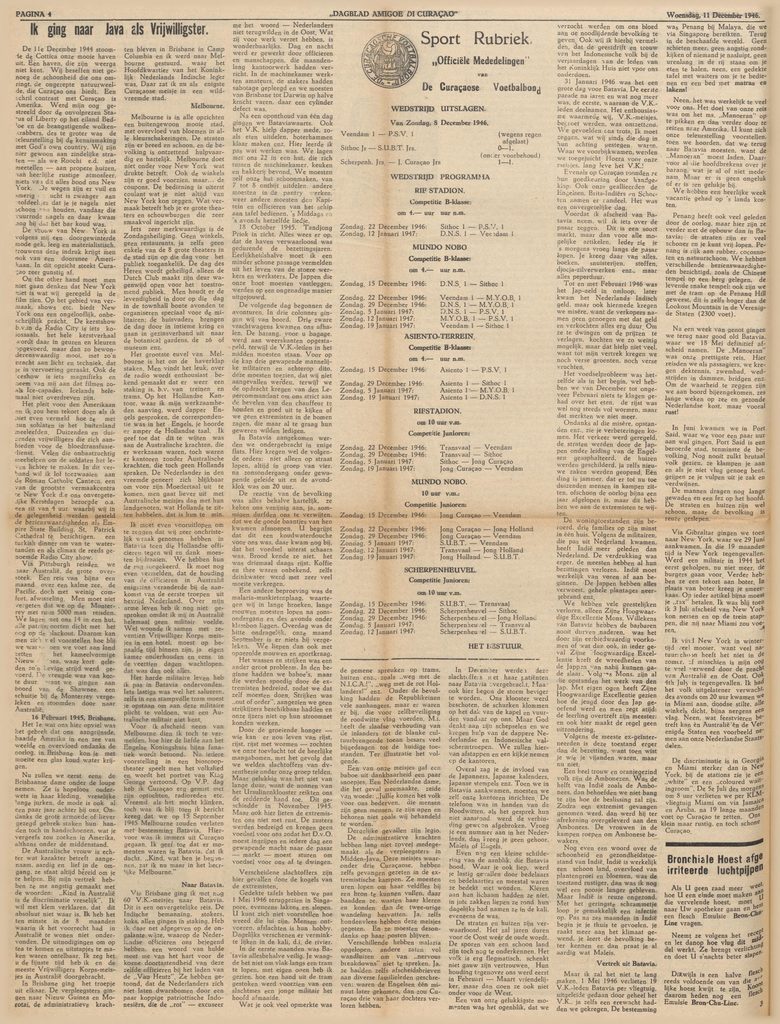
In December 1946, the Curaçao newspaper Amigoe di Curaçao published the recollections of a young woman who had volunteered for the Dutch Women’s Corps, the Vrouwenkorps KNIL (VK-KNIL). Her article, “Ik ging naar Java als Vrijwilligster” (“I Went to Java as a Volunteer”), described an extraordinary journey from Curaçao through the United States and Australia to the Netherlands East Indies.
Unfortunately, the newspaper did not identify the author by name. Her identity therefore remains unknown. Nevertheless, her account provides valuable first-hand evidence of the recruitment of VK-KNIL women in Curaçao and their experiences in Australia and postwar Batavia.
Leaving Curaçao
The volunteer left Curaçao aboard the Cottica on 11 December 1944. Her journey initially took her to Havana and New York.
She was impressed by New York’s entertainment, particularly the Christmas production at Radio City Music Hall, but was less complimentary about the city’s cleanliness and social atmosphere. At the same time, she praised the many Americans who volunteered at blood banks, canteens and other organisations supporting servicemen and women.
From New York, the volunteers travelled across the United States to the Pacific coast. They then embarked for Australia aboard the Monterey. Nearly 5,000 people were carried on the ship, and the women slept fourteen to a cabin with the portholes closed during blackout conditions.
After a brief stop in New Guinea, they continued to Australia.
Arrival in Brisbane
The group arrived in Brisbane on 16 February 1945. After the abundance they had seen in wartime America, the shortages in Australia came as a surprise. The writer recalled that even obtaining a glass of cold water in Brisbane could be difficult.
Her impressions of Australian women were far more positive. Although she considered Australian fashions old-fashioned, she described the women themselves as friendly, kind and always willing to help.
Before leaving Curaçao, she had been warned that she might encounter severe racial discrimination in Australia. She wrote that she had not personally experienced this during her eight months in the country. Invitations to private homes, afternoon teas and excursions were numerous, and she remembered Australia as the place where she and many of the other VK-KNIL volunteers spent some of their happiest months.
Upon reaching Brisbane, the group was divided according to its members’ intended duties. Nurses were sent onward to New Guinea and Morotai. Administrative personnel remained at Camp Columbia at Wacol, while the author was assigned to the headquarters of the Royal Netherlands East Indies Army in Melbourne.
Her account is important because it confirms that women recruited in Curaçao passed through Brisbane and that some served or stayed at Camp Columbia before being sent elsewhere.
A Curaçaoan volunteer in Melbourne
The author found herself the only Curaçaoan woman in an unfamiliar city. She nevertheless came to admire Melbourne, describing its broad, clean streets, flowers, shops, theatres and helpful population.
She worked in a Dutch military office where much of the daily conversation and correspondence was conducted in English, partly because Australian staff also worked there. She shared a hotel with seventeen other Women’s Corps members. Their military routine was relatively light: they had to return by a specified time, maintain their rooms and perform guard duty once every two weeks.
She wrote that she did not truly feel like a soldier until she reached Batavia.
The article also records the social life available to Dutch personnel in Melbourne. On Sundays, when most shops, restaurants and theatres were closed, the Dutch Club organised activities and entertainment, particularly for military personnel.
Although she enjoyed Australia, she had volunteered because she wanted to go to the Netherlands East Indies. She was therefore pleased when informed that the group would leave Melbourne on 15 September 1945 for Batavia. She later admitted that there were moments in Batavia when she wished she were safely back in Melbourne.
From Brisbane to Batavia
Approximately sixty VK-KNIL members assembled in Brisbane for the voyage north. They travelled aboard a ship identified in the newspaper as the Van Heutsz.
The voyage was far from comfortable. A dispute involving members of the Netherlands East Indies crew disrupted the ship’s operation, and the vessel travelled between Brisbane and Darwin at reduced power because of engine trouble.
The women assisted wherever they were needed. They distributed meals, prepared sandwiches, worked in the pantry, cleaned their crowded accommodation and served the captain and officers. The author shared a cabin with 21 other women near the engine room and kitchen.
On 18 October 1945, they sighted Tanjung Priok, the port of Batavia.
A dangerous arrival
The end of the war had not brought peace to Java. Indonesia had declared its independence on 17 August 1945, and the women arrived during the violent and politically complex opening months of the Indonesian Revolution.
The VK-KNIL members travelled from the harbour in three heavily guarded trucks. Armed servicemen were positioned at the front and rear of each vehicle. The women were instructed to follow the driver’s orders and watch the trees and surrounding buildings for possible attackers.
In Batavia, they were accommodated in several flats. They were ordered not to go out alone, to travel in groups of at least four and to remain under armed escort after sunset. A curfew began at 8 p.m.
Food was scarce. Rice was served repeatedly, while bread, coffee, tea, fresh vegetables and fruit were difficult to obtain. Clean drinking water could also be hard to find. Mosquitoes and malaria presented another constant danger. The women wore long sleeves and trousers after sunset and slept under mosquito nets.
Washing and ironing their uniforms created further problems. Domestic workers initially assisted them but, according to the author, withdrew after receiving threats. The women then had to do their own washing, while their European irons could not be used with the local electricity supply.
Nurses from Curaçao
The author emphasised that the administrative members of the corps did not experience the same dangers as the nurses sent into Central Java.
She reported that three Curaçaoan nurses were detained in camps during the fighting. They had to walk long distances to obtain water and endured malaria, bedbugs, severe food shortages and extreme psychological pressure. According to the account, they had written farewell letters to their families before Allied troops reached them.
The nurses and their patients were later transferred to Batavia. Even there, the building in which they were accommodated came under fire before Dutch and Indonesian troops serving with the Allied forces intervened.
These experiences were reported by the anonymous author on the basis of information available to her at the time. The identities of the three Curaçaoan nurses have not yet been established.
Work in postwar Batavia
The VK-KNIL women assisted in restoring Dutch and Netherlands East Indies administrative services. Offices had been neglected or emptied during the Japanese occupation, and the women sometimes had to organise and furnish their workplaces before normal duties could resume.
The author described unreliable telephone services and difficulties communicating in Dutch. Malay or English was often more effective.
Her account also records one of the more constructive aspects of the women’s service: VK-KNIL members were asked to donate blood for local people in urgent need. She remembered this as one of the group’s happiest moments.
The VK-KNIL on parade
On 31 January 1946, VK-KNIL members participated in a major parade through Batavia. The author described it as the city’s first large parade in years and the first in which the Women’s Corps had taken part.
She recalled an enthusiastic reception from spectators. People applauded and cheered the women as they passed. British, British Indian and Scottish troops also participated.
For the author, the parade marked an important change in public attitudes towards the VK-KNIL. She believed that the women had earned greater respect through their work and service.
Leaving the Netherlands East Indies
On 1 May 1946, nineteen VK-KNIL members left Batavia by air for Penang via Singapore. For women accustomed to insecurity, shortages and curfews, the return to normal surroundings was almost overwhelming. They again encountered properly set tables, beds with mattresses and sheets, and streets where they could walk without armed protection.
After a week in Penang, they briefly returned to Batavia. They finally departed on 18 May aboard the Manoeran.
The voyage took them through Port Said and Gibraltar to New York, where they arrived on 29 June. From there, the author travelled through the United States to Miami. She observed the formal racial segregation she encountered in Georgia and Florida, including separate waiting rooms for white and “coloured” passengers.
On 5 July 1946, after approximately nineteen months away, she flew from Miami via Jamaica and Aruba to Curaçao.
She ended her account with renewed appreciation for her home island: small and quiet, but beautiful.
A valuable but personal account
The article provides a rare voice from among the women recruited for the VK-KNIL in the Dutch Caribbean. It connects Curaçao directly with Camp Columbia, Melbourne and the Dutch return to the Netherlands East Indies.
At the same time, it is a personal account written from the perspective of a young Dutch colonial servicemember in 1946. Some passages employ highly derogatory colonial descriptions of Indonesians and present the Indonesian independence struggle almost entirely as a threat to returning Dutch personnel. Those statements should not be repeated as objective historical conclusions.
The article remains valuable precisely because it shows how one volunteer experienced and interpreted these events at the time. Her observations must be considered alongside Indonesian accounts and broader historical research into decolonisation and the Indonesian Revolution.
The author’s name has not yet been established. Further research may allow this unidentified Curaçaoan volunteer to be connected with VK-KNIL personnel records, passenger lists or the women named elsewhere in the Curaçao press.
VK-KNIL Research Portal
This story forms part of the VK-KNIL Research Portal: Dutch Women in Military Service from Australia to Indonesia, which brings together the history and personal experiences of women who served in the Vrouwenkorps KNIL.
Source
Amigoe di Curaçao, 11 December 1946, p. 4, “Ik ging naar Java als Vrijwilligster.”
The article was published without a byline. The identity of its author is presently unknown. The newspaper image and the author’s original Dutch account form the principal source for this article.