The Second World War transformed Ineke Thysse’s life. She arrived in Australia from the Netherlands East Indies intending to study architecture, but the Japanese occupation separated her from her family and prevented her return. She subsequently became one of the earliest members of the VK-KNIL and served as a medic in New Guinea, Morotai, Singapore and Sumatra.
This article is based on research by Douglas Hurst and on personal notes and recollections supplied by Ineke Thysse, including her account My Australian Memories.
From Bandung to Sydney
Ineke was born and raised in Bandung in the highlands of Java. In September 1941, she travelled to Sydney aboard a ship of the Koninklijke Paketvaart Maatschappij (KPM) to continue her education.
She initially stayed at Hopewood House, a finishing school at Darling Point, with her friends Julie Vreeburg and Nanny Weiffenbach. Ineke remembered her first months in Australia as happy ones. The unfamiliar surroundings, Australian customs and the people she encountered were exciting.
She intended to study architecture. Had the war not intervened, she would probably have completed her degree and returned to the Netherlands East Indies.
War and separation from her family
Japan’s entry into the Pacific War in December 1941 completely changed Ineke’s circumstances. By March 1942, Japanese forces had occupied almost all the Netherlands East Indies.
Ineke was cut off from her parents and other family members, who she later learned had been interned. The occupation also ended the financial support her father had been sending from Java.
The Dutch consulate provided her with a monthly loan, although it was only about half the amount she had previously received from home. She stayed briefly with a Dutch family and then moved to Women’s College at the University of Sydney.
Despite her limited finances and the uncertainty surrounding her family, Ineke continued studying for approximately two and a half years.
Contributing to Australia’s war effort
While studying, Ineke looked for ways to contribute to the country that had given her refuge. She volunteered at Air Force House, worked with the Australian Women’s Land Army picking cherries at Nashdale and obtained work as a draughtswoman in a CSIRO office at the university.
The establishment of the Women’s Corps of the Royal Netherlands East Indies Army in March 1944 provided an opportunity to become more directly involved in the Dutch war effort. Joining, however, meant abandoning her architectural studies.
Ineke later wrote:
“Although the choice was very hard for me, I joined the corps in Sydney immediately.”
One of the first VK-KNIL recruits
Ineke was among the first seven VK-KNIL trainees and received registration number 4/VK.
Her initial military training took place in Sydney. The women practised marching on the roof of the Kembla Building and received driving instruction at Liverpool from Australian instructors.
Because Ineke was being trained for medical work, she also undertook an intensive course conducted principally by Dr van Leent, the doctor attached to the KPM organisation in Sydney.
The course covered anatomy, physiology, injections and laboratory procedures. Practical experience was provided in a Dutch clinic, hospital and sanatorium, where many of the patients were Indonesian and other personnel from KPM ships.
Dr van Leent conducted this training in addition to caring for approximately 1,800 KPM personnel based in Sydney. He was also involved in establishing the Princess Juliana Hospital at Turramurra.
Deployment to Hollandia
Approximately ten months after joining the corps, Ineke and members of the first medically trained group were sent north to Hollandia, now Jayapura, in Dutch New Guinea.
The original intention was that the medical teams would follow the Allied advance through “island hopping”, entering recaptured territories to provide healthcare to local communities and people emerging from Japanese occupation.
Ineke spent about two weeks at Hollandia before receiving another posting.
Medical work on Morotai
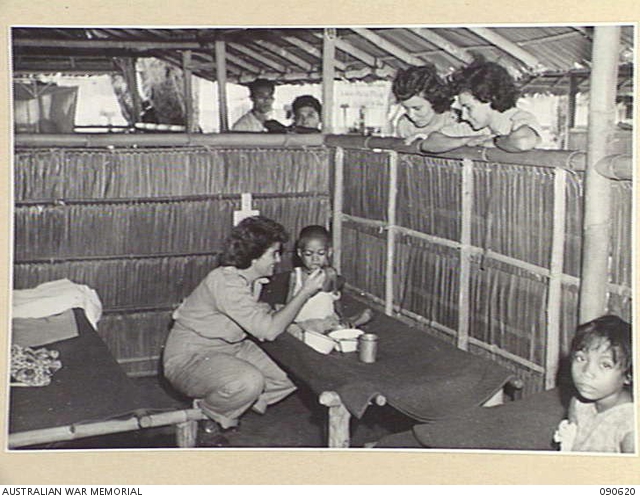
Ineke was sent with a doctor and two nurses to Morotai, an important Allied base northwest of New Guinea.
There she worked in a small hospital. VK-KNIL women from Suriname and Curaçao later joined the medical team. Ineke recalled:
“We cared for many ill locals, worked in the laboratory and gave injections for all sorts of illnesses. We even went around the island in a PT boat to visit coastal sick people.”
She also acknowledged how much the women learned from the Indonesian male nurses working at the hospital.
The end of the Pacific War
Japan surrendered in August 1945, but the end of the war did not immediately bring peace or reunite the many families separated by occupation and internment.
Ineke returned to Australia before joining a small team sent to Singapore. Its task was to register former prisoners and internees in hospitals and protected camps.
The names and addresses they collected were forwarded to Batavia, where a Displaced Persons Register was being compiled. This register attempted to account for the hundreds of thousands of people displaced, imprisoned or separated from their families during the war.
Singapore and Sumatra
From Singapore, Ineke’s work took her to Palembang and Lubuklinggau in Sumatra. She helped register former prisoners and distribute clothing and mail.
Together with two VK-KNIL women from Canada, she assisted women who had recently been released from internment. The work was humanitarian, but it took place amid the escalating Indonesian struggle for independence.
The women required military protection as Dutch authority was challenged and violence spread. British Indian troops and temporarily rearmed Japanese soldiers were among the forces used to protect camps, hospitals and evacuation routes.
Ineke’s surviving recollections reflect the Dutch perspective and terminology of the period. They are valuable eyewitness evidence, but should be read within the wider context of Indonesia’s declaration of independence on 17 August 1945 and the conflict that followed.
Searching for her family
In December 1945, Ineke received permission to travel to Bandung to visit relatives who had survived Japanese internment.
She still did not know the fate of her eldest brother, who had been held as a prisoner of war in Japan. She was finally reunited with him several months later in Batavia.
The uncertainty surrounding her family had shaped Ineke’s wartime life from the fall of Java in 1942. Her medical and registration work also brought her into daily contact with other families experiencing the same uncertainty, loss and difficult process of reunion.
Bangka and demobilisation
working with the Netherlands Indies Civil Administrationon Bangka Island.
Ineke eventually joined him there and worked in the local hospital. She was demobilised from the VK-KNIL on 31 December 1946.
Her wartime service had taken her from university life in Sydney to medical work across the Pacific and Southeast Asia. Although she had joined the corps after being forced to abandon her architectural studies, the VK-KNIL gave her an opportunity to assist people affected by occupation, internment, illness and displacement.
An early VK-KNIL story
Ineke’s experience differed from that of many women recruited in the Netherlands after the war. She belonged to the corps’s earliest Australian period, when its members included women already living or studying in Australia and recruits drawn from Dutch communities around the world.
Her story also shows that VK-KNIL members did not all train or remain at Camp Columbia. Medical personnel were trained in Sydney and deployed in small teams to hospitals, clinics and recently recaptured territories.
Ineke and Joan van Embden-Butler were both early VK-KNIL members, but apparently did not meet during their wartime service. Their contrasting experiences demonstrate the geographical range and diversity of the work undertaken by the corps.
Sources and acknowledgement
This article is based on:
Douglas Hurst, “The Women Corps”, written from information and personal records supplied by Ineke Thysse and Joan van Embden-Butler.
Ineke Thysse, personal notes supplied to Douglas Hurst on 18 June 2004.
Ineke Thysse, My Australian Memories, May 1989.
This personal story forms part of the VK-KNIL Research Portal – Dutch women in military service from Australia to Indonesia.