Civil administration, intelligence and the attempted restoration of Dutch authority, 1944–1945
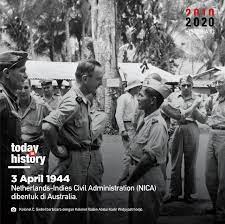
The Netherlands Indies Civil Administration (NICA) was created in Australia in 1944 to solve an increasingly urgent problem: who would govern territories of the Netherlands East Indies as Allied forces recaptured them from Japan?
For the Netherlands Indies Government operating from Australia, military liberation and restoration of civil administration were inseparable. As Allied forces advanced through New Guinea, the Moluccas and Borneo, Dutch authorities wanted trained personnel ready to follow them into recovered territory, restore government services, organise relief, gather information and prepare for the return of civilian administration.
NICA was established on 3 April 1944.
Although closely associated with the Netherlands Indies Government-in-Exile and later headquartered within the Dutch administrative complex at Camp Columbia in Brisbane, NICA was not simply a government department waiting in Australia for the war to end. It was a militarised civil-affairs organisation designed to operate alongside Allied forces in the field.
Its first detachments were deployed almost immediately.
When American forces landed at Hollandia in Netherlands New Guinea on 22 April 1944, NICA personnel accompanied the Allied advance. As further territory was recovered, NICA detachments established themselves at locations including Hollandia, Biak, Noemfoer and Sansapor.
The organisation subsequently moved farther west with the Allied advance. NICA personnel operated from Morotai (Moluccas) and accompanied operations into Borneo, including Tarakan and Balikpapan. They restored local administration, dealt with displaced and liberated populations, collected information, organised supplies and relief, and prepared recovered areas for renewed civilian government.
NICA also became involved in activities that blurred the boundary between civil administration and military intelligence. In the Moluccas and elsewhere, its personnel worked with Allied special-operations organisations and local guerrilla groups. Australian Special Operations Australia/SRD personnel assisted NICA projects, while NICA officers and local personnel provided regional knowledge, contacts and administrative capabilities.
From Brisbane, this appeared to be part of the orderly restoration of the Netherlands East Indies after Japanese occupation.
On the ground, the situation was considerably more complicated.
The Japanese occupation had transformed Indonesian society. Nationalism had strengthened, the authority of the pre-war colonial state could no longer simply be assumed, and local attitudes towards returning Dutch officials varied greatly between regions and communities.
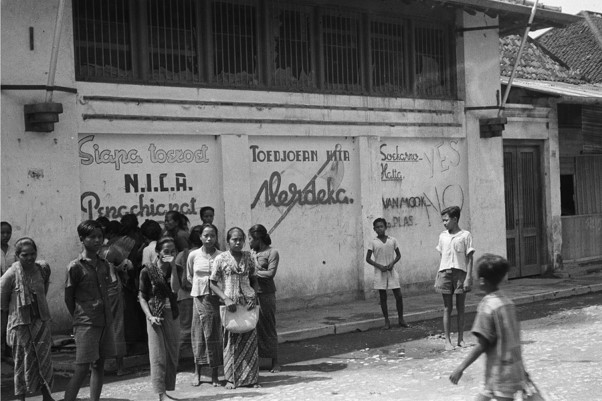
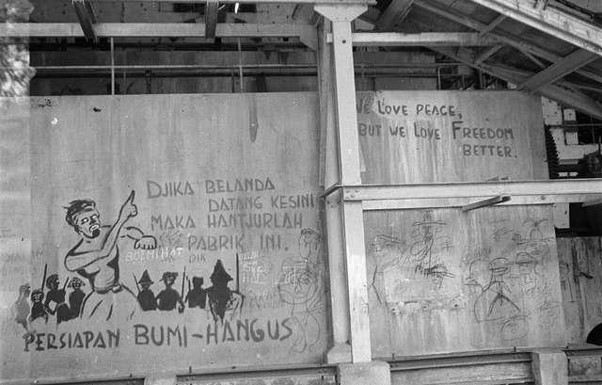
NICA therefore occupied an increasingly difficult position. To Dutch authorities it represented the restoration of legitimate government and the beginning of postwar reconstruction. To many Indonesian nationalists, however, the letters “NICA” came to symbolise an attempt to restore colonial rule.
That political conflict became dramatically more important after Japan announced its surrender on 15 August 1945 and Sukarno and Mohammad Hatta proclaimed Indonesian independence two days later.
NICA’s history therefore connects two different stories.
The first is the wartime story of Dutch, Indonesian and Allied personnel working from Australia to restore administration in territory recovered from Japan.
The second is the emerging political struggle over whether the Netherlands East Indies that NICA had been created to restore could—or should—return to its pre-war colonial form.
Brisbane and Camp Columbia stood at the centre of the first story. The Indonesian Revolution would transform the second.
Why NICA was created
By early 1944, the Allied advance towards the Netherlands East Indies created an immediate administrative problem.
Territory occupied by Japan was beginning to come within reach of Allied forces. Military commanders could capture and temporarily administer these areas, but they were not equipped to provide long-term civilian government across the enormous and diverse Netherlands East Indies.
For the Netherlands Indies authorities operating from Australia, the objective was clear: as territory was recaptured, Dutch civil administration should be restored as quickly as military circumstances permitted.
Lieutenant Governor-General Hubertus van Mook discussed the problem with General Douglas MacArthur, Commander-in-Chief of the Southwest Pacific Area, during a visit to Australia in March 1944. They reached an informal understanding about the principles governing civil administration in Netherlands territory recovered by Allied forces.
Against this background, the Netherlands Indies Civil Administration was established in Australia on 3 April 1944.
NICA was designed to provide trained civil-affairs personnel who could accompany Allied forces into recaptured Netherlands Indies territory. During active military operations, Allied commanders retained the authority necessary to conduct the campaign. As conditions stabilised, responsibility for civil administration was intended to pass progressively back to Netherlands Indies authorities.
This required much more than simply appointing government officials.
NICA personnel had to be prepared to enter areas damaged by war and occupation, restore local administration and judicial functions, organise food and medical assistance, deal with displaced populations and liberated prisoners, re-establish communications and public services, and work with local officials and communities.
The organisation therefore operated in the borderland between military and civilian government. Its personnel accompanied military forces and operated within the Allied command structure, but their purpose was to restore civilian administration.
The arrangement between Van Mook and MacArthur was not formally signed until 10 December 1944. The resulting Civil Affairs Agreement recognised that the Allied commander would retain the authority required by military operations while the Netherlands Government would resume responsibility for civil administration in recovered Netherlands territory as rapidly as practicable.
In practice, NICA did not wait for the formal agreement.
Within weeks of its establishment, its personnel were already accompanying Allied forces into Netherlands New Guinea.
From Australia to Hollandia: NICA goes into the field
NICA moved from planning to operations with remarkable speed.
On 22 April 1944, less than three weeks after NICA had been established in Australia, American forces landed at Hollandia in Netherlands New Guinea as part of Operation Reckless.
NICA personnel accompanied the Allied advance.
Their presence demonstrated the basic principle upon which the organisation had been created. Allied military forces would capture territory and retain military authority while operations continued, but Dutch and Netherlands Indies personnel would begin restoring civil administration behind the advancing front.
At Hollandia, a NICA detachment established an administrative headquarters in an area that subsequently became known as Kota NICA.
The work was practical and immediate. Years of Japanese occupation and the fighting associated with the Allied advance had disrupted local administration, supplies and communications. NICA personnel assisted civilians and former forced labourers and began rebuilding basic administrative services.
Hollandia became the first major test of the NICA system.
As Allied forces continued westwards along the New Guinea coast and through the offshore islands, further NICA detachments followed. Administrative units were subsequently established in areas including Sarmi, Biak, Noemfoer and Sansapor.
Each detachment operated under a Commanding Officer NICA, commonly abbreviated as CONICA. These officers were responsible for administering recovered territory while working within the authority of the Allied military command.
The surviving NICA records demonstrate the extent of this activity. Separate administrative reports were produced for Hollandia, Sarmi, Biak, Noemfoer and Sansapor during 1944–45.
NICA was therefore already functioning as a field administration months before the formal Van Mook–MacArthur Civil Affairs Agreement was signed in December 1944.
New Guinea also provided NICA with practical experience that could not have been gained in Australia. Its personnel had to work with local communities, restore administrative structures, organise relief and supplies, and adapt pre-war institutions to areas profoundly changed by occupation and war.
This experience would become increasingly important as the Allied advance moved farther west towards the Moluccas and Borneo.
Brisbane and Camp Columbia: headquarters behind the advance
While NICA detachments were beginning to operate in Netherlands New Guinea, the Dutch authorities in Australia were also reorganising the administrative and military structure supporting them.
Since 1942, Netherlands East Indies government and military organisations had been scattered across Melbourne, Canberra and other Australian locations. As their activities expanded, communication between the different offices became increasingly cumbersome.
The Allied advance also shifted the strategic focus northwards.
During 1944, the Netherlands East Indies authorities began consolidating much of their Australian administration at Camp Columbia, the former United States Army complex at Wacol on the western outskirts of Brisbane. In September the Netherlands East Indies Government in Exile was officially established here.
Camp Columbia offered something the Dutch administration had previously lacked in Australia: a large site where government departments, military headquarters, intelligence services, training facilities and supporting organisations could operate in close proximity.
NICA established its headquarters there alongside other important Netherlands East Indies organisations. These included the headquarters of the Royal Netherlands East Indies Army (KNIL), the Netherlands Forces Intelligence Service (NEFIS) and other administrative and support services.
Eventually around 2,000 military and civilian personnel – many from Brisbane – associated with the Netherlands East Indies administration were based at Camp Columbia.
For NICA, Brisbane served both as a headquarters and as a preparation and staging centre for personnel who would be sent forward into recovered territory.
Civil-administration personnel needed more than knowledge of pre-war government procedures. They were preparing to work in areas emerging from years of Japanese occupation and, in many cases, recent military operations.
Training therefore included subjects relevant to the restoration of government and public administration. Personnel had to be prepared for duties involving civil law and justice, population administration, health, education and other essential government functions.
Camp Columbia also provided a direct connection between NICA and the wider Dutch military organisation. Personnel destined for recovered territory could be assembled and prepared there before moving north into the operational area.
This made Camp Columbia an important link in a much larger system.
Brisbane was the rear administrative base. Forward NICA detachments operated in recovered territory. Allied military headquarters determined the requirements of active operations, while Dutch authorities attempted to prepare the personnel, supplies and administrative structures needed to resume civilian government.
NICA’s headquarters at Camp Columbia therefore did not itself administer Hollandia, Biak or other recovered areas on a day-to-day basis. Rather, it formed part of the organisational infrastructure that recruited, trained, coordinated and supported the personnel operating farther forward.
Camp Columbia also brought NICA into close proximity with NEFIS. Although the two organisations had different principal responsibilities — NICA for civil administration and NEFIS for intelligence — conditions in newly recovered and still-contested territory increasingly brought their activities into contact.
That overlap would become particularly apparent as the Allied advance moved towards Morotai, the Moluccas and Borneo.
Morotai: where civil administration met intelligence operations
As the Allied advance moved westwards, Morotai became one of the most important forward bases for operations into the Netherlands East Indies. Morotai lies just north of the larger island of Halmahera in the northern Moluccas (Maluku), strategically positioned between New Guinea to the east and the rest of the Netherlands East Indies to the west.
American forces had captured part of the island in September 1944 and developed it into a major Allied air, naval and logistical base. Dutch military, intelligence and civil-administration personnel subsequently operated there alongside their Allied counterparts.
For NICA, Morotai represented another stage in the transition from planning in Australia to administration in the field.
NICA personnel worked among populations affected by Japanese occupation and the continuing fighting in the surrounding islands. Their responsibilities included administration, relief, movement of civilians and preparation for the restoration of government in areas that were still partly contested.
The distinction between civil administration and intelligence could not always be maintained under these conditions.
Large areas of the Moluccas remained under Japanese control. Information about Japanese forces, local conditions and the attitudes of communities therefore had immediate military as well as administrative value. NICA officers and Indonesian personnel could bring regional knowledge, language skills and contacts that were useful to Allied intelligence organisations.
At the same time, Special Operations Australia, operating under the cover name Services Reconnaissance Department (SRD), was conducting clandestine reconnaissance and guerrilla operations throughout the region.
The two organisations had different responsibilities. SRD specialised in intelligence gathering, special operations and support for resistance activities. NICA’s primary responsibility was civil administration in recovered Netherlands Indies territory.
In practice, however, their activities sometimes overlapped.
Operational records examined by Australian military historian Peter Dunn show that SRD Group B assisted NICA with projects in the Moluccas. NICA had only a small intelligence capacity of its own, and SRD could provide expertise in planning and conducting operations involving reconnaissance, clandestine contacts and guerrilla activity.
NICA personnel and local contacts could in turn provide the detailed regional knowledge upon which such operations depended.
Projects associated with this cooperation included efforts to establish contact with populations and guerrilla groups in Japanese-held areas and to obtain information that would assist the Allied return. Operations with codenames including GIRAFFE, CRANE and MAGPIE formed part of this complex operational environment.
The relationship illustrates how difficult it is to draw a sharp boundary between intelligence and civil administration during the final phase of the war.
A NICA officer entering newly recovered territory needed to know who controlled surrounding villages, where Japanese troops were located, which local officials remained in place, where displaced civilians had gone and who might be willing to cooperate with the returning administration.
Those were administrative questions, but they were also intelligence questions.
Morotai therefore became more than another NICA administrative post. It was a forward base where Dutch and Indonesian civil administrators, NEFIS personnel, Allied military forces and Australian special-operations organisations operated within the same rapidly changing environment.
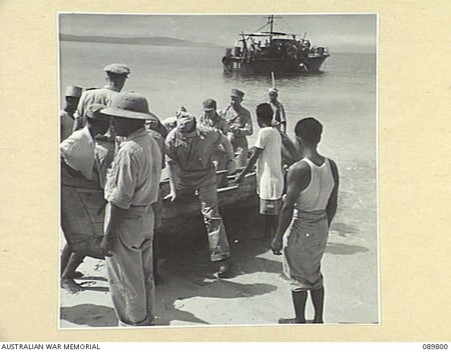
The human consequences were visible around the island. In May 1945, Australian photographs recorded a NICA vessel operating off Rao Island carrying United Nations relief personnel. On another voyage the vessel encountered an Indonesian family travelling by canoe from Japanese-held Loloda towards the NICA settlement at Rao.
Such episodes reveal another side of NICA’s work. Behind the military planning and intelligence operations were civilians attempting to survive a war that was still continuing around them.
Tarakan and Balikpapan: NICA returns with the Allied invasion
By 1945 the Allied advance had reached Borneo, bringing NICA closer to the economic and population centres of the pre-war Netherlands East Indies.
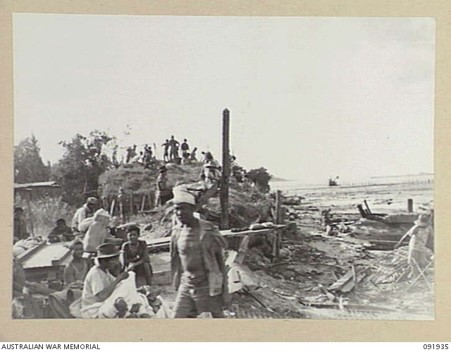
The Australian-led OBOE operations provided some of the clearest examples of how Dutch and Netherlands Indies military, intelligence and civil-administration personnel worked alongside Australian forces during the final months of the war.
On 1 May 1945, the Australian 26th Infantry Brigade landed on Tarakan, an oil-rich island off the east coast of Borneo. The Australians were accompanied by approximately 140 KNIL soldiers, who served principally as scouts and interpreters, as well as NEFIS intelligence and civil-affairs personnel.
NICA followed directly behind the fighting.
Within days a NICA compound had been established near the headquarters of the Australian 26th Infantry Brigade. Civilians emerging from Japanese-controlled areas were directed there, where NICA assumed responsibility for their immediate welfare and administration.
The surviving Australian photographic record provides an unusually detailed picture of this work.
Chinese and other local refugees were brought to the NICA compound. NICA organised local labour to clear the devastated Tarakan oilfields and arranged workers for Australian airfield construction units. Water, food, accommodation and medical assistance had to be provided while fighting continued elsewhere on the island.
Tarakan also demonstrates particularly clearly the connection between NICA and intelligence.
NEFIS intelligence officers were attached to NICA there, and their reports were sent back through the Dutch intelligence organisation. The surviving NEFIS archive contains a separate file devoted specifically to reports received from NEFIS intelligence officers attached to NICA at Tarakan during 1945.
This was a practical arrangement. NICA personnel needed intelligence about the territory and population they were attempting to administer, while NEFIS required information from newly liberated areas and from civilians who had lived under Japanese occupation.
The relationship did not make NICA an intelligence service. Rather, it demonstrates how closely civil administration and intelligence could become connected immediately behind an advancing army.
Balikpapan
Two months after the Tarakan landing, Australian forces returned to Borneo on an even larger scale.
On 1 July 1945 the Australian 7th Division landed at Balikpapan on the east coast of Borneo. As at Tarakan, the Australian force was accompanied by a KNIL infantry company and Dutch support personnel.
Again, NICA followed the military advance and established facilities for the civilian population.
The scale of the humanitarian problem was considerable. Civilians emerged from Japanese-held areas suffering from malnutrition, illness and the effects of years of occupation. Australian photographs show men, women and children carrying their possessions towards the NICA compound as the fighting moved inland.
NICA established medical facilities, including a hospital treating Indonesians who had suffered severe mistreatment during the Japanese occupation. It also became involved in restoring essential economic infrastructure. At the Balikpapan oil installations, for example, a NICA Oil Rehabilitation Unit supervised work associated with restoring equipment and facilities.
These activities show what the planners in Australia had intended NICA to do.
The military forces captured territory. Intelligence organisations gathered information about the enemy and local conditions. NICA moved into the space created behind the front and attempted to restore administration, provide relief and re-establish essential services.
But Borneo also exposed a fundamental assumption underlying that system.
NICA was not simply creating an emergency administration. It was restoring the authority of the Netherlands Indies Government.
From Brisbane, this had appeared to be the natural political outcome of Allied liberation. The Japanese occupation would end, Dutch authority would return, civil government would be restored and the Netherlands East Indies would begin its post-war reconstruction.
By the time Australian troops and NICA personnel reached Borneo in 1945, however, the political future of the archipelago was becoming much less certain.
The approaching Japanese surrender would transform NICA’s task from the restoration of government after military liberation into something far more contentious: an attempt to restore Dutch colonial authority during the emergence of an Indonesian independence movement.
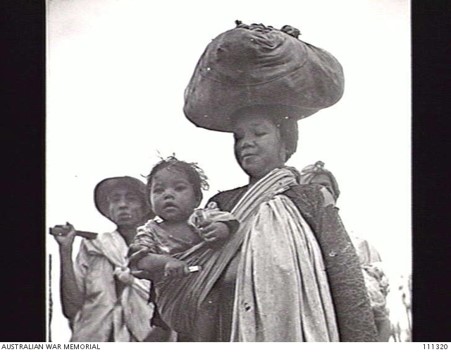
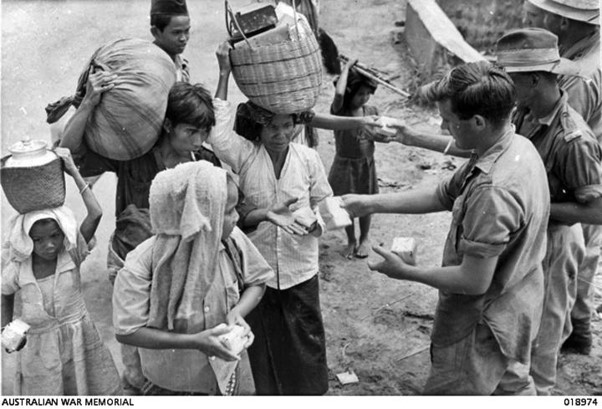
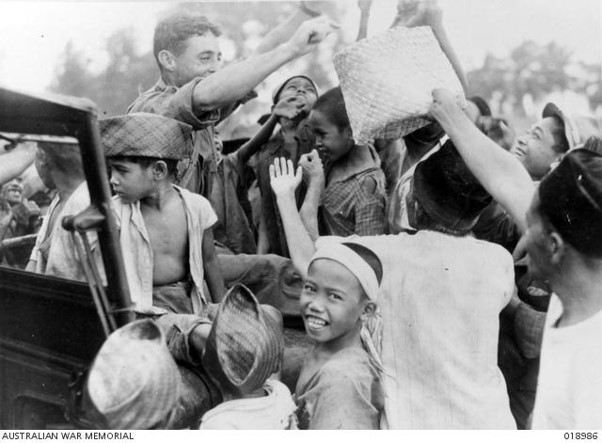
The Japanese surrender changes everything
The surrender of Japan in August 1945 transformed the circumstances in which NICA was expected to operate.
Until then, Dutch planning had been based on a relatively straightforward assumption. Allied forces would progressively liberate the Netherlands East Indies from Japanese occupation, NICA would follow them into recovered territory, and civilian authority would gradually be returned to the Netherlands Indies Government.
That process was already taking place in New Guinea, the Moluccas and Borneo.
Japan’s sudden surrender disrupted this sequence.
On 15 August 1945, Japan announced its acceptance of the Allied surrender terms. On the same day, responsibility for most of the Netherlands East Indies was transferred from General MacArthur’s American-led Southwest Pacific Area to Admiral Lord Louis Mountbatten’s British-led South East Asia Command.
The change had major consequences for NICA.
The arrangements negotiated between Van Mook and MacArthur could no longer provide the framework for restoring civil government throughout the archipelago. Plans for the deployment of large numbers of NICA detachments, particularly to Java, were interrupted while new arrangements had to be negotiated with the British.
On 24 August 1945, the Netherlands and Britain concluded a new Anglo-Dutch Civil Affairs Agreement. In principle, it continued the concept that Allied military authorities would initially exercise control while Netherlands Indies civil administration was progressively restored.
But events inside Indonesia were moving much faster than Allied administrative planning.
The proclamation of Indonesian independence
On 17 August 1945, two days after Japan announced its surrender, Sukarno and Mohammad Hatta proclaimed the independence of the Republic of Indonesia.
For Indonesian nationalists, the Japanese surrender did not mean that the Netherlands East Indies should simply return to its pre-war political status. It created an opportunity to establish an independent Indonesian state.
Republican institutions began to emerge on Java and Sumatra. Indonesian officials, youth organisations and former members of Japanese-sponsored military formations increasingly asserted control over government offices, communications, transport and weapons.
NICA now faced a situation fundamentally different from the one for which it had been created.
In places such as Hollandia, Morotai, Tarakan and Balikpapan, NICA had entered behind advancing Allied forces while Japanese resistance was still being overcome. Its authority derived from the Allied military command and from the Netherlands Indies Government whose sovereignty the Allies continued to recognise.
Java and Sumatra were different.
There had been no Allied liberation of these islands before Japan surrendered. By the time Allied forces began arriving in significant numbers, an Indonesian Republic had already been proclaimed and nationalist authorities were attempting to establish effective control.
NICA personnel therefore no longer appeared simply as civil administrators following an Allied liberation force.
To the Netherlands Government and many Dutch and Netherlands Indies officials, NICA represented the restoration of the lawful administration displaced by the Japanese invasion in 1942.
To Indonesian republicans, however, NICA increasingly represented something very different: the attempted return of Dutch colonial rule after independence had already been proclaimed.
The name itself became politically charged.
From Allied partner to symbol of colonial restoration
The difficulty was compounded by the position of the British.
South East Asia Command had immediate responsibilities that included accepting the Japanese surrender, disarming and repatriating Japanese forces, recovering Allied prisoners of war and civilian internees, and maintaining order.
Restoring Dutch political control over Indonesia was a much more difficult proposition.
When Allied forces began arriving on Java in September 1945, they encountered an Indonesian nationalist movement that was already organised and increasingly armed. British commanders consequently found themselves caught between their military responsibilities, their agreements with the Netherlands and the political reality they encountered on the ground.
NICA became one of the most visible symbols of this conflict.
Its arrival alongside Allied forces strengthened Indonesian suspicions that the Allies intended not merely to disarm the Japanese and release prisoners, but to enable the Netherlands to re-establish colonial authority.
Resistance to NICA consequently became intertwined with resistance to the Dutch return.
The contrast with the assumptions made in Brisbane only months earlier was profound.
NICA had been created as a practical mechanism for moving civil administration from Australia back into territories liberated from Japan. By September 1945, it was becoming part of a political and military struggle over the future sovereignty of Indonesia.
The wartime task of reconstruction had become entangled with revolution and decolonisation.
What happened to NICA?
The proclamation of Indonesian independence fundamentally changed the purpose and political position of NICA.
The organisation had been created in Australia as a temporary civil-affairs administration that would accompany Allied forces into territory recovered from Japan. Its original purpose was therefore closely connected with the Allied war effort.
After August 1945, that context rapidly disappeared.
On Java and Sumatra, where British and Indian forces assumed responsibility for accepting the Japanese surrender and maintaining order, the arrival of NICA encountered strong opposition from Indonesian Republicans. The name itself had become so closely associated with the restoration of Dutch colonial authority that it became politically problematic.
In late October 1945, NICA on Java was renamed the Allied Military Administration Civil Affairs Branch (AMACAB).
The change of name did not resolve the underlying political conflict. Dutch civil administrators continued to operate under Allied military authority, but their effective control on Java remained limited largely to areas occupied by Allied forces. Republican authorities controlled substantial areas beyond them.
The situation was different in Borneo and the eastern Netherlands East Indies.
There, Australian forces had accepted the Japanese surrender and NICA continued operating under its original name. In these areas Dutch and Netherlands Indies personnel were able to re-establish administration more extensively, and the name NICA remained in use until the withdrawal of the Allied forces in 1946.
As Australian forces progressively withdrew, responsibility for administration passed to Netherlands Indies authorities. In Borneo and the eastern islands this transfer was substantially completed by July 1946.
On Java and Sumatra, British and Indian forces remained until 30 November 1946. With their departure, AMACAB also came to an end. Its administrative functions were subsequently transferred to the Temporary Administrative Service (Tijdelijke Bestuursdienst).
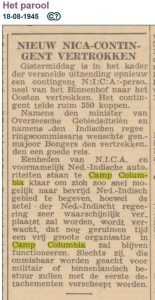
The transfer of NICA personnel from Australia to the Netherlands East Indies began immediately after Japan’s surrender, but Camp Columbia did not suddenly cease functioning as NICA’s Australian base. A Dutch newspaper report of 18 August 1945 stated that NICA units and Netherlands Indies officials were standing ready at Camp Columbia to proceed as quickly as possible to liberated territory. Initially, however, only personnel considered indispensable for military or civil administration were to be sent forward. The report specifically noted that a substantial organisation was expected to remain functioning at Camp Columbia “for some considerable time”.
Over the following months, as personnel and administrative functions were progressively transferred back into the archipelago, Camp Columbia’s role diminished. During the first months of 1946 the camp increasingly also served as a reception and welfare centre for Dutch and Netherlands Indies evacuees. On 1 May 1946 its closure as the remaining Netherlands Indies service and evacuee camp was announced. No precise date has yet been identified for the formal closure of NICA headquarters itself, but the surviving evidence indicates a gradual transfer rather than an abrupt departure in August 1945.
By then, however, the historical circumstances were entirely different from those in which NICA had been conceived at Camp Columbia.
The Netherlands was no longer attempting simply to restore administration behind an Allied advance against Japan. It was confronting an Indonesian Republic claiming sovereignty over the former Netherlands East Indies.
What followed — negotiations, armed conflict, Dutch military operations and eventually the transfer of sovereignty to Indonesia in December 1949 — belongs principally to the history of the Indonesian Revolution and Dutch-Indonesian decolonisation.
That wider history lies beyond the scope of this article.
For the Dutch-Australian wartime story, NICA’s significance lies primarily in the period from 1944 to 1946: its creation in Australia, its headquarters and preparation at Camp Columbia, and its deployment alongside American and Australian forces into territories recovered from Japanese occupation.
The last Dutch transport plane left Archerfield Airport in Brisbane in September 1947.
NICA’s place in the Dutch-Australian wartime story
NICA existed for only a relatively short period, but its history provides an important link between Australia and the Netherlands East Indies during the final phase of the Pacific War.
It was conceived and organised in Australia at a moment when the Netherlands Indies Government had lost control of its territory but was preparing for an Allied return.
Camp Columbia became one of the principal centres from which that return was organised. Dutch, Indonesian and Indo-European military personnel, civil servants, intelligence officers and specialists worked there alongside the wider Netherlands Indies administration.
From Brisbane, NICA personnel moved north into the advancing Allied war. They followed American forces into Netherlands New Guinea, operated from Morotai and the surrounding islands, and accompanied Australian forces into Borneo.
Their work ranged from restoring administration and providing relief to organising labour, medical care and essential services. In the fluid conditions of newly recovered territory, NICA personnel also worked alongside NEFIS and Australian special-operations organisations involved in intelligence, reconnaissance and contacts with local communities.
NICA therefore illustrates how extensive the Dutch presence in wartime Australia had become.
Australia was not simply a refuge for a displaced Netherlands Indies administration. It became a base from which Dutch and Netherlands Indies authorities attempted to rebuild military forces, intelligence networks and civil administration while the war was still being fought.
The Japanese surrender brought that Dutch-Australian wartime partnership to its final stage.
The political struggle that followed would increasingly become a Dutch-Indonesian story rather than a Dutch-Australian one. But the origins of NICA, its organisation and many of the people who carried it back into the archipelago remain firmly connected with Australia — and particularly with Camp Columbia in Brisbane.
That makes NICA an important final chapter in the story of the Netherlands Indies Government and its military, intelligence and administrative organisations operating from Australia during the Second World War.
Related research in this portal
- This article provides the wider Allied intelligence context. Other articles in this DACC Research Portal examine the NEI Section, NEFIS and NEFIS III, the Z Experimental Station at Cairns, clandestine communications, individual agents and missions, and the later involvement of the Netherlands Indies Civil Administration.
- Back to the Research Portal:
Sources and further research
- Australian War Memorial – Allies in Adversity: Australia and the Dutch in the Pacific War – NEFIS. Overview of NEFIS and its role in Australia during the Pacific War.
- Australian Signals Directorate – ASD’s Origin Story. Background on Australia’s wartime signals-intelligence organisations, including Central Bureau and FRUMEL.
- National Archives of Australia – records relating to the Allied Intelligence Bureau, Inter-Allied Services Department, Services Reconnaissance Department and associated intelligence and special-operations activities.
- Dr Jonathan (Jack) Ford – Allies in a Bind: Australia and the Netherlands East Indies in the Second World War. Detailed study of Australian-Dutch military, political and intelligence cooperation during the Second World War. Rather than linking this separately to another DACC article, I would leave it as a bibliographic source: Australian Netherlands Ex-Servicemen & Women’s Association, Queensland Branch, 1996.