Sophia Kruyswijk-van Thiel was both a member of the Vrouwenkorps Koninklijk Nederlands-Indisch Leger (VK-KNIL) and one of its most important historians. Her wartime generation had been among the first Dutch women formally admitted to military service, but its contribution was largely forgotten after the dissolution of the KNIL in 1950.
Decades later, Kruyswijk-van Thiel set out to recover that history. Her research culminated in a doctoral thesis and book that documented the motivations, service and later recollections of the women of the VK-KNIL.
Joining the VK-KNIL
Sophia van Thiel was twenty years old when her fiancé, Evert Kruyswijk, was sent to Indonesia as a conscripted officer in 1948. Her decision to enlist was motivated not by abstract patriotism but by a determination to follow him.
She volunteered for the VK-KNIL and arrived in Indonesia on 18 February 1948. Following her military training in Bandung, she requested a posting to Padang in West Sumatra, where Evert was stationed.
Her story therefore differs from those of the women who established and joined the VK-KNIL in wartime Australia during 1944 and 1945. Sophia belonged to the postwar generation recruited while the Indonesian struggle for independence was underway.
Intelligence work in Padang
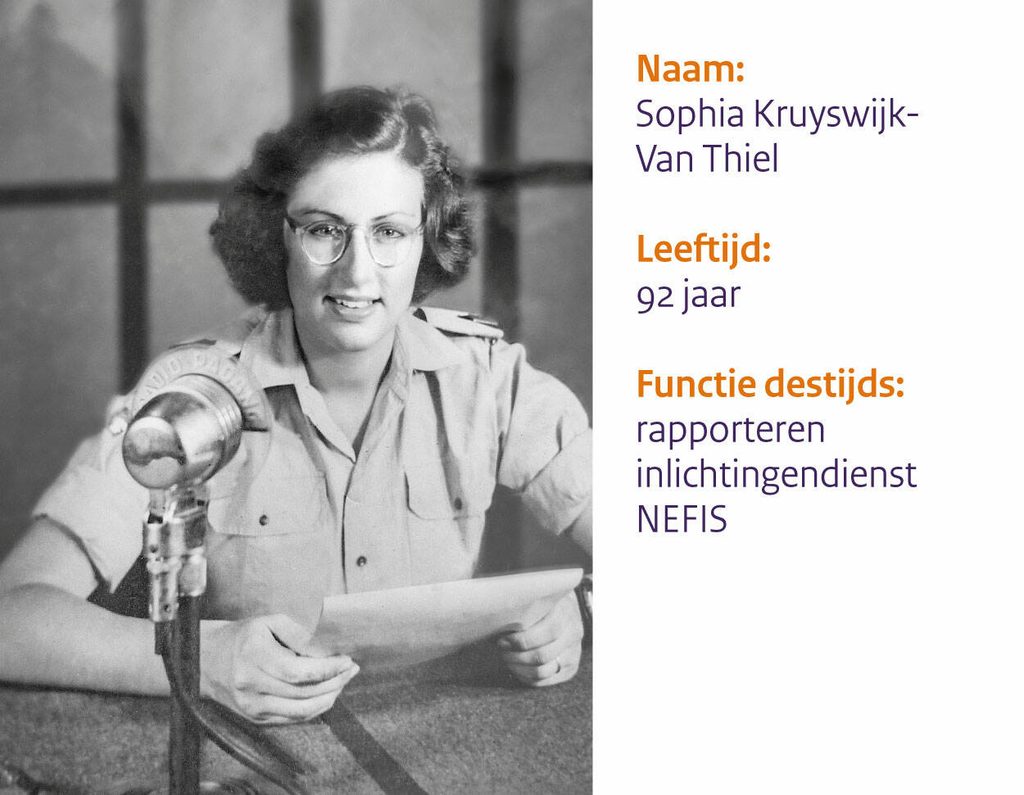
In Padang, Sophia worked for the Netherlands Forces Intelligence Service (NEFIS). Her duties included processing information supplied by a Chinese informant who regularly crossed the demarcation line.
She later explained that the informant reported what he had observed on the other side of the line. Sophia’s task was to turn this information into reports for military headquarters.
Her work demonstrates that VK-KNIL members were employed in more than nursing, clerical and welfare duties. During the Indonesian independence conflict, some women also worked within intelligence and communications organisations.
Sophia was regularly assessed and described as a very diligent and correct worker. She rose rapidly from private to sergeant-major. She hoped to progress further, but was considered too young to receive an officer’s commission.
Radio Padang and life beyond military duties
Outside her formal work, Sophia became involved in the cultural life of the Dutch military community. She undertook voluntary work as a presenter and disc jockey with Radio Padang and also participated in theatrical productions.
Looking back on her time in Indonesia, she remarked:
“I didn’t read a book, but I learned a great deal.”
The surviving biographical notes also record her youthful motivation more simply:
“I wanted to see something of the world.”
Her experience combined military responsibility, intelligence work, travel, relationships and exposure to cultures very different from those she had known in the Netherlands.
Women entering the military
Kruyswijk-van Thiel later placed her own service within the wider history of women in the Dutch armed forces.
The establishment of the VK-KNIL in 1944 represented a significant institutional change. Dutch women had undertaken voluntary and auxiliary work during earlier conflicts, but the VK-KNIL was formally constituted as part of the military. Its members held military ranks and were subject to military discipline.
This did not mean that they were treated in the same way as men. Women received military training but were generally employed in nursing, administration, communications, transport and related support duties. According to Kruyswijk-van Thiel, they were trained but not normally permitted to carry or use weapons.
Their enlistment also provoked social opposition. Some people, particularly within conservative religious circles, regarded women entering a predominantly male environment as improper. Rumours circulated about their morality and behaviour.
For many of the women, however, military service was personally liberating. They were young, received responsibilities that would rarely have been given to women in civilian life and learned to work with people from different countries and cultures.
Kruyswijk-van Thiel later observed:
“We were very young, were given considerable responsibilities and learned to deal with other cultures. It was a formative experience that we remember very positively.”
Return to the Netherlands
The Royal Netherlands East Indies Army was disbanded on 26 July 1950, bringing the VK-KNIL to an end. Sophia and Evert returned to the Netherlands.
Postwar Dutch society showed little interest in the Women’s Corps. The country was occupied with reconstruction, while attitudes towards the former colony and the Indonesian conflict were changing. The experiences of the VK-KNIL women consequently received little public attention.
Sophia nevertheless continued to lead an active life. A talented athlete, she became a Dutch national rowing champion in the women’s eight in 1961. She later studied psychology and worked as an independent therapist. Among her patients were daughters of former KNIL servicemen.
She also organised annual VK-KNIL reunions. Through these gatherings, she saw how rapidly the corps was disappearing from public memory.
Recovering the history of the VK-KNIL
Sophia was disturbed that the women’s contribution appeared to have been put aside. In 1994, she began researching a doctoral thesis about the VK-KNIL.
The project took approximately nine years. She assembled personnel lists, photographs, documents and personal recollections and investigated why women joined, how they were perceived and what military service meant to them.
Her research drew upon information and recollections collected from more than 200 former VK-KNIL members, including 28 women who participated in more extensive personal interviews.
Her work identified 1,019 women who had served in the VK-KNIL between 1944 and 1950.
The resulting study, Het Vrouwenkorps-KNIL, was published by Dutch University Press in 2004. It comprised 279 pages and was accepted as a doctoral thesis on 13 February 2004.
The fuller title recorded by the National Military Museum is Vrouwenkorps van het voormalig Koninklijk Nederlands-Indisch Leger, 1943–1950: motivatie en beeldvorming—the Women’s Corps of the former Royal Netherlands East Indies Army, 1943–1950: motivation and representation.
A pioneer documenting other pioneers
Kruyswijk-van Thiel believed that the VK-KNIL had played a modest but important role in the eventual integration of women into the Dutch armed forces.
The corps demonstrated that women could accept military discipline, perform responsible duties and replace men in positions required by the war effort. Yet the women themselves did not necessarily describe their actions in the language of feminism. Many saw their service as a practical response to extraordinary circumstances rather than as part of an organised campaign for women’s equality.
Sophia’s importance lies not only in her own military service. By recording names, collecting photographs and preserving women’s recollections, she ensured that the VK-KNIL could be studied as more than an organisational footnote.
Her work has subsequently become an important source for researchers, museums and families reconstructing the lives of individual VK-KNIL members.
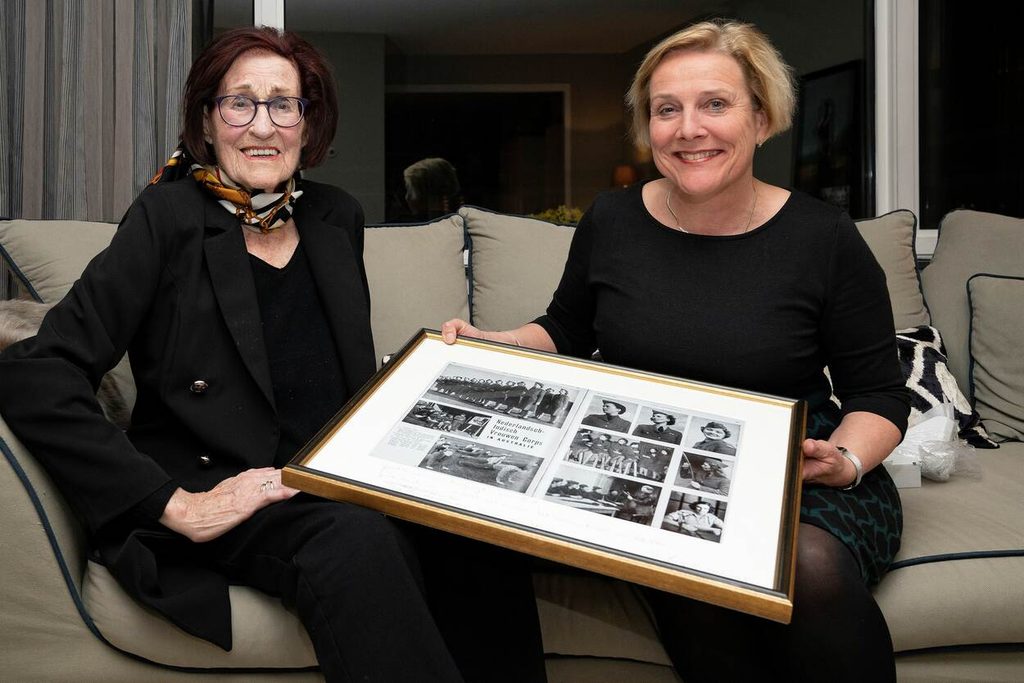
In later life, she received recognition from the Dutch Ministry of Defence. This photograph, published by the Netherlands Institute for Military History, shows Minister of Defence Ank Bijleveld-Schouten presenting Sophia Kruyswijk-van Thiel with a collage of VK-KNIL photographs.
Surviving newspaper and biographical material
Several images preserved in the Camp Columbia collection relate to Kruyswijk-van Thiel and her research.
One is a newspaper article headed “Vrouwen onder de wapenen” (“Women under Arms”), discussing her study and the publication of her book. Its accompanying photograph shows three early VK-KNIL recruits and is credited to the Kruyswijk Collection. The same photograph was used on the cover of her book.
The names of the newspaper and its publication date have not yet been established.
A second image contains pages three to five of an incomplete biographical account of Sophia and the Women’s Corps. These pages preserve information about her promotion to sergeant-major, her voluntary work with Radio Padang and her reflections on women’s military service. The first two pages and the publication details have not yet been located.
These documents should therefore be described as surviving fragments rather than as complete publications.
Sources
- Sophia Kruyswijk-van Thiel—portrait and service history, Netherlands Institute for Military History
- Het Vrouwenkorps-KNIL—Tilburg University doctoral-thesis record
- Sophia Kruyswijk-van Thiel’s book in the National Military Museum collection
- Sophia Kruyswijk-van Thiel, Het Vrouwenkorps-KNIL, Dutch University Press, Amsterdam, 2004.
- “Vrouwen onder de wapenen,” unidentified newspaper clipping, Kruyswijk Collection.
- Incomplete biographical notes concerning Sophia Kruyswijk-van Thiel and the VK-KNIL, pages 3–5.
VK-KNIL Research Portal
This article forms part of the VK-KNIL Research Portal: Dutch Women in Military Service from Australia to Indonesia.