This chapter by anthropologist and oral historian Renate Stapelbroek, Met z’n tweeën in een vreemd land (“The two of us in a strange land”) – published in: in Vughtse Historische Reeks (VHR) (Vught 2013) 13, 122-137. – examines postwar migration from the North Brabant town of Vught. While the original study includes migration stories to Canada, the United States and Australia, for the DACC the material is particularly valuable for documenting several families who settled in Australia and maintained lasting connections with their Dutch hometown.
The article highlights how Australia emerged as one of the most attractive destinations for Dutch migrants during the 1950s. Although the chapter acknowledges the broader international migration movement, its Australian stories provide a vivid picture of the personal decisions, family networks and long-term consequences of migration.
The Linsen family and migration to Sydney
One of the most detailed Australian case studies concerns the family of Ad Linsen and Theresia Linsen-Bausch. The family emigrated from Vught to Sydney during the early 1950s. Their decision was influenced by a desire to create a better future for their large family and by responsibilities arising from the postwar period, including caring for relatives connected to the former Netherlands East Indies.
The article records that Ad Linsen hoped to establish a biscuit factory in Australia. Although the venture ultimately proved unsuccessful, the family remained in Australia and built a new life there. Ad later found employment with the major Australian retailer David Jones.
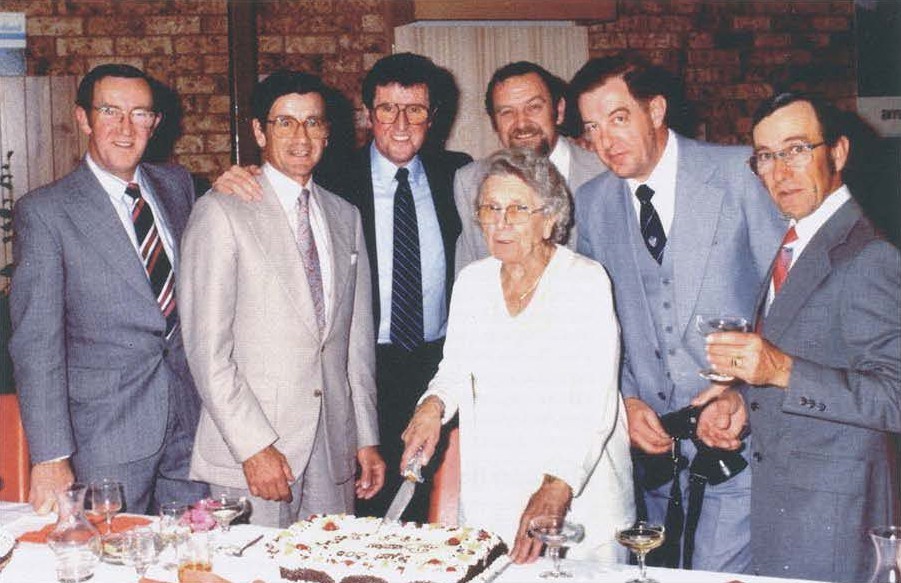
The chapter follows the family across several decades and includes a photograph of Theresia Linsen-Bausch celebrating her 80th birthday at the Dutch Club in Canberra in 1983. The image identifies her sons Ge Linsen, Hans Linsen, Harry Linsen, Jos Linsen, Ad Linsen and Ton Linsen, demonstrating how the family became firmly established within the Dutch-Australian community while retaining strong links with their Dutch origins.
Ton Linsen later reflected on the migration experience and the family’s life in Australia. Despite building a successful future overseas, he maintained an attachment to Vught and preserved family memorabilia, including an old Vught telephone directory that had travelled to Australia with the family in 1952.
The Marechal family in Adelaide
Another important Australian migration story concerns Louis Marechal and Marie Marechal-Moors, who emigrated from Vught to Adelaide. Their departure caused considerable tension within the family. Louis’s brother Henk Marechal strongly opposed the decision and remained deeply upset by the migration for many years.
The chapter includes recollections from Puck van Helmond-Marechal, who vividly remembered the family conflict surrounding the departure. For those who remained behind in the Netherlands, migration could feel like a permanent loss rather than an exciting opportunity.
After years of invitations from Australia, Henk Marechal and his wife Henny finally travelled to Adelaide in 1978. The visit reunited family members who had been separated for decades. According to the account, the emotional reunion brought great joy to both families. Tragically, Louis Marechal died from a heart attack in Adelaide only a few months later, and Henk himself died shortly afterwards in Vught.
Family connections across generations
A recurring theme throughout the Australian stories is the enduring connection between migrants and their hometown. Family ties were maintained through letters, photographs, occasional visits and later air travel. Migration did not sever connections with Vught; instead, it created transnational family networks spanning the Netherlands and Australia.
The article demonstrates how descendants continued to identify with both countries. Dutch traditions, family memories and local histories remained important, while Dutch clubs and community organisations in Australia provided social and cultural support for migrants adapting to their new environment.
Significance for Dutch-Australian history
Although Met z’n tweeën in een vreemd land examines migration from Vught to several overseas destinations, its Australian examples offer valuable insight into the broader Dutch migration experience in Australia. Through the stories of the Linsen and Marechal families, the chapter reveals the hopes, challenges and achievements of Dutch migrants who helped build new lives in Sydney, Canberra and Adelaide while preserving strong emotional and cultural links with the Netherlands. Their experiences form part of the larger story of postwar Dutch migration and the development of Dutch-Australian communities across the country.