From Penguin to Kingston
South Eastern Builders was a construction company established around 1955 by members of two Dutch migrant families, the Betlehems and the Herweynens. Its development illustrates the contribution of post-war Dutch migrants to Tasmania’s building industry and the growth of Kingston and Hobart.
The families had initially settled in northern Tasmania, where they were involved in the emerging Reformed Church community at Penguin and Ulverstone. They subsequently moved to Kingston, where Dutch migrants were establishing the settlement known as Little Groningen.
According to the recollections of former company accountant Andrew Vanderschoor, the principal founders were Arie H. Betlehem and J. P. Herweynen. Their sons and other family members subsequently became involved in the enterprise.
A growing Dutch-Australian building business
South Eastern Builders began operating from the Betlehem family’s property at Kingston, where a workshop and storage facilities were established.
The company later transferred its operations to Hobart, including premises in Campbell Street.
Several members of the Herweynen family worked for the company, alongside other Dutch migrant tradespeople and managers. Among those identified by Vanderschoor were Gerald Betlehem, Jan Herweynen, Henk Wierenga, Lammert Herweynen, Cornelis Herweynen, Fred Hartog and Bertus Verdouw.
Vanderschoor estimated that South Eastern Builders employed between 90 and 100 men at its peak.
The company’s workforce also included tradespeople from other migrant communities. Vanderschoor particularly remembered the Bocchino brothers, Italian concrete finishers whose craftsmanship was highly regarded.
Connections with the Australian Building Corporation
South Eastern Builders developed alongside the Australian Building Corporation (ABC), the earlier Dutch migrant enterprise associated with the founders of Little Groningen.
Although the companies shared connections through the Dutch community, they were separate businesses and competitors.
Following the restructuring of ABC after Eerke van der Laan’s death in 1959, several workers transferred to South Eastern Builders.
These developments demonstrate how the original migrant building initiative contributed to a wider network of construction enterprises, employment opportunities and professional relationships in Tasmania.
Empress Towers and major construction projects
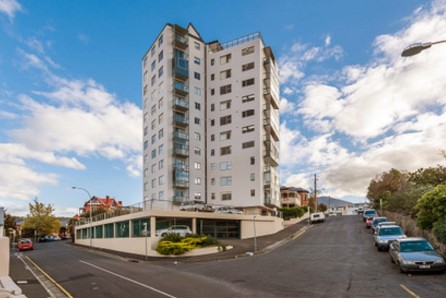
One of the company’s most notable projects was Empress Towers, constructed at Battery Point in Hobart during the 1960s.
Completed in 1967, the high-rise residential development became a prominent feature of Hobart’s skyline and attracted controversy because of its scale and location near the historic Battery Point precinct.
Vanderschoor recalled that the company undertook the project during a period of reduced construction activity, partly to maintain employment for its workforce.
Other projects he associated with South Eastern Builders included the Howrah water reservoir, television station buildings at New Town and industrial work for the Electrolytic Zinc Company.
The company also developed commercial interests in interior partitioning and shopfitting.
Employees and community connections
South Eastern Builders provided employment and training opportunities for members of Dutch migrant families.
Peter Herweynen joined the company as an apprentice carpenter in February 1958 and later worked on major construction projects. His personal history provides a complementary account of the company’s development.
Vanderschoor also recalled that Cornelis (Cor) Herweynen received a prestigious Tasmanian apprenticeship award around 1960–61, although the precise year and award details require confirmation.
The company’s connections extended to other Dutch migrant enterprises. Bertus Verdouw, an early employee, later became associated with Laver Construction.
Closure and historical significance
South Eastern Builders ceased operating during the 1970s. Peter Herweynen recalled its closure in 1974 following financial difficulties, while Andrew Vanderschoor remembered a date closer to 1976.
Despite this uncertainty, the company’s significance is clear. It developed from the skills and initiative of Dutch migrant families into a substantial construction enterprise whose work contributed to Kingston’s development and Hobart’s changing built environment.
Its history also illustrates how Dutch migrant networks expanded beyond the original Little Groningen settlement into Tasmania’s wider economy.
Historical source – Andrew Vanderschoor
The principal source for this article is Dutch Migrants Building Tasmania – South Eastern Builders, a two-page personal account by Andrew Vanderschoor, who served as the company’s accountant in 1970 and 1971.
His recollections include the names of directors, managers and employees, business premises, major contracts and personal anecdotes.
The original document is reproduced below as a historical source. Some dates and details reflect the author’s recollections and remain subject to verification.
Related research
- Peter Herweynen – From Canadian chocolate to Antarctic builder – A detailed family history including Peter’s employment with South Eastern Builders.
- Little Groningen – Tasmania – The origins and development of the Dutch settlement at Kingston.
- Calvin School Tasmania became a model for Australia – The development of the school closely associated with the Dutch migrant building community.
This article forms part of the Research Portal – Little Groningen: Dutch migration, faith and community in Kingston, Tasmania.
Sources
- Andrew Vanderschoor, Dutch Migrants Building Tasmania – South Eastern Builders, personal recollections, undated.
- Kees Wierenga, Peter Herweynen – From Canadian chocolate to Antarctic builder, DACC.
- Hobart City Council, Central Hobart Building Height Standards Review, 2018.
- ABC News, Hobart angst over bold architecture vision not new, 26 October 2016.