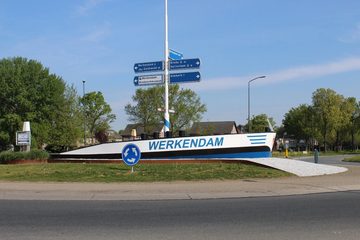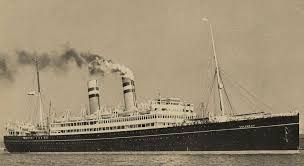
The SS Volendam played a pioneering role in post-war Dutch migration to Australia. Originally built for the Holland America Line’s transatlantic passenger service, she survived a torpedo attack during the Second World War, carried more than 100,000 Allied troops and was later adapted to transport emigrants.
In January 1949, Volendam brought one of the first large organised groups of post-war Dutch migrants to Australia. Her Australian voyages preceded the main migration services of ships such as Johan van Oldenbarnevelt, Waterman, Groote Beer and Zuiderkruis.
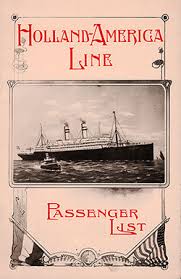
A Holland America Line passenger ship
Volendam was built for the Nederlandsch-Amerikaansche Stoomvaart Maatschappij, internationally known as the Holland America Line. She was constructed by Harland & Wolff at Govan, Glasgow, and launched on 6 July 1922.
Her maiden voyage began at Rotterdam on 4 November 1922. She called at Boulogne and Plymouth before crossing the Atlantic to Hoboken, New Jersey, the Holland America Line’s terminal opposite New York City.
As built, Volendam could accommodate approximately 900 passengers in first, second and third class. She and her sister ship Veendam operated principally between Rotterdam and New York, although Volendam was also employed on seasonal cruises.
During the 1920s and 1930s, her passenger accommodation was modified several times in response to changing travel patterns and the growing demand for less expensive tourist-class passages.
Refugee ship and torpedo attack
After the outbreak of the Second World War in September 1939, the neutral Netherlands continued operating passenger services across the Atlantic. The name VOLENDAM – HOLLAND and large Dutch flags were painted prominently on the ship’s hull to identify her nationality.
Following the German occupation of the Netherlands in May 1940, Volendam came under Allied control. She was used to evacuate refugees from Britain, including children sent overseas to escape German bombing.
On 30 August 1940, while carrying more than 300 children and other passengers to Canada, Volendam was attacked by the German submarine U-60 in the North Atlantic. One torpedo exploded against the ship and another became embedded in her bow without detonating.
The passengers were transferred to accompanying vessels and no lives were lost in the attack. However, during the evacuation, fourteen-year-old Robert Whyte was accidentally left aboard. He was found several hours later and rescued after the damaged ship had been taken under tow.
Volendam was beached in Scotland and subsequently repaired at Birkenhead.
Allied troopship
In 1941, Volendam returned to service as a troopship capable of carrying approximately 3,000 military personnel. During the following years, she sailed between Britain, North America, Africa, the Middle East and the Indian Ocean.
Her voyages included operations to Suez, South Africa, East Africa and Madagascar. By July 1945, she had transported more than 100,000 Allied troops.
Following the liberation of the Netherlands, Volendam returned to Rotterdam for the first time in more than five years. In 1946, the Dutch Government chartered her to transport Dutch troops to the Netherlands East Indies.
Conversion for emigrant transport
As the immediate requirement for military transportation declined, Volendam was adapted for another post-war task. Her accommodation was reorganised to carry emigrants in a single class, with capacity for approximately 1,500 to 1,680 passengers.
The facilities were more basic than those of her pre-war passenger service. Large dormitories and multiple-berth cabins allowed the ship to carry substantial numbers at relatively low cost.
Volendam was used on emigration voyages to several destinations. She carried Dutch emigrants to Australia and North America and also transported displaced people and other European migrants seeking new homes after the war.
Early Dutch migration to Australia
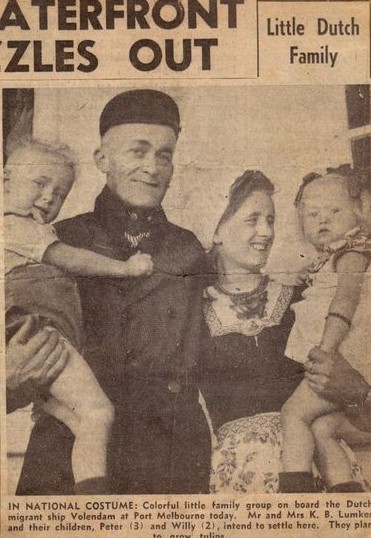
In February 1947, Volendam carried Dutch emigrants to Australia. Her most historically significant Australian voyage, however, began at Rotterdam in December 1948.
The ship reached Fremantle on 13 January 1949 with 1,552 passengers. Contemporary Australian reports stated that approximately 645 were Dutch migrants. This was described as the first mass arrival of Dutch migrants in post-war Australia.[1]
The passenger group included former Dutch servicemen selected for settlement in Australia. Other passengers were displaced people from different parts of Europe, British migrants and Australian women returning with Dutch husbands.
When Volendam reached Sydney on 24 January, approximately 450 Dutch migrants were reported aboard, together with around 500 displaced persons, 162 British migrants and 30 Australian women married to Dutch men.[2]
The arrival occurred before the Netherlands and Australia concluded their formal assisted-migration agreement in 1951. It therefore represents an important early stage in the development of organised Dutch migration to Australia.
Further Australian voyages
Volendam made additional voyages to Australia during 1949 and 1950. In January 1950, Australian newspapers recorded Dutch migrants disembarking at Fremantle and exchanging their Dutch money for Australian currency.[3]
On another voyage, she departed Rotterdam on 17 October 1950 and arrived in Sydney on 29 November, a journey of six weeks and one day. The passengers again included Dutch emigrants preparing to establish new lives in Australia.
The voyages generally included Fremantle, Melbourne and Sydney. From these ports, migrants continued to employment, private sponsors or reception centres in different parts of Australia.
For those aboard, the ship formed a temporary community between two countries. Families lived in shared cabins or dormitories, ate in communal dining rooms and spent several weeks adjusting to the reality that their departure from the Netherlands might be permanent.
Return to the Atlantic service
Although Volendam became important to the early Australian migration programme, Australia was only one part of her post-war service.
From June 1948, she operated between Rotterdam and Quebec. She also returned to the Rotterdam–New York route and carried large groups of American and Canadian students travelling to and from Europe.
The ship made other specialised voyages, including the transportation of Mennonite emigrants from Europe to South America. One settlement established in Paraguay was named Colonia Volendam in recognition of the vessel that carried its founders.
Withdrawal and demolition
By 1951, Volendam was approaching thirty years of service. Newer ships were entering the passenger and emigration trades, while maintaining and operating an older steamship had become increasingly uneconomic.
After completing her final Atlantic crossings, she was laid up in Rotterdam in November 1951. She was sold for demolition and broken up at Hendrik-Ido-Ambacht in 1952.
Although her post-war emigration career was relatively brief, Volendam occupies an important place in Dutch-Australian history. She helped establish the maritime connection that enabled large-scale Dutch migration before the bilateral assisted-migration agreement of 1951 and before the better-known emigration ships became regular visitors to Australian ports.
Related DACC articles
- Dutch emigration ships to Australia – Portal
- Dutch emigration ship Johan van Oldenbarnevelt
- Where to find shipping lists and passenger-arrival records
Sources
- Australian press report – Volendam brings the first mass arrival of Dutch migrants, January 1949
- Brisbane Telegraph – Arrival of Dutch migrants in Sydney, 24 January 1949
- The West Australian – Dutch migrants arriving at Fremantle, 20 January 1950
- National Archives of Australia – Records relating to Dutch migration held in Sydney