The history of Korevaar Marine Group in Australia began with the organised migration of Dutch dredging workers and their families from Sliedrecht in 1950. Among those families were Teunis Korevaar, his wife Annigje Visser and three of their sons.
Their story shows how the specialist maritime knowledge brought to Australia for a particular post-war development project became the foundation of a lasting Australian family enterprise.
A Sliedrecht maritime family
Teunis Korevaar was born in Sliedrecht on 17 July 1897. He worked as a stoker and marine engineer, occupations closely associated with the shipping, shipbuilding and dredging industries for which Sliedrecht and the surrounding region were renowned.
On 14 August 1920, he married Annigje Visser, who had been born in Sliedrecht on 8 July 1898. She was the daughter of Johannes Visser, a skipper, and Maria Hougee. Maritime work was therefore present on both sides of the family.
Teunis and Annigje had several children. Their sons included:
- Pieter Adrianus Korevaar, born on 20 February 1921;
- Johannes, known in Australia as John, born on 11 December 1926;
- Teunis Korevaar Jr, born on 25 October 1929; and
- Jan Korevaar, born on 1 March 1932.
Their daughter Maria remained in the Netherlands and later married Leendert van den Herik.
This family information was provided to the Dutch Australian Cultural Centre by Fred Stuy as part of the research undertaken in Sliedrecht into the families associated with the 1950 Australian dredging project (see below)
The family’s journey to Australia
On 22 June 1950, Teunis and Annigje travelled to Australia by KLM with their sons John, Teunis Jr and Jan. The surviving passenger and seating plan records the five members of the Korevaar family in seats F1 to F5.
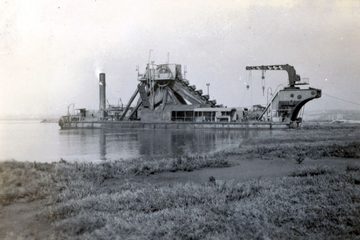
They were part of the organised migration of Dutch dredging workers and their families to Australia in 1950, associated with the establishment of Australian Dredging and General Works and its post-war dredging projects in Victoria.
The presence of Annigje and their three sons demonstrates that this was not simply the temporary dispatch of individual male workers. At least some participants migrated as complete families and were already contemplating the possibility of building longer-term lives in Australia.
Their eldest son, Pieter Adrianus Korevaar, later followed them to Australia with his wife, Grada Leenman, and their children. Pieter and his family subsequently became Australian citizens.
Teunis and Annigje remained in Victoria. Teunis died in Geelong on 21 December 1974. Annigje died there on 15 January 1993.
Establishing T. Korevaar & Sons
The Korevaar family carried its maritime and engineering experience into its new Australian life. In 1967, seventeen years after the family’s arrival, it established a marine business in Williamstown under the name T. Korevaar & Sons Pty Ltd.
The company name preserved the family character of the enterprise. The “T” referred to Teunis Korevaar, while his sons represented the next Australian generation of the family’s maritime tradition.
T. Korevaar & Sons became involved in towage, marine engineering, vessel construction, dredging support, salvage, survey work and other specialised maritime activities. Its establishment represented a direct continuation of the skills that had originally brought Teunis and his family from Sliedrecht to Australia.
The family’s maritime connections were later described as extending across more than five generations in the Netherlands and Australia.
Acquisition of Sprightly
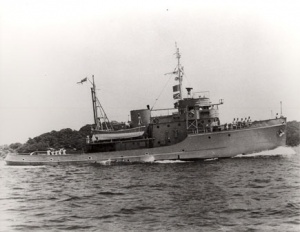
An important step in the company’s development came on 29 August 1969, when T. Korevaar & Sons purchased the former Royal Australian Navy salvage tug HMAS Sprightly for $65,150.
Built in the United States in 1942, Sprightly had served with the Commonwealth Salvage Board and the Royal Australian Navy. During the Second World War, it operated in northern Australian and New Guinea waters. It was later classified as a submarine rescue ship before being sold by the Navy.
Following its purchase, the vessel was registered in Melbourne to Pacific Towing Company, a Korevaar subsidiary.
The company originally intended to use Sprightly for towage. When insufficient towage work became available, the Korevaars successfully adapted the vessel for a succession of specialised assignments.
These included:
- meteorological work for Esso Exploration in Bass Strait;
- marine survey work around Tasmania for the Bureau of Mineral Resources;
- service as a standby vessel for helicopters supporting Shell’s offshore drilling operations;
- oceanographic and fisheries research for the CSIRO;
- marine surveys in Bass Strait and elsewhere;
- salvage and towing operations; and
- transporting dredged material from the Yarra River to disposal grounds in Port Phillip Bay.
Conversion into a research vessel
In 1973, Sprightly was extensively modified at the company’s Geelong workshops for use as a CSIRO research vessel.
The modifications included laboratories, additional working areas, specialised hydraulic winches, oceanographic equipment and improved accommodation for scientists and technicians. A bow thruster and further technical equipment were subsequently installed.
For approximately twelve years, Sprightly supported CSIRO fisheries and oceanographic research. Its assignments included research into the Western Australian crayfish industry, Gulf of Carpentaria prawns and coastal waters around New South Wales, Queensland and Victoria.
The vessel also participated in expeditions extending as far as Honiara and completed a research voyage around Australia in 1982.
After its CSIRO service ended in 1984, Sprightly continued to undertake marine survey, salvage and dredging-related work. In February 1987 it salvaged the trawler Cape Flinders from the beach at Jan Juc near Torquay.
It was also used to tow the hopper barge Big Yella, carrying material dredged from the Yarra River into Port Phillip Bay under a Korevaar contract with the Melbourne and Metropolitan Board of Works.
The Korevaars sold Sprightly in 1989 after almost twenty years of varied commercial and scientific service.
Vessel construction and marine services
T. Korevaar & Sons also developed vessel-building and engineering capabilities. The tug Sea Horse, built at Geelong in 1982, is among the vessels attributed to the company.
Over time, the business developed into Korevaar Marine Group. It provided towage, bunker-barge, vessel-support and other marine services from its base in Williamstown, with later operations extending to Brisbane.
In 2009, Korevaar Marine Group entered into an arrangement with Caltex Australia involving the double-hulled, self-propelled bunker barge Bunker V. The vessel supplied fuel to cruise ships and international cargo vessels operating on the Brisbane River.
The company’s Williamstown head office was located at 127 Nelson Place, with a workshop in Albemarle Street. Its continuing presence in Williamstown placed the family business within the same maritime community in which the Korevaars had first established themselves following their arrival in 1950.

John Korevaar and the family legacy
Johannes “John” Korevaar was 23 years old when he travelled to Australia with his parents and brothers in June 1950. He became an important figure in the family company and in Williamstown’s maritime community.
John married Patricia, and the couple had six children: Anita, Peiter, Julie, Vicki, Craig and Michelle. He died peacefully on 26 September 2019 at the age of 92.
Following his death, employees and crews of Korevaar Marine Group in Melbourne and Brisbane joined his family in mourning him.
John’s contribution is also commemorated at Seaworks in Williamstown. A massive ship’s anchor donated by Korevaar Marine Group was installed there as a memorial to John and as a tribute to Williamstown’s maritime heritage. The anchor symbolises both the family’s long association with the sea and its contribution to the local community.
From migrant skills to an Australian enterprise
The Korevaar family story adds an important dimension to the history of the Sliedrecht-Williamstown dredging migration.
Teunis Korevaar arrived in Australia as part of a Dutch dredging project, bringing with him the maritime and engineering skills developed in Sliedrecht. These skills became part of a family tradition that contributed to the establishment of a successful Australian maritime business.
Within seventeen years of arriving in Australia, the family had established T. Korevaar & Sons. The business subsequently expanded from its original marine and engineering activities into towage, vessel construction, dredging support, scientific research operations and marine bunkering.
The development from Dutch dredging migrants to Korevaar Marine Group demonstrates how the organised migration of 1950 contributed not only to particular Australian infrastructure projects but also to the longer-term development of Australia’s maritime industries.
Sources and further reading
- Family and genealogical information supplied by Fred Stuy, Sliedrecht (below)
- From Sliedrecht to Williamstown: Dutch dredging workers in post-war Australia
- HMAS Sprightly – Sea Power Centre Australia
- The Big Korevaar Anchor – Seaworks Williamstown
- Anchor makes a statement at Williamstown
- Korevaar Marine Group – Australian Business Register
- Caltex reaches bunkering agreement with Korevaar Marine
- Johannes “John” Korevaar funeral notice
The original Dutch family account as supplied by Fred Stuy