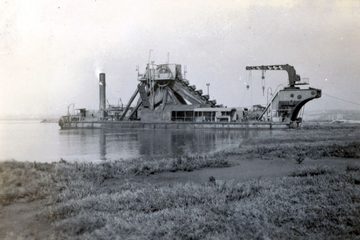
The development of Kwinana as one of Western Australia’s principal industrial centres depended on the creation of deep-water access for large ocean-going ships. A major part of this work was entrusted to the Dutch dredging contractor Hollandsche Aanneming Maatschappij, generally known as HAM.
The Kwinana undertaking was separate from the work of Australian Dredging and General Works, the Dutch-Australian company established at Williamstown in 1950. Together, however, the two enterprises demonstrate the significant contribution made by Dutch dredging companies to Australia’s post-war industrial development.
From shipwreck to industrial centre
Kwinana takes its name from the steamship Kwinana, which was driven ashore during a storm in 1922. The wreck became a local landmark and the surrounding area became known as Kwinana Beach. The name was officially adopted for the township in 1937.
Three decades after the wreck came ashore, the relatively undeveloped coastal area was selected for one of Western Australia’s most important post-war industrial projects.
In 1952, the Western Australian Government reached an agreement with the Anglo-Iranian Oil Company—later renamed British Petroleum—to construct a major oil refinery at Kwinana. The refinery required reliable access for large tankers, but sandbanks restricted navigation into Cockburn Sound.
Creating an adequate shipping channel therefore became an essential part of the entire industrial development.
A £2 million contract for a Dutch company
The initial dredging contract, valued at approximately £2 million, was awarded in 1952 to the Hollandsche Aanneming Maatschappij.
The work involved dredging a channel through the Success and Parmelia banks, which lay across the approaches to Cockburn Sound. Contemporary accounts described a channel approximately 152 metres wide and 11.5 metres deep.
Around seven million cubic yards—approximately 5.4 million cubic metres—of material had to be removed. The new channel would provide access for vessels of approximately 40,000 tons, including the tankers required to supply and service the refinery.
The size of the contract illustrates the importance placed on the project. Dredging was not a secondary addition to the refinery development: without deep-water access, Kwinana could not fulfil its intended role as a major port and industrial centre.
Hollandsche Aanneming Maatschappij
HAM was one of the Netherlands’ major international dredging and marine-construction companies.
The company was founded in 1909 and became involved in harbour construction, land reclamation and dredging projects in many parts of the world. Its work drew upon the extensive Dutch experience of managing waterways, constructing ports and reclaiming land.
By the middle of the twentieth century, Dutch dredging contractors possessed not only specialised vessels but also the organisational capacity to move equipment, engineers and crews between countries. Large projects such as Kwinana required hydrographic knowledge, powerful dredging machinery, logistical planning and the ability to operate far from the company’s Dutch base.
HAM was separate from Adriaan Volker and Van Hattum en Blankevoort, the two companies that had established Australian Dredging and General Works in Williamstown. The simultaneous presence of these businesses shows that Dutch participation in Australian dredging was broader than the activities of a single company.
Building the maritime gateway to Kwinana
The dredging works opened Cockburn Sound to much larger vessels and helped create the maritime gateway required by the new refinery.
The refinery formed the nucleus of a much wider industrial area. Other enterprises subsequently established operations at Kwinana, taking advantage of its port access, available land, energy supplies and proximity to Perth and Fremantle.
Later facilities included bulk-cargo terminals, chemical plants, steel-related industries, grain-handling infrastructure and other major industrial operations. The dredged approaches were therefore important not only to the original oil refinery but also to Kwinana’s longer-term development.
The project demonstrates how hydraulic engineering could determine the location and viability of industrial expansion. By altering the navigable approaches to Cockburn Sound, the dredging works helped transform an exposed coastal district into one of Western Australia’s most important industrial and maritime precincts.
Reported in the Netherlands
Dutch newspapers followed the progress of the project.
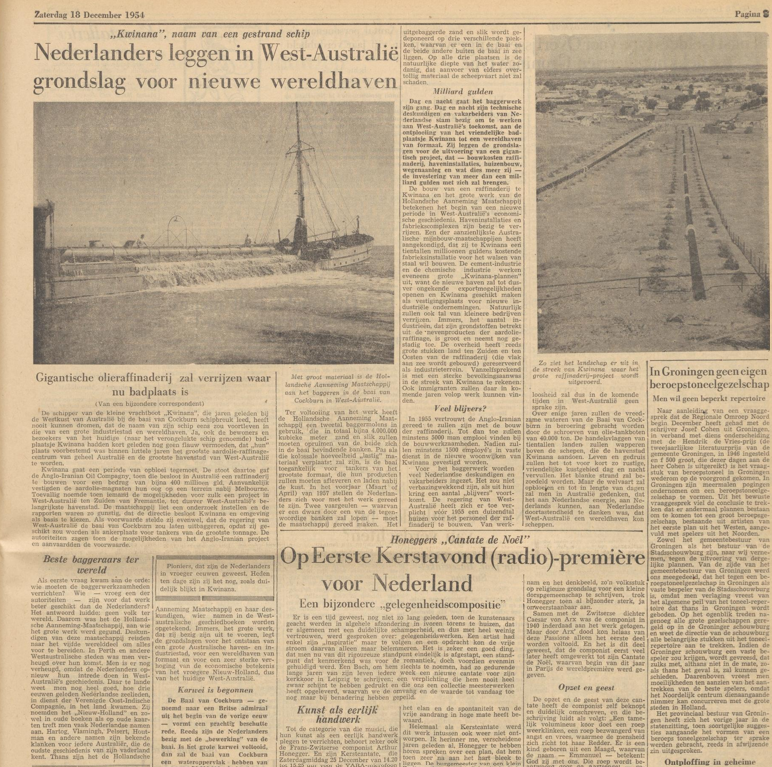
An article published on 18 December 1954 described how Dutch engineers were helping to lay the foundations for a new world port in Western Australia. Its headline drew attention to the unusual origin of the name Kwinana, linking the industrial project with the ship wrecked there more than 30 years earlier.
The report presented the project as an example of Dutch technical expertise being applied abroad. For readers in the Netherlands, it demonstrated the international reach of the country’s dredging industry during the post-war period.
Such reports are valuable historical records. They provide information about the machinery, companies and engineering works, but also show how Dutch business achievements in Australia were presented to the Dutch public.
The original clipping is included in the DACC’s collection of contemporary reports associated with Dutch dredging and migration.
Part of a wider Dutch contribution
The Kwinana works formed part of a wider period of Dutch dredging activity in Australia.
In Victoria, Australian Dredging and General Works established an operating base at Williamstown and brought equipment, workers and their families from the Netherlands. The company undertook dredging and marine-construction work in several parts of Australia.
In Western Australia, HAM carried out the major channel works associated with Kwinana and Cockburn Sound.
These were independent companies and should not be confused. Nevertheless, both drew upon the same broader Dutch tradition of hydraulic engineering. Their Australian activities occurred at a time when governments were expanding ports, developing heavy industry and seeking overseas expertise to overcome shortages of specialist equipment and skilled labour.
From HAM to Van Oord
HAM’s name later disappeared through a series of corporate mergers, but its dredging expertise continued within successor companies.
In 2001, HAM and the dredging division of Ballast Nedam were combined to form Ballast HAM Dredging. In 2003, Ballast HAM Dredging merged with Van Oord ACZ. The combined business continued under the Van Oord name.
This places HAM within the corporate heritage of the modern Dutch marine contractor Van Oord, which has itself undertaken major projects in Australia, including work associated with Brisbane Airport, the Port of Gladstone and offshore energy infrastructure.
The corporate connection does not mean that modern Van Oord was the company originally awarded the Kwinana contract. Rather, HAM’s organisation, experience and historical records became part of the larger business assembled through the later mergers.
Read more: Van Oord’s Dutch engineering legacy in Australia
An important Dutch-Australian business story
The Kwinana project deserves recognition as an important episode in Dutch-Australian business history.
Dutch engineers and dredging crews did not merely maintain an existing harbour. Their work helped create the deep-water access upon which a new industrial centre depended. The contract linked Dutch maritime expertise with Western Australia’s ambitions for post-war economic and industrial development.
It also complements the story of the Dutch dredging workers who arrived in Melbourne in 1950. While the Williamstown history reveals the close relationship between industrial recruitment and migration, Kwinana demonstrates the wider commercial reach of the Netherlands’ international dredging industry.
Together, these stories show that the Dutch contribution to Australia’s maritime development consisted of companies, vessels, engineering expertise and people.
For the wider history and related company, project and personal stories, see the Dutch dredging in Australia – Research Portal.
Sources
- City of Kwinana – History and Heritage
- City of Kwinana – Centenary of the SS Kwinana coming to rest on local shores
- Western Australian Government – Oil Refinery (Kwinana) Agreement Act 1952
- The West Australian – “Dredging Job Interests Many Firms”, 21 May 1952
- The West Australian – “Six Firms Bid for Dredging at Refinery”, 2 June 1952
- The West Australian – “A £2,000,000 Contract Let: Dredging for Kwinana”, 1952
- The West Australian – “Two Dredges for Contract in Sound”, 3 October 1952
- The Argus – “First tanker at Kwinana”, 8 January 1955
- DACC – Contemporary newspaper reports on the Sliedrecht–Williamstown dredging migration, 1950–1954
- Royal BAM Group – “Ballast HAM Dredging and Van Oord ACZ to merge”, 3 October 2003
- Van Oord – Breaking New Ground: a history of Van Oord and its predecessors