Part 2 of a four-part series examining the growth of relations between Australia and the Netherlands East Indies immediately before the Japanese invasion.
The first article in this series described how Australia and the Netherlands East Indies gradually moved beyond their previously limited official relationship. By 1941, the need for closer contact had become urgent. Australian ministers, military officers, technical specialists and journalists travelled to the NEI to investigate its defences, establish liaison arrangements and improve Australian understanding of its northern neighbour.
These missions were driven principally by Australia’s growing fear of Japanese expansion. However, they also reflected Australia’s attempt to develop more direct regional relationships instead of relying almost entirely on British diplomatic and defence arrangements.
The results were substantial. Within a few months, Australian and Dutch officers were sharing naval information, inspecting military facilities, preparing airfields and arranging for Australian forces to reinforce Ambon and Timor. Australian journalists were also invited to inspect the NEI’s preparations and explain their significance to the Australian public.
The cooperation remained incomplete and sometimes difficult, but it represented a remarkable change from the situation only a year earlier.
From secret contacts to direct discussions
The Australian missions of 1941 built on secret negotiations that had begun before the German occupation of the Netherlands.
In December 1939, Australian Minister for Supply and Development Richard Casey and Controller-General of Munitions Supply Norman Brodribb stopped at Surabaya while returning from London. They met Dutch Army officers to discuss the possible supply of Australian ammunition to the NEI.
Following Germany’s occupation of the Netherlands in May 1940, the NEI’s need for alternative sources of military equipment became more urgent. A three-man KNIL commission travelled to Australia in October 1940. Publicly described as an “Industrial Research Commission”, it inspected 65 Australian weapons and munitions factories as well as military installations and testing grounds.
The mission provided Australian officials with information about NEI military requirements and gave Dutch officers an understanding of Australia’s expanding industrial capacity. Australia agreed to provide five million rounds of small-arms ammunition, although shortages prevented it from meeting many of the larger Dutch requests.[1]
By the end of 1940, liaison arrangements had also begun. Commander G.B. Salm was appointed as the Dutch naval liaison officer in Australia, while Commander V.E. Kennedy of the Royal Australian Navy was appointed to Batavia.
These arrangements created the foundation for the more direct Australian missions of 1941.
Percy Spender opens the way
On 12 January 1941, Australian Minister for the Army Percy Spender met Governor-General A.W.L. Tjarda van Starkenborgh Stachouwer in Batavia. Spender obtained the Governor-General’s agreement to direct staff talks between Australian and Dutch military representatives.
This was an important development. Australia wanted to discuss the defence of the NEI directly with the authorities responsible for the territory rather than relying solely on discussions conducted through Britain or the Netherlands Government-in-Exile in London.
The Australian Government acted quickly. On 22 January, Prime Minister Robert Menzies accepted a Dutch invitation to send a military delegation to Batavia.
The delegation consisted of:
- Wing Commander W.L. Hely and Squadron Leader H.W. Berry of the Royal Australian Air Force
- Commander V.E. Kennedy of the Royal Australian Navy
- R.H. Doyle, Controller of Production in the Department of Munitions
On 11 and 12 February, the Australians met officers of the Royal Netherlands Navy and the Royal Netherlands East Indies Army—KNIL—in Batavia. The inclusion of Doyle demonstrated that the talks were not confined to strategy. The ability to provide weapons, ammunition and industrial support was an essential part of the developing relationship.[2]
Sharing operational information
The February discussions produced practical agreements. Australian and Dutch naval authorities agreed to exchange information about the movements of ships entering and leaving the NEI and Australian operational areas.
The Dutch also provided information about minefields and discussed the rerouting of shipping between the NEI and the west coast of the United States through Torres Strait. Plans were considered for expanding Tjilatjap, on Java’s south coast, so that the harbour could handle more freight.
Commander Kennedy described the meetings as open and cordial. He was surprised to discover that some informal operational cooperation was already occurring. British naval authorities had been sharing the movements of Australian warships with their Dutch counterparts, even though this level of cooperation had not been formally authorised by all the governments involved.
This demonstrated that military officers in the region were sometimes establishing working relationships faster than their governments could develop the necessary diplomatic arrangements.
Menzies meets the Governor-General
Australia’s developing aviation connections also facilitated political contact. The Qantas service between Sydney and London stopped at Batavia, allowing Australian ministers and officials travelling to Europe to meet NEI authorities along the way.
On 28 January 1941, Prime Minister Robert Menzies met Governor-General Tjarda van Starkenborgh during his journey to Britain. According to the Governor-General’s report to the Netherlands Minister for the Colonies, Menzies indicated that Australia would be prepared to go to war if Japan attacked Dutch territory. He was also willing to discuss the possible stationing of an Australian division on Java.
Menzies subsequently raised the strategic importance of the NEI during meetings in London. He asked British officials whether they considered the integrity of the NEI sufficiently important to justify war with Japan.
The response exposed a fundamental difference between Australian and British priorities. Australia regarded the islands to its north as essential to its own security. British strategy remained concentrated on defeating Germany and defending Singapore, and British authorities were unwilling to guarantee the territorial integrity of the entire NEI.
Australia was therefore trying to build a more direct relationship with Batavia while still operating within the wider system of British imperial defence.
Ambon, Timor and Australia’s northern defence
After their meetings in Batavia, the Australian delegation continued to Singapore for wider talks involving British, Dutch, Australian and American representatives.
These discussions produced plans for the defence of the eastern NEI. Australia agreed to provide forces for Ambon and Dutch Timor if war broke out in the Pacific. Australian air units based around Darwin would use prepared airfields at Ambon and Koepang, while Australian Army units would reinforce the Dutch garrisons.
The Australian Government subsequently proposed forces of approximately 1,200 troops for Ambon and a similar number for Koepang. Australia also began sending bombs, ammunition, fuel, vehicles, communications equipment and general military stores to the two locations.[3]
In May 1941, six Dutch military aircraft arrived in Darwin and returned to Koepang with an Australian reconnaissance party. It included Brigadier Edmund Lind, commander of the Australian 23rd Brigade, and the officers selected to command the battalions intended for Ambon and Timor.
The visits allowed Australian officers to inspect the terrain, airfields, port facilities and military preparations in the areas they might soon be required to defend. Small Australian maintenance parties were subsequently sent to Ambon and Koepang to look after equipment stored there.
The importance of this activity was recognised by the KNIL Chief of Staff. In May 1941, he observed that Ambon and Timor had seen more Australians during the preceding weeks than during the previous hundred years.[4]
Political caution delays deployment
Although the military planning became increasingly detailed, political restrictions continued to limit what could be done.
Australia wanted to send larger advance parties to Ambon and Koepang before hostilities began. This would give the troops time to become familiar with the terrain, equipment and Dutch command arrangements. The NEI authorities were reluctant to allow a visible Australian military presence while they were not at war with Japan.
Australia also had to work through Britain on matters that might affect wider imperial policy. Britain was unwilling to provide the Netherlands with a formal guarantee that it would defend the entire NEI against attack. This complicated Australia’s efforts to persuade the Dutch to accept Australian troops in advance.
The political sensitivity produced unusual compromises. Some Australians working with equipment in the NEI initially operated in secrecy wearing civilian clothing and were described as technical or factory personnel. The fiction allowed preparations to proceed without openly stationing Australian forces on Dutch territory.
By October 1941, larger Australian maintenance parties were finally approved. Full combat forces, however, would not move to Ambon and Timor until war had begun.
Harry Foll and the Australian press mission
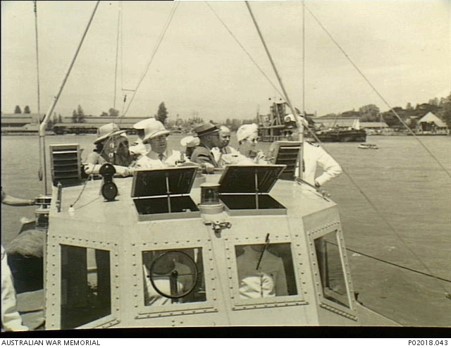
Military officers were not the only Australian visitors. In August 1941, Minister for Information Senator Harry Foll led a party of Australian journalists on a fact-finding tour of the Netherlands East Indies and Malaya.
The purpose was to show Australian media representatives the region’s military preparations so that they could explain them to Australian readers. The mission visited Dutch defence facilities, including Surabaya, where Foll and the journalists inspected a motor torpedo boat in the harbour.[5]
This was an exercise in public information and regional diplomacy. The Australian Government recognised that closer military cooperation required greater public awareness of the NEI and its importance to Australia. For many Australians, the archipelago remained a relatively unfamiliar European colony rather than a neighbouring society whose fate was directly connected to Australian security.
The journalists’ mission also had a reciprocal dimension. In October, an eleven-member Netherlands East Indies Press Delegation led by Charles van der Plas toured Australia (see next article). It inspected Australian military bases, munitions factories and industrial facilities. That return visit, including the delegation’s stay in Brisbane, is the subject of the next article in this series.
From visits to operational cooperation
By the second half of 1941, the relationship had progressed well beyond ceremonial goodwill. Australian and Dutch officers were sharing information and visiting each other’s military establishments. Equipment was being positioned in the eastern NEI, liaison officers were operating openly, and Dutch ships and aircraft were using Australian facilities.
In Australia’s assessment, the NEI formed part of what was increasingly described as the “Malay Barrier”—the chain of islands separating Australia from Japanese-controlled or threatened territory farther north. Ambon and Timor were not viewed as distant Dutch colonial outposts. They had become forward positions in Australia’s own defence.
Nevertheless, serious weaknesses remained. The Netherlands Government-in-Exile, the Governor-General in Batavia, the British Government and the Australian Government did not always share the same priorities. Britain remained unwilling to guarantee the NEI, while Dutch authorities feared that the premature arrival of Australian troops might provoke Japan or expose their inability to defend the colony independently. They wanted to keep their military relationship with Australia as secret as possible.
Australia itself also lacked sufficient forces and equipment to carry out all the plans being discussed.
Cooperation overtaken by war
Despite these limitations, a significant framework for cooperation had been established before Japan entered the war.
On 5 December 1941, the NEI Government asked Australia to send aircraft to Ambon and Timor. The Australian War Cabinet approved the request. At dawn on 7 December 1941, before Japan’s attacks brought the Pacific War to Australia, RAAF Hudson bombers flew to Ambon and Koepang as part of the preparations already agreed with the Dutch authorities.
Australian troops followed. Gull Force was sent to Ambon and Sparrow Force to Timor, where stores and heavy equipment had already been positioned.
The political and military missions of 1941 had therefore produced more than reports and goodwill. They had established personal contacts, communications, supply arrangements and operational plans that could be activated when war arrived.
They had not, however, created sufficient power to stop the Japanese advance. The preparations begun during these visits would soon be tested under the most difficult possible conditions.
Sources
- Herman Theodore Bussemaker, “Australian-Dutch defence cooperation, 1940–1941”, Australian War Memorial, sections 3–4.
- Bussemaker, “Australian-Dutch defence cooperation”, section 5; Jack M. Ford, Allies in a Bind: Australia and the Netherlands East Indies in the Second World War, University of Queensland.
- Australian Government, Department of Foreign Affairs and Trade, Commonwealth Government to Lord Cranborne, 27 March 1941; Lionel Wigmore, Australia in the War of 1939–1945: The Japanese Thrust, including “The Loss of Ambon”.
- Bussemaker, “Australian-Dutch defence cooperation”, sections 5–6.
- Australian War Memorial, “Sourabaya, Java, Netherlands East Indies, August 1941”; “Senator Foll and editors leave for tour of East Indies”; Daily Telegraph, “Newspapermen to Visit Dutch East Indies”, 30 July 1941, available through Trove.
Four part series
This four-part series examines how Australia and the Netherlands East Indies moved from limited contact towards direct diplomatic, military, public and economic cooperation immediately before the Pacific War.
- From distant neighbours to regional partners: Australia and the Netherlands East Indies before the Pacific War
An introduction to the previously limited relationship and the growing connections through diplomacy, trade, aviation and shared strategic concerns. - Australia looks north: Australian missions to the Netherlands East Indies in 1941
Australian ministers, military officers and journalists travelled to the NEI as both neighbours developed direct defence planning and greater public awareness of their shared interests. - Australia and the Netherlands East Indies on the eve of war: the 1941 Press Delegation
Led by Charles van der Plas, the diverse NEI delegation toured Australian military establishments and industries only two months before Japan entered the war. - Trade, resources and the final mission before war: the NEI Economic Mission to Australia, 1941
The November mission sought increased Australian supplies and permanent purchasing arrangements, but its plans were overtaken within weeks by the outbreak of the Pacific War and the invasion of the NEI.
Related DACC series
A three-part series examining constitutional authority in London and the development of the Netherlands East Indies administration in wartime Australia.
This six-part series continues the story by examining how the displaced Netherlands East Indies administration was reconstructed in Australia, how it worked with Australia and the Allied command, and how wartime cooperation was affected by the political transformation of Indonesia after 1945.
Dutch–Australian wartime cooperation
This six-part thematic series explores particular political, administrative and practical issues within the wartime relationship, including neutrality, tensions between London and the Indies administration, constitutional reform, Indonesian voices, wartime purchasing and the development of Dutch–Australian diplomatic relations.