Dutch soldiers in British service
The Napoleonic Wars (1803–1815) created unexpected connections between the Netherlands, Britain and territories across the world. One intriguing but largely unexplored question is whether Dutch soldiers who entered British military service during this period subsequently found their way to colonial Australia.
An interesting starting point is the York Light Infantry Volunteers, a British Army regiment formed in 1803 as the Barbados Volunteer Emigrants. Its original recruits included prisoners of war captured during British operations against the Dutch colonies of Demerara, Essequibo and Berbice in South America.
Following the British capture of Surinam in 1804, further Dutch colonial military personnel joined British forces. According to an account published in the Journal of the Royal Artillery in April 1951, 603 soldiers and non-commissioned officers joined the York Light Infantry Volunteers, while another 74 entered the Royal Artillery and Royal Military Artificers.
These figures demonstrate the considerable involvement of soldiers from Dutch colonial forces in British military operations during the Napoleonic period. However, service in a Dutch colonial garrison does not necessarily establish that every recruit was born in the Netherlands.
Lieutenant Jonathan Warner and the Great North Road
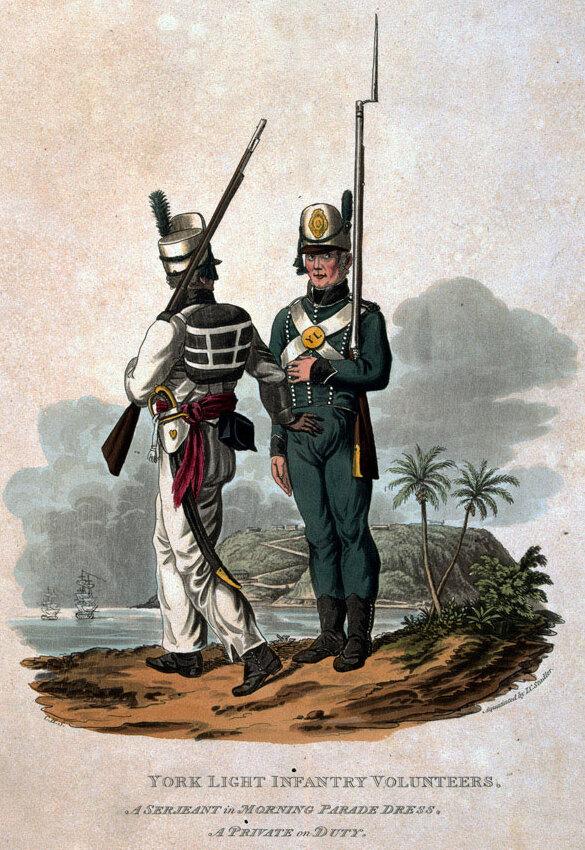
One officer of the York Light Infantry Volunteers was Lieutenant Jonathan Warner (born circa 1785–1786), who joined the regiment as an ensign in 1808.
The regiment served in the Caribbean during the Napoleonic Wars, participating in British military campaigns against French possessions, including Martinique and Guadeloupe. It was disbanded in Britain in March 1817.
Warner subsequently joined the New South Wales Royal Veteran Corps and arrived in Sydney aboard the Orpheus in September 1826.
He was later appointed an Assistant Surveyor and became involved in supervising convict labour during construction of the Great North Road, particularly around Wisemans Ferry.
The Great North Road, constructed between 1825 and 1836, was one of colonial Australia’s major engineering undertakings. Built largely by convict labour, it connected Sydney with the Hunter Valley and remains an important example of early colonial infrastructure.
Warner’s career therefore provides an indirect connection between a British military regiment with Dutch colonial origins and the development of colonial Australia.
There is, however, no evidence that Dutch soldiers from the York Light Infantry Volunteers accompanied him to Australia.
Another Napoleonic connection: Sir Thomas Mitchell and the Prince of Orange
The Great North Road also has a more direct historical connection with the Netherlands through Sir Thomas Mitchell, who became Surveyor General of New South Wales in 1828.
Mitchell had served during the Napoleonic Wars and was acquainted with the Prince of Orange, the future King Willem II of the Netherlands.
Their association later found an enduring Australian expression in the naming of Orange in New South Wales.
The Dutch Australian Cultural Centre has documented this connection separately in its article:
Prince of Orange honoured in Orange.
Mitchell also played an important role in surveying and planning sections of the Great North Road. His association with the Prince of Orange and Warner’s service in the York Light Infantry Volunteers therefore provide two distinct links between the Napoleonic period and early Australian colonial development.
Did Dutch Napoleonic veterans settle in Australia?
A broader question remains unanswered.
Following the Napoleonic Wars, many former British soldiers emigrated to Australia’s colonies, while others arrived as members of military garrisons or, in some cases, as transported convicts.
Some British regiments had previously served Dutch colonial authorities or incorporated soldiers recruited from Dutch military forces.
For example, the Regiment de Meuron, originally a Swiss regiment employed by the Dutch East India Company, transferred to British service in 1795. A former soldier of that regiment, Jean Pierre Meunier, arrived in Sydney as a convict in 1815. Although Meunier was French rather than Dutch, his story demonstrates how military careers spanning different European colonial powers could eventually lead to Australia.
Whether any of the hundreds of soldiers recruited from Dutch colonial forces into the York Light Infantry Volunteers or other British units subsequently settled in Australia remains unknown.
British Army muster rolls, discharge papers and regimental description books may provide answers, particularly when compared with Australian colonial immigration, military and convict records.
An invitation for further research
The connections identified here do not establish a direct Dutch contribution to the construction of the Great North Road. They do, however, illustrate how the Napoleonic Wars brought Dutch and British military histories together, with possible consequences for early Australian settlement.
The Dutch Australian Cultural Centre welcomes contributions from military historians, genealogists and family researchers who may have information about Dutch-born soldiers who served in British forces during the Napoleonic Wars and later migrated to Australia.
Such research could reveal a largely overlooked chapter in the earliest history of Dutch connections with Australia.
Sources and further reading
- Journal of the Royal Artillery, April 1951, pp. 134–135, “The Royal Artillery at Surinam 1804”. Read the journal.
- National Army Museum, London. Historical collection relating to the York Light Infantry Volunteers, including an illustration dated 1812.
- UK National Archives. War Office series WO 12 (muster rolls and pay lists), WO 25 (description books) and WO 97 (soldiers’ discharge documents). National Archives research catalogue.
- Christine Wright, ‘Really respectable settlers’: Peninsular War veterans in the Australian colonies, 1820s and 1830s, Australian National University, 2005.
- Australian Government, Australian Convict Sites World Heritage documentation, Great North Road.
- Dutch Australian Cultural Centre, Prince of Orange honoured in Orange.