When the Japanese advance through Southeast Asia and the Pacific forced Allied governments, military personnel and intelligence organisations back to Australia in early 1942, Australia became much more than a military base.
It also became a major centre of the Allied intelligence war against Japan.
Australian, American, British, Dutch and Indonesian personnel became involved in an extraordinary collection of intelligence, codebreaking, propaganda and special-operations organisations. Some intercepted Japanese communications. Others gathered intelligence from occupied territory, organised clandestine missions, conducted psychological warfare or maintained networks of agents and coastwatchers behind Japanese lines.
The Netherlands Forces Intelligence Service (NEFIS), created in Australia following the fall of the Netherlands East Indies, became part of this much larger intelligence environment.
Understanding that environment is important because NEFIS did not operate in isolation. Its Dutch and Indonesian personnel depended upon Allied aircraft, submarines, communications, training facilities and operational support. At the same time, the Allies needed the languages, geographical knowledge, local networks and detailed understanding of the Netherlands East Indies that Dutch and Indonesian personnel could provide.
The result was extensive cooperation, but also rivalry, duplication and disagreement over who should control intelligence operations.
An intelligence world converges on Australia
The rapid Japanese victories of 1941–42 created an enormous intelligence problem.
Large areas of Southeast Asia and the Pacific had fallen under Japanese occupation. Established intelligence networks had disappeared or been disrupted, while Allied commanders urgently needed information about Japanese forces, shipping, airfields, communications and defences.
Australia consequently became a base from which new intelligence organisations and networks were established or reorganised.
General Douglas MacArthur arrived in Australia in March 1942 and initially established his headquarters in Melbourne. His General Headquarters, Southwest Pacific Area (GHQ SWPA), moved to Brisbane in the second half of July.
Intelligence and special-operations organisations also increasingly concentrated their activities in Australia and, particularly, Brisbane.
The resulting system was complicated because there was no single organisation responsible for everything.
The Allied Intelligence Bureau
One attempt to coordinate this increasingly crowded intelligence world was the Allied Intelligence Bureau (AIB), established in 1942.
AIB brought several forms of clandestine intelligence, special operations and propaganda within a broader coordinating structure. Its activities included gathering information from Japanese-occupied territories, supporting guerrilla and resistance operations, sabotage and psychological warfare.
But the organisations operating within and alongside this system retained different functions, command structures and national connections.
This distinction is important.
Terms such as AIB, SRD, SIA, Z Special Unit, Coastwatchers and Central Bureau are sometimes used rather loosely in popular histories of Australia’s secret war. They were not different names for the same organisation.
Special operations and clandestine intelligence
Special Operations Australia and its successors developed capabilities for reconnaissance, sabotage, guerrilla warfare and clandestine operations behind Japanese lines.
The Inter-Allied Services Department (ISD) brought together personnel from several Allied countries. Within it, a Netherlands East Indies Section involved Australian, Dutch and Indonesian personnel in attempts to penetrate Japanese-occupied parts of the NEI.
Following organisational changes, much of Australia’s special-operations work eventually came under the Services Reconnaissance Department (SRD).
Z Special Unit became closely associated with these clandestine operations. Its personnel were trained to enter enemy-held territory by submarine, aircraft, small craft or other means to gather intelligence and undertake special missions.
Dutch and Indonesian personnel participated in this world from an early stage.
Their involvement eventually developed into a more distinct Dutch operational capability through NEFIS.
British secret intelligence
Another organisation operating from Australia was Secret Intelligence Australia (SIA).
Despite its name, SIA should not be confused with a later Australian intelligence service. It was a wartime organisation connected with Britain’s Secret Intelligence Service, MI6.
Its role and command arrangements differed from those of the Australian special-operations organisations.
SIA therefore represents another strand in the complicated Allied intelligence environment: British secret intelligence operating from Australia while maintaining its own international connections and priorities.
Propaganda and psychological warfare
The Far Eastern Liaison Office (FELO) performed yet another function.
Rather than primarily sending intelligence parties behind enemy lines, FELO concentrated on propaganda and psychological warfare.
It prepared and distributed material intended to undermine Japanese morale and influence populations throughout the region.
Dutch and NEI expertise was again relevant because language and cultural knowledge were essential to effective propaganda directed towards the Netherlands East Indies.
Coastwatchers
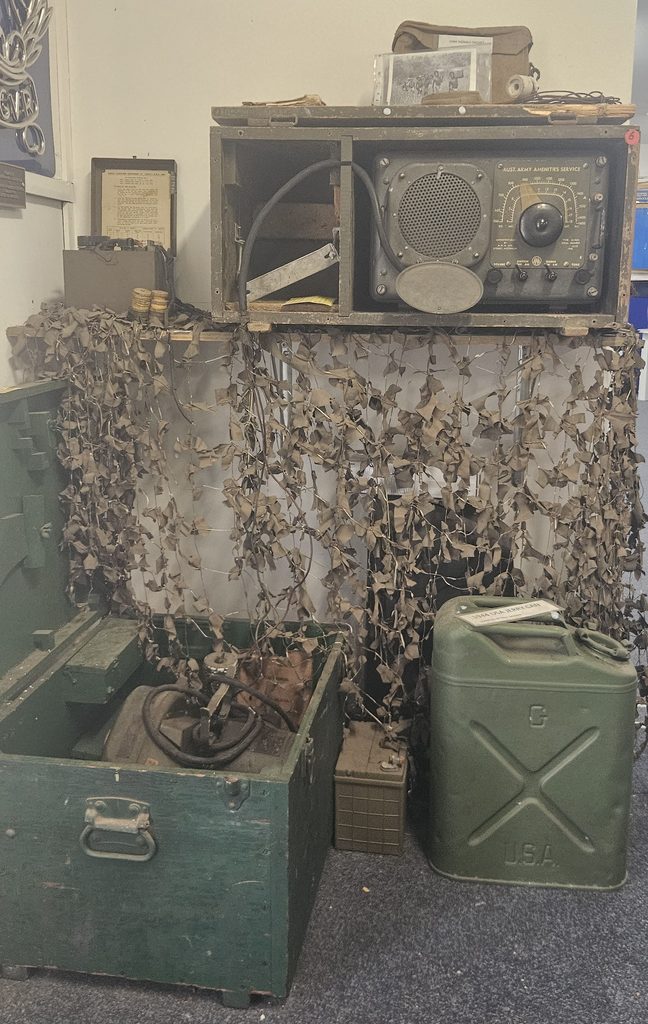
The Coastwatchers formed another important intelligence network.
Operating from remote islands and occupied territory, coastwatchers reported Japanese aircraft, shipping and troop movements by radio.
Their work became particularly important during the campaigns in New Guinea and the Solomon Islands.
Although their operations sometimes intersected geographically with clandestine parties and special-operations organisations, coastwatching was a distinct intelligence activity and should not simply be grouped together with NEFIS or Z Special Unit.
A separate codebreaking war
Some of the most important intelligence organisations in Australia were engaged in an entirely different kind of secret war.
Central Bureau and the Fleet Radio Unit Melbourne (FRUMEL) intercepted and analysed Japanese communications.
Central Bureau was a combined Australian-American signals-intelligence organisation supporting MacArthur’s command. Established in Melbourne in 1942, it moved to Brisbane later that year and operated from Nyrambla at Ascot.
FRUMEL concentrated particularly on Japanese naval communications.
These organisations intercepted radio traffic, analysed communications patterns and broke Japanese codes and ciphers.
Their work was fundamentally different from sending NEFIS or SRD agents into occupied territory. Nevertheless, all formed part of the much wider intelligence effort supporting Allied operations against Japan.
NEFIS brings something different
Within this crowded intelligence environment, NEFIS possessed a particular advantage.
It knew the Netherlands East Indies.
Following the Japanese conquest, Dutch military and intelligence personnel who reached Australia began reconstructing an intelligence capability from exile. NEFIS was established in Melbourne soon after the fall of the NEI and eventually developed into a substantial organisation.
Its personnel included both Dutch and Indonesian members with knowledge of the languages, geography, administration, communities, shipping, communications and economic infrastructure of the archipelago.
That expertise was difficult for the other Allies to reproduce.
NEFIS gathered and analysed military, political and economic information, interrogated refugees and people arriving from occupied territory, prepared maps and reports, and eventually developed its own secret-intelligence and special-operations capability.
Its clandestine operations were only one part of a much broader intelligence function.
Cooperation did not mean common control
The need to cooperate was obvious, but deciding who should control intelligence concerning the Netherlands East Indies was more difficult.
Allied commanders wanted intelligence relevant to the war against Japan.
The Dutch shared that objective, but they also regarded the NEI as Dutch territory and wanted substantial control over intelligence concerning it.
There was therefore an inherent tension.
An Australian or American commander might prioritise information about Japanese positions in areas where an Allied offensive was planned.
Dutch authorities also wanted political, economic and social information from places such as Java because they were already considering the restoration of government after liberation.
These were not necessarily contradictory objectives, but they were not identical.
The problem became more important as the end of the war approached.
Rivalry in a multinational system
Intelligence organisations also competed for scarce resources.
Experienced personnel, wireless operators, aircraft, submarines, training facilities and secure communications were all in demand.
Secrecy compounded the problem. Intelligence organisations necessarily compartmentalised information to protect agents and operations, but this could also lead to duplication and institutional rivalry.
Dutch intelligence officers sometimes believed Allied training and operational methods were unsuitable for conditions in the Netherlands East Indies. Allied officials, in turn, were concerned about coordination and the proliferation of separate organisations.
Yet disagreements at headquarters should not obscure what happened operationally.
Australian, Dutch and Indonesian personnel trained together. Dutch submarines and flying boats transported clandestine parties. Allied facilities in Australia trained and accommodated agents. Australian personnel participated in operations involving the NEI, while Dutch and Indonesian specialists supported Allied forces advancing through New Guinea and towards the Netherlands East Indies.
The secret war was simultaneously cooperative and competitive.
Brisbane becomes increasingly important
Brisbane’s importance grew as the Allied war moved north.
MacArthur’s GHQ SWPA was established in the city in 1942. Central Bureau also transferred to Brisbane. Other intelligence and special-operations organisations maintained headquarters, offices, communications facilities or personnel in and around the city.
NEFIS remained initially centred in Melbourne but subsequently transferred its headquarters to Camp Columbia at Wacol.
By 1944 Camp Columbia had also become an important centre for the Netherlands East Indies government-in-exile and associated Dutch military and administrative organisations.
NEFIS was therefore operating from within one of the principal Allied command centres of the Southwest Pacific Area while remaining a specifically Dutch organisation concerned primarily with the occupied Netherlands East Indies.
This combination helps explain both the extensive cooperation and the recurring disputes over independence and control.
An interconnected intelligence system
No single organisation tells the story of the Allied secret war from Australia.
Central Bureau and FRUMEL intercepted enemy communications.
Coastwatchers reported Japanese movements from remote territories.
SIA represented British secret intelligence interests.
FELO conducted propaganda and psychological warfare.
ISD and later SRD organised clandestine reconnaissance and special operations.
AIB attempted to coordinate significant parts of this complicated intelligence environment.
NEFIS brought Dutch and Indonesian regional expertise and increasingly developed its own intelligence and special-operations capabilities directed towards the Netherlands East Indies.
Their organisational charts were different, their chains of command sometimes crossed international boundaries and their priorities did not always coincide.
Yet together they formed part of the intelligence system supporting the Allied war against Japan.
For the Dutch, Australia was crucial. The loss of the Netherlands East Indies had destroyed much of their pre-war intelligence capability. From Australia they rebuilt it.
For the Australians and other Allies, Dutch and Indonesian personnel provided something equally valuable: knowledge of the enormous archipelago through which the war was moving.
The history of NEFIS therefore cannot be understood simply as a Dutch story, just as Australia’s wartime intelligence history cannot be understood entirely as an Australian story.
It was an Allied secret war — multinational, complicated and sometimes contentious — and Australia was one of its principal bases.
Related research in this portal
This article provides the wider Allied intelligence context. Other articles in this DACC Research Portal examine the NEI Section, NEFIS and NEFIS III, the Z Experimental Station at Cairns, clandestine communications, individual agents and missions, and the later involvement of the Netherlands Indies Civil Administration. Back to the Research Portal.
Sources and further research
Australian War Memorial – Allies in adversity: Australia and the Dutch in the Pacific War – NEFIS
Australian Signals Directorate – histories of Central Bureau and FRUMEL
National Archives of Australia – records of the Allied Intelligence Bureau, Inter-Allied Services Department, Services Reconnaissance Department and NEFIS-related operations
Dr Jonathan (Jack) Ford – Allies in a Bind: Australia and the Netherlands East Indies in the Second World War