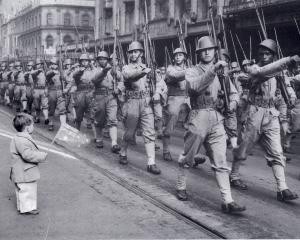
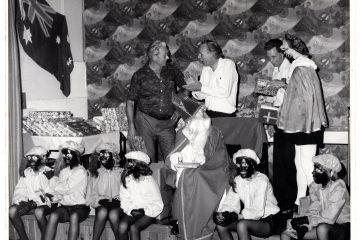
On 12 September 1946, Dutch guards opened fire on Indonesian detainees at Camp Victory near Casino in northern New South Wales. One man, Soerdo, was killed, while two other prisoners, Parta and Lengkong, were wounded.
The shooting followed months of growing tension at the camp and occurred only a day after another Indonesian detainee, Corporal Emod, had been found hanging from a tent pole. Contemporary accounts disagreed about whether Emod had taken his own life or had been killed by other prisoners.
These events brought the disputed detention of hundreds of Indonesian servicemen into national attention and intensified demands for Camp Victory to be closed.
From military camp to detention centre
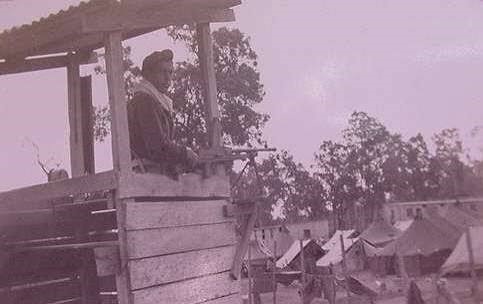
Camp Victory had operated under Dutch authority during the Second World War and accommodated personnel from the Royal Netherlands East Indies Army. Its population included soldiers from Indonesia, Suriname, the Dutch Caribbean and New Guinea, together with Dutch military personnel.
The political situation changed dramatically following Japan’s surrender and Indonesia’s declaration of independence on 17 August 1945. Many Indonesian members of the KNIL no longer considered themselves subjects of the Netherlands and refused orders that might involve supporting the restoration of Dutch colonial rule.
Dutch authorities treated these refusals as breaches of military discipline. Indonesian servicemen were arrested, court-martialled and confined at Camp Victory. By September 1946, contemporary newspapers reported that approximately 550 prisoners were being held in the compound.
The legal and political status of these men was deeply contested. The Dutch regarded them as military personnel subject to Dutch authority. The prisoners and their supporters increasingly regarded them as Indonesians being detained for supporting their newly proclaimed republic.
The disputed death of Emod
On 11 September 1946, the body of an Indonesian identified as Corporal Emod—also recorded as Emot—was found hanging from a pole in an open lecture tent within the compound.
Initial newspaper reports described the death as an apparent suicide. Some Dutch officers, however, believed that Emod had been killed by other prisoners. Australian police questioned several Indonesians, but the precise circumstances remained disputed.
The archive of Camp Victory guard Jan de Wit records that a prisoner had been taken to hospital with knife wounds shortly before Emod’s death. De Wit subsequently wrote that twelve camp leaders were removed from the compound. Dutch authorities later alleged that a group of prisoners was responsible for killing Emod, while Indonesian and Australian supporters questioned that account.
Indonesian archival research identifies Emod as a 28-year-old soldier with KNIL service number 9663. This information is derived from records associated with Indonesian nationalist Mohamad Bondan, now held by the Arsip Nasional Republik Indonesia.
Guards open fire
The following day, 12 September, two armed Dutch guards attempted to enter the compound. According to a contemporary report in Melbourne’s Herald, some prisoners resisted or displayed opposition.
The guards initially fired into the air and ground before directing their weapons at the prisoners. Soerdo was killed and Parta and Lengkong were wounded.
The Herald reported that Soerdo had thirteen bullet wounds extending from his head to his stomach. It stated that all the bullets had entered from behind, suggesting that he may have been moving away when he was struck.
This was not the first shooting at Camp Victory. An Indonesian prisoner identified variously as Tadjeri, Tarsan or Tarji had been shot in an earlier confrontation. Sources disagree about whether that incident occurred in April or May 1946 and about the precise date of his death.
Casino demands action
News of the September shooting caused considerable anxiety in Casino. The Herald reported fears that the approximately 550 prisoners might overwhelm their guards if the unrest escalated.
Suggestions were made that the mayor should call a public meeting demanding that the camp be closed and that both Dutch and Indonesian personnel be removed from the district. A Casino police officer reportedly said that local residents would be “more than satisfied” to see the camp go.
The shooting also exposed the unusual legal position created by the camp’s operation under Dutch authority. The Commonwealth Crown Solicitor reportedly advised that the matter fell entirely within the jurisdiction of the Dutch military authorities. The local coroner viewed Soerdo’s body and issued an order for burial but took no further action.
This inability—or unwillingness—of Australian authorities to intervene in a fatal shooting on Australian soil added to the controversy surrounding the camp.
Australian officials subsequently investigated conditions at Camp Victory. Contemporary reports discussed the possible appointment of “peace officers” and moves to accelerate the camp’s closure.
Release and repatriation
During October and December 1946, the remaining Indonesian detainees were progressively released. Many were discharged from Dutch military service, transferred through Brisbane and repatriated to Republican-controlled territory in Indonesia.
The Mohammad Bondan archive in Indonesia contains extensive material concerning this process. Its records include correspondence about conditions at Camp Casino, the release and transfer of detainees, nominal rolls of returning personnel and an original list of the militia strike at Casino.
One letter dated 12 December 1946 stated that passengers transported aboard the Manoora had arrived safely in Yogyakarta and that no Indonesians remained detained at Casino.
Camp Victory officially closed on 17 December 1946.
Historical significance
The September 1946 shooting was more than an isolated disturbance within a military camp. It brought the Indonesian independence struggle directly into an Australian country town.
For the Dutch authorities, the prisoners were servicemen who had rejected military discipline. For the Indonesian detainees, refusal to obey Dutch orders was part of their support for an independent republic. For Australians, the deaths raised troubling questions about the detention of political prisoners and the exercise of foreign military authority on Australian soil.
Soerdo’s death, the disputed death of Emod and the wounding of Parta and Lengkong intensified public pressure for the camp to be closed. They also demonstrated how quickly the wartime alliance between Australia and the Netherlands was being overtaken by the political struggle over Indonesia’s future.
The surviving Dutch, Australian and Indonesian records do not always agree. Even the names and dates vary between sources. Further examination of the Camp Casino files in the Mohammad Bondan archive may provide an Indonesian perspective on the confrontation and help clarify what occurred inside the compound.
Australian investigation of the shooting
The National Archives of Australia holds official correspondence concerning the fatal shooting of an Indonesian military prisoner at the Dutch detention camp at Casino on 12 September 1946. The date and circumstances indicate that these documents almost certainly relate to Private Soerdo, who is recorded as having died after being shot by guards at Camp Victory on that date.
The correspondence shows that the incident attracted attention at senior levels of the Australian Government. The Prime Minister’s Department, Department of External Affairs, Attorney-General’s Department, Department of Transport and External Territories and Commonwealth Investigation Service exchanged information about the shooting and the wider conditions under which Indonesians were being detained by the Dutch authorities.
Australian officials sought clarification of the circumstances surrounding the death, whether a formal military inquiry had been conducted and whether a coroner’s inquest had established the cause of death. The surviving papers demonstrate that the shooting was not treated merely as an internal Dutch military matter. It became part of a broader Australian examination of the legality and administration of the Casino detention camp.
The selected records reproduced below are from National Archives of Australia: A9108, ROLL 20/39, Netherlands East Indies – Military detention camp – Casino, 1945–1947, item 1353596.
Sources and further reading
- “Closure of Dutch Camp in NSW Wanted,” Herald, Melbourne, 13 September 1946, p. 8. Trove
- “Indonesian Killed in N.S.W. Camp,” News, Adelaide, 13 September 1946. Trove
- “Peace Officers to Control N.E.I. Camp?”, Queensland Times, 16 September 1946. Trove
- Jan de Wit family archive, reproduced by the Dutch Australian Cultural Centre.
- Jan Lingard, Refugees and Rebels: Indonesian Exiles in Wartime Australia, Australian Scholarly Publishing, 2008.
- Graham Irvine, “Legality and Freedom: Indonesian Internees in the Victory Camp, Casino, New South Wales,” Australia & New Zealand Law & History E-Journal, 2011.
- Arsip Nasional Republik Indonesia, Inventaris Arsip Mohammad Bondan 1945–1968. ANRI