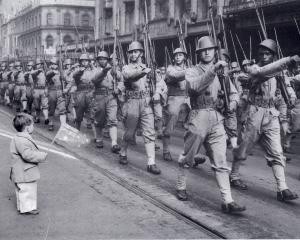
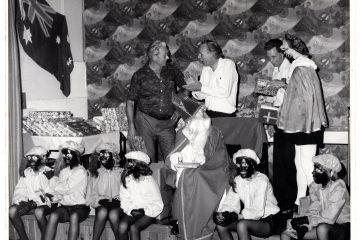
During the Second World War, Australia became the birthplace of a little-known Dutch women’s military organisation: the Vrouwenkorps Koninklijk Nederlands-Indisch Leger, or VK-KNIL—the Women’s Corps of the Royal Netherlands East Indies Army.
The corps was formally established in Melbourne on 5 March 1944. Its creation reflected both the severe shortage of Dutch military personnel following the Japanese conquest of the Netherlands East Indies and the growing recognition across the Allied forces that women could perform essential military, medical, communications and administrative duties.
The VK-KNIL brought together women from widely different backgrounds. Some were refugees or students from the Netherlands East Indies already living in Australia. Others were recruited in Canada, the United States, the Caribbean, Britain and other parts of the Dutch world. Later recruits came directly from the liberated Netherlands.
They trained and served in Melbourne, Sydney, Brisbane, Camp Columbia and Netherlands New Guinea before many were deployed to Java, Sumatra and other parts of the Indonesian archipelago. Their service began as part of the Allied war against Japan but continued during the far more politically complicated Indonesian struggle for independence.
The history of the VK-KNIL therefore connects Australia with the final years of the Pacific War, the liberation of Japanese-occupied territories, the recovery of prisoners and displaced civilians, and the end of Dutch colonial rule in Indonesia.
The research portal
This article provides an introduction to the DACC VK-KNIL Research Portal. It outlines the corps’ origins, organisation, training in Australia, deployment to the Netherlands East Indies and eventual dissolution. The people, places and events introduced here are explored in greater detail in the linked articles and personal stories throughout the portal.
Understanding the name
The official Dutch name was: Vrouwenkorps Koninklijk Nederlands-Indisch Leger. This is generally abbreviated as VK-KNIL and can be translated as the Women’s Corps of the Royal Netherlands East Indies Army.
The corps is sometimes described in English as the Dutch Women’s Army Corps or Dutch WAC. These descriptions can cause confusion because the United States already had its own Women’s Army Corps, officially abbreviated as WAC. American WAC personnel trained and socialised with the Dutch women at Yeronga Park in Brisbane, but the two organisations remained separate.
The VK-KNIL should also be distinguished from the Volunteer Women’s Auxiliary Corps, or VVHK, established for the Royal Netherlands Army in London in December 1943.
Another separate organisation had emerged in Fremantle in 1942, where women evacuated from the Netherlands East Indies volunteered to support the Royal Netherlands Navy. Jack Ford described this organisation as a Dutch Women’s Auxiliary Force. It preceded the formal VK-KNIL but was not necessarily an earlier branch of the same organisation.
Origins in wartime exile
The Japanese conquest of the Netherlands East Indies in early 1942 destroyed the existing Dutch colonial military structure. Most KNIL personnel were killed, captured or interned. Dutch and Netherlands East Indies government, military and civilian personnel who escaped regrouped in Australia and elsewhere.
Australia became an important centre for Dutch wartime reorganisation. The Netherlands Indies Commission and KNIL headquarters were initially based in Melbourne. Dutch naval units operated from Australian ports, while Dutch and Indonesian airmen served in the combined Netherlands East Indies–Royal Australian Air Force squadrons. The Netherlands Forces Intelligence Service, or NEFIS, gathered information about Japanese-occupied territories and prepared personnel for intelligence and special operations.
All these organisations faced an acute shortage of people. Military personnel were needed not only for operational service but also for administration, communications, medical work, records, transport, supply, welfare and preparations for returning to the Netherlands East Indies.
Women represented an important but largely untapped source of skilled personnel.
The Fremantle women’s auxiliary organisation
An early example emerged in Western Australia before the establishment of the VK-KNIL.
In September 1942, General Hein ter Poorten’s successor in Australia, General Coster, visited the substantial Royal Netherlands Navy presence at Fremantle. Following his visit, a Dutch Women’s Auxiliary Force was formed from women evacuated from the Netherlands East Indies.
Some had survived the Japanese air raid on Broome in March 1942. Many had husbands or other family members who were prisoners of war, and few knew what had happened to them.
Jack Ford records that the women wanted to make an active contribution to the war effort. US Rear-Admiral Charles Lockwood, who commanded Allied naval forces at Fremantle, remembered their courage and determination under extremely distressing circumstances.
Their voluntary work helped establish and operate facilities supporting Dutch naval personnel. Ford wrote that the facilities created through their enthusiasm compared favourably with those available to other Allied naval forces in Fremantle.
This organisation demonstrated that displaced Dutch and Netherlands East Indies women were not merely passive refugees. However, it should be regarded as a locally formed naval auxiliary organisation rather than automatically identified as the later VK-KNIL.
Establishment in Melbourne
The VK-KNIL was formally established in Melbourne on 5 March 1944. The Netherlands Ministry of Defence regards its creation as an important moment in the history of women in the Dutch armed forces.
The new corps was intended to support the liberation of the Netherlands East Indies from Japanese occupation. Allied forces were advancing through New Guinea, and Dutch authorities expected recovered islands to require immediate medical assistance, administration and civilian relief.
The original strategic concept involved following the Allied advance from island to island. Wherever military forces returned, women would be needed as nurses, medical assistants, laboratory workers, secretaries, typists, clerks and communications personnel.
The women received military status, uniforms, ranks and training, but the corps was non-combatant. Some members received weapons instruction during training, but they generally served unarmed.
The early leadership included Lieutenant J.M. Meerburg, who became the corps commander, together with officers C.A. Smit and J.C. Person. In its early Australian phase, however, Jack Ford records that a male officer commanded the small Brisbane contingent.
Recruitment and early training in Australia
Recruitment within Australia began immediately after the corps was established. Lieutenant-Colonel G.A. de Stoppelaar, who initially exercised general supervision over the VK-KNIL, toured Australian cities in which Dutch and Netherlands East Indies communities were concentrated. According to Sophia Kruyswijk-van Thiel, the largest number of recruits came forward in Melbourne and Sydney.
Elementary military training began in Melbourne on 7 March 1944, only two days after the formal establishment of the corps. In Sydney, training was organised by Mrs Van der Vloodt, secretary of the Netherlands Women’s Organisation, together with Dr Van Leent and two unnamed officers from the local Australian military service. Van der Vloodt had escaped from the Netherlands East Indies shortly before its fall; her husband was subsequently held by the Japanese.
The women’s preparation was not confined to military drill. Depending on their intended employment, recruits were trained for administrative work, auxiliary nursing, ambulance driving, telegraphy and other communications duties. These early Melbourne and Sydney programs preceded the concentration of most VK-KNIL activity in Brisbane.
Recruitment throughout the Dutch world
The German occupation made recruitment within most of the Netherlands impossible. Dutch authorities therefore looked for eligible women throughout the unoccupied Dutch and Allied world.
The early recruits included women from:
- Australia;
- the Netherlands East Indies;
- Canada;
- the United States;
- Britain;
- Curaçao and other parts of the Caribbean;
- South Africa;
- Argentina and other countries with Dutch communities.
Some were Dutch by birth, while others qualified through Dutch parentage or marriage. Several had grown up in the Netherlands East Indies but happened to be studying or living overseas when Japan invaded.
Others were so-called Engelandvaarders who had escaped from the German-occupied Netherlands and reached Allied territory.
Personal circumstances strongly influenced their decisions. Some wanted to participate directly in the defeat of Japan. Some had family members in Japanese internment or prisoner-of-war camps. Others saw military service as an opportunity to use their medical, linguistic or administrative skills.
A contemporary article from the West Australian explained that the corps would be divided into three principal sections: medical assistants, administrative personnel and general-service personnel undertaking duties such as military driving.
Medical training and service connected with Sydney
Sydney became an important centre for the medical training of early VK-KNIL recruits.
One of the first members was Ineke Thysse, who had been born and raised in Bandung and travelled to Australia to continue her education before the Japanese invasion. Cut off from her family and financial support, she was among seven initial women selected for medical training.
Her instruction included anatomy, physiology, injections, laboratory procedures and practical work in Dutch medical facilities. Much of the course was organised by Dr van Leent, who was already responsible for the health of large numbers of Dutch merchant seamen and other personnel associated with the Koninklijke Paketvaart Maatschappij in Sydney.
After extensive training, Ineke and other medical members were sent north. They worked in hospitals and clinics in Hollandia and Morotai and assisted local people as well as military personnel. Their work included laboratory duties, injections, nursing and visits to isolated coastal communities.
Another member who received specialist training in Sydney was pharmacist G.L.M.A. Hage-Noel. After arriving from Britain aboard the Rangitata in 1945, she was temporarily attached to the public health service. She worked in a medical supply store supervised by pharmacist Koos Rikker and in the new laboratory at the Wilhelmina Hospital.
Hage-Noel familiarised herself with English pharmaceutical terminology and Australian supply and distribution procedures. She sometimes assumed temporary responsibility for the laboratory and taught Dutch nurses how to take blood samples and examine blood smears. After completing her Australian training, she departed for Hollandia in September 1945 and became head of the Pharmaceutical Service in Netherlands New Guinea.
Sydney also became a place of treatment and temporary reassignment. Curaçao recruit Fortunata “Norma” Hart served as an auxiliary nurse in Hollandia until she developed serious Atabrine poisoning in July 1945 and was evacuated to Sydney. Kruyswijk-van Thiel records that Hart subsequently worked for an intelligence service in Australia until Japan’s surrender. She departed for Batavia around mid-September 1945 and resumed medical work as an auxiliary nurse in the military hospital. In 1948 she served as a nurse aboard the troopship Groote Beer during a voyage carrying patients to the Netherlands, before returning to the Netherlands East Indies in August 1949.
These experiences show that the VK-KNIL was not solely an administrative organisation based in Australian offices. Australia provided medical and specialist training, treatment and temporary employment before women were deployed closer to the advancing Allied campaign and into areas where infrastructure and medical services had been severely disrupted.
Recruitment in Western Australia
Dutch military representatives also travelled to Western Australia to recruit women.
On 17 May 1944, Lieutenant-Colonel de Stoppelaar and Lieutenant-Commander de Groot addressed interested Dutch women at the Palace Hotel in Perth. The Netherlands Consulate helped organise the meeting.
Among those recruited were Joan Butler, Dien Freese and Johanna Mol. They travelled across the Nullarbor to Melbourne, where they were fitted with uniforms, before continuing by train to Brisbane.
They arrived on 15 August 1944 and reported to the Netherlands East Indies Army authorities. Joan Butler received the service number VK 43 and was later promoted to corporal.
Other recruits connected with Western Australia included Mia La Bree and Hazel Whitton. The surviving personal accounts demonstrate how widely the Dutch authorities had to search for suitable personnel.
Yeronga Park and the American WAC
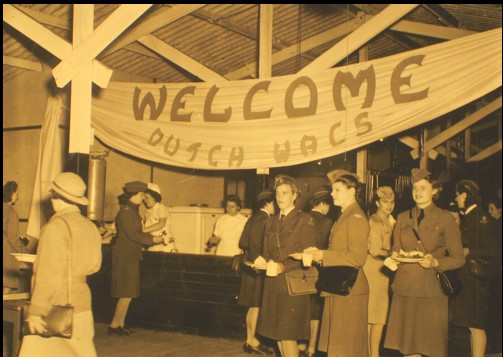
The United States Army had established a military camp at Yeronga Park in Brisbane. Among the units based there were members of the US Women’s Army Corps.
Jack Ford records that the Dutch Women’s KNIL Corps transferred from Melbourne to Brisbane in September 1944. The Dutch women trained with American WAC personnel at Yeronga Park.
At that time, the Dutch contingent numbered 26 women and was led by a male officer. On 26 September, the American WAC hosted a welcome lunch for the VK-KNIL members in its mess.
The occasion symbolised the cooperation between two separate women’s military organisations. The American WAC had considerably greater experience and resources, while the VK-KNIL was still a new and very small corps preparing for service in a colonial territory largely occupied by Japan.
The Dutch women received military instruction, including drill, physical training and military procedures. Training varied according to their intended work and could also include driving, communications, languages, clerical work and medical instruction.
Camp Columbia
Camp Columbia at Wacol became the principal centre for the VK-KNIL in Brisbane.
Originally constructed and occupied by the United States Army, the camp began passing to Netherlands East Indies control during 1944. It accommodated KNIL headquarters and personnel together with organisations connected to the Netherlands East Indies administration in exile.
Kruyswijk-van Thiel estimated that approximately 225 VK-KNIL members were present in or passed through Australia between the corps’ establishment in March 1944 and the first major deployments in September 1945. This should not be interpreted as 225 women being stationed at Camp Columbia simultaneously. Some trained or worked in Melbourne and Sydney, while others remained in Brisbane only briefly before being sent north.
VK-KNIL members lived, trained and worked at the camp. Their duties included:
- switchboard and communications work;
- typing and clerical administration;
- maintaining records and archives;
- driving;
- supply and stores work;
- medical support;
- language training;
- preparing for deployment to recovered territories.
Joan van Embden-Butler recalled working on the switchboard, in the motor pool and in the Supply Depot. Members attended army school and studied Dutch and Malay. Physical training was reportedly provided at one stage by the celebrated Dutch boxer Bep van Klaveren.
Camp life also included films, dances, social visits, picnics and trips into Brisbane. Relationships developed among the international mixture of military and civilian personnel. Several VK-KNIL women met their future husbands while serving in Australia.
The women’s accommodation was separated from the rest of the camp and enclosed by a fence that was locked at night. Such restrictions reflected contemporary military attitudes towards women and concerns about discipline, reputation and fraternisation.
Military and civilian women at Camp Columbia
Not all women working for the Dutch at Camp Columbia were VK-KNIL members.
Australian civilian women were recruited for typing, mapping, communications and administrative work. They worked beside Dutch, Indonesian and other Allied personnel but did not necessarily have military status.
Jean van Schilfgaarde, for example, was an Australian civilian employed by NEFIS. She worked in its Mapping Room in Melbourne before moving with the organisation to Camp Columbia. Her work involved drawing and annotating maps and aerial photographs using intelligence about Japanese-occupied Indonesia.
Joan McConachy was another Australian secretary who worked for the Dutch Army at Camp Columbia, possibly within NEFIS or a related records organisation. Her surviving photographs provide valuable visual evidence of the camp, including its offices, messes, library, Indonesian personnel and social activities.
The presence of military and civilian women in the same environment later contributed to confusion about who belonged to the VK-KNIL. The distinction should be maintained while recognising that both groups contributed to the Dutch and Allied effort.
Preparing to return
By early 1945, the Netherlands East Indies authorities were preparing for the expected liberation of the archipelago.
A KNIL inventory dated 9 March 1945 listed the Women’s KNIL Corps alongside the Technical Battalion, soldiers attached to NICA and NEFIS, sentries at Camp Columbia and KNIL units serving in Netherlands New Guinea. Ford gives the combined KNIL strength as approximately 1,350 personnel.
The number was far too small for Dutch plans to restore control throughout the Netherlands East Indies. The recruitment of women formed part of a much wider search for personnel that included escaped servicemen, Papuans, recovered prisoners of war and volunteers from countries around the world.
VK-KNIL members could not solve the fundamental shortage, but they released male personnel from administrative and support work and provided skills urgently needed in medical, welfare and communications services.
Japan’s surrender changes the mission
Japan’s surrender in August 1945 transformed the VK-KNIL’s mission.
The corps had been created to assist in liberating the Netherlands East Indies from Japanese occupation. However, on 17 August 1945—two days after Japan announced its surrender—Sukarno and Mohammad Hatta proclaimed Indonesian independence.
The women were therefore sent into a situation profoundly different from the one for which they had been recruited. The Japanese empire had collapsed, Allied prisoners and civilian internees required urgent assistance, and food, transport, communications and government services had been severely disrupted.
At the same time, Indonesian nationalists opposed the restoration of Dutch colonial authority. British forces initially held responsibility for accepting the Japanese surrender and recovering Allied prisoners in Java and Sumatra. Dutch military deployments were restricted, while violence escalated among Indonesian nationalists, returning Dutch authorities, former internees, armed groups, Japanese forces and British and British Indian troops.
The distinction between liberation, humanitarian recovery and colonial restoration became increasingly difficult to maintain.
Deployment from Camp Columbia
Deployments had already begun before the broader movement order of 18 September. An order signed by Commandant Janet Meerburg on 7 September 1945 directed twenty VK-KNIL members to fly from Brisbane to Balikpapan under the command of Second Lieutenant Dencher. The surviving list includes future detachment commander Tjitske van Tongeren. Kruyswijk-van Thiel noted that the precise reason for the group’s urgent departure was not recorded, although it probably reflected an immediate need for personnel in Borneo.
On 18 September 1945, Captain Janet Meerburg issued a movement order transferring VK-KNIL members at Camp Columbia to the Netherlands East Indies.
Some travelled by air, while others departed by ship. Their work included:
- locating and registering former prisoners and internees;
- helping reunite families;
- distributing clothing and essential supplies;
- working in hospitals, laboratories and clinics;
- providing welfare services;
- communications and clerical work;
- maintaining records;
- assisting Dutch civil and military organisations.
Women served in Batavia, Bandung, Palembang and other locations on Java and Sumatra. Others worked in Malaya when political and military circumstances prevented their immediate entry into Java.
The work could be dangerous even though the women were classified as non-combatants. Some operated in areas affected by political violence and had to be protected by British, British Indian, Japanese or Dutch troops.
Expansion after the war
The corps had originally been intended as a temporary wartime organisation. Plans were made to dissolve it in 1946, but the continuing shortage of personnel led to its retention.
Recruitment subsequently expanded in the Netherlands. Newspaper advertisements sought women with medical, administrative and other professional skills. Recruits received military training before travelling overseas.
The nature of the corps also changed. Medical and humanitarian responsibilities remained important, but administrative work became increasingly prominent. VK-KNIL members served as:
- secretaries and typists;
- records and archive personnel;
- communications staff;
- medical and pharmacy assistants;
- nurses and laboratory workers;
- welfare officers;
- canteen personnel;
- liaison and information staff.
The headquarters was eventually established in Batavia, while Bandung became an important training centre.
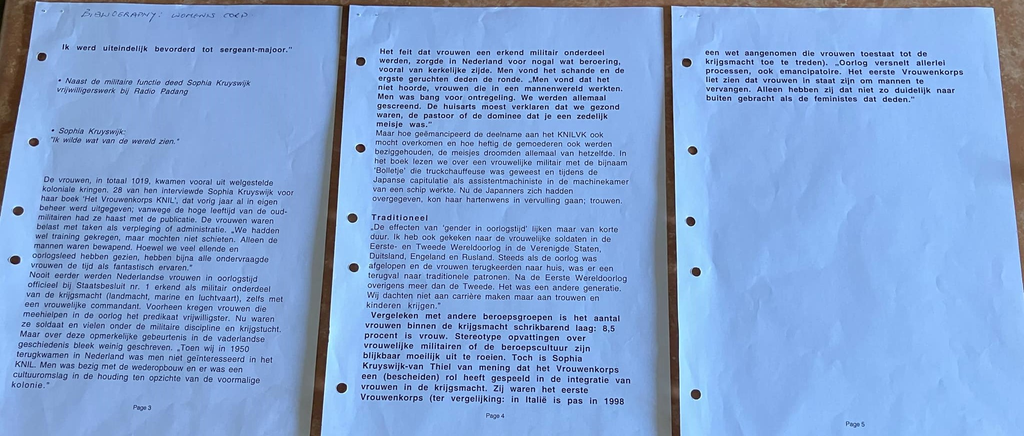
Sophia Kruyswijk-van Thiel records that 1,019 women served in the VK-KNIL between 1944 and 1950, with individual periods of service ranging from approximately six months to three years. The corps did not have 1,019 members serving simultaneously: its maximum strength at any one time was 519 women.
Women and the Indonesian Revolution
The VK-KNIL’s postwar history cannot be separated from the Indonesian Revolution.
Many women had enlisted with the expectation that they would help liberate the Netherlands East Indies from Japan and assist people who had survived occupation and internment. Instead, they became part of a Dutch military organisation attempting to restore authority over a population whose nationalist leaders had declared independence.
Individual members responded differently. Some continued to regard their service primarily as humanitarian or administrative. Others became increasingly uncomfortable with the colonial conflict around them. Many were young, inexperienced and poorly prepared for the political and moral complexities they encountered.
Jorien Wallast’s book Saluut Batavia explores these experiences through the lives of five VK-KNIL women. Her work demonstrates how personal memories of fear, service, friendship, boredom and trauma became entangled with the larger and often painful history of decolonisation.
This perspective is important. The women should not be portrayed merely as heroic pioneers, nor should their individual service be reduced entirely to the policies of the Dutch colonial government. Their history requires attention to both personal motivation and the political system in which they served.
Dissolution and later lives
The Netherlands formally transferred sovereignty to the Republic of the United States of Indonesia on 27 December 1949.
The KNIL was dissolved on 26 July 1950, and the VK-KNIL ceased to exist with it. Members were discharged, returned to the Netherlands, remained temporarily in Indonesia or moved elsewhere.
Some came or returned to Australia as postwar migrants. Their wartime experiences consequently became part of Dutch-Australian migration and family history as well as military history.
For many years, their contribution attracted little public attention. Women’s support work was frequently treated as secondary to combat operations, while the controversial history of the Dutch-Indonesian conflict made personal recollections difficult to place within national commemorative narratives.
Family letters, photographs, service papers and oral histories are now helping to recover these stories.
Significance for Dutch-Australian history
The VK-KNIL occupies a distinctive position in the shared history of Australia, the Netherlands and Indonesia.
It was formally created in Australia, partly trained by American military women and supported by Australian facilities and personnel. Its members served within the multinational Allied environment that developed across wartime Australia.
Their story also reveals the diversity of the Dutch world. The women came from Europe, the Netherlands East Indies, Australia, North America, the Caribbean and elsewhere. Some were Dutch, some Indo-European, and others had complex family connections across the former empire.
Through their experiences, we can explore:
- women’s changing position in military service;
- the experience of refugees and displaced people;
- Dutch military reorganisation in Australia;
- life at Camp Columbia;
- Allied cooperation;
- medical and humanitarian recovery;
- the transition from war to decolonisation;
- postwar migration to Australia.
The VK-KNIL was a relatively small corps, but its history connects several of the most important transformations of the mid-twentieth century: global war, women’s military service, the collapse of European empires and the emergence of an independent Indonesia.
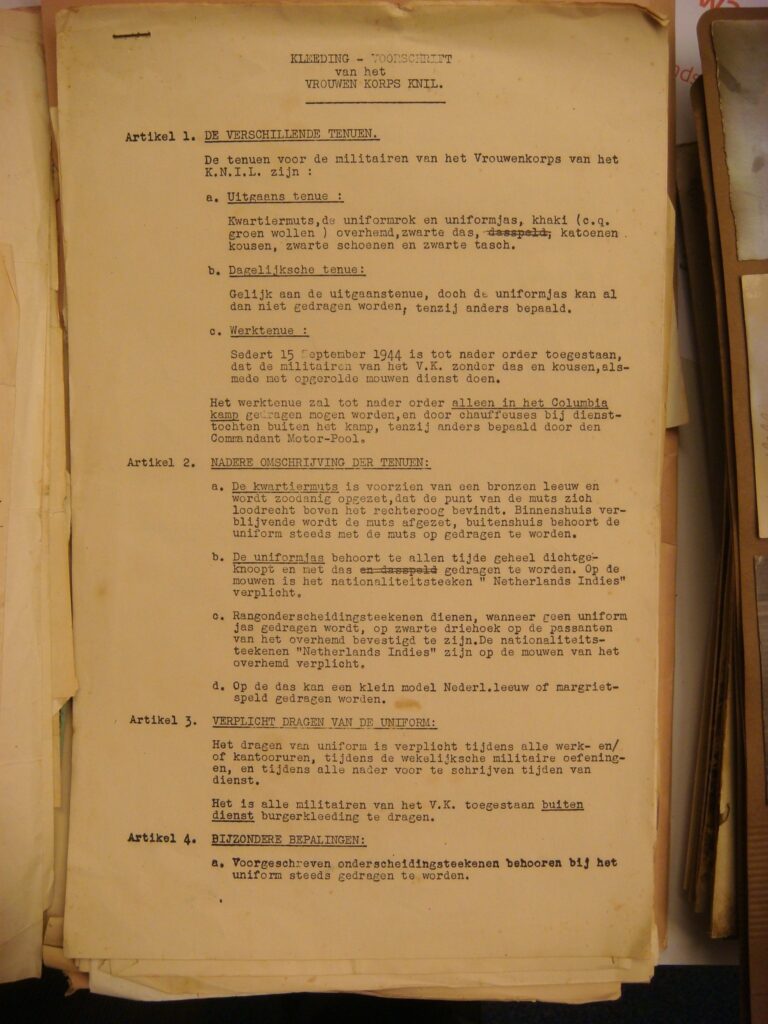
VK-KNIL uniform
The document below shows a surviving VK-KNIL uniform preserved in the collection of Museum Bronbeek in Arnhem.
Preserving the history of the corps
One of the most important later studies of the corps was undertaken by Sophia Kruyswijk-van Thiel, who joined the VK-KNIL in the Netherlands and arrived in Indonesia in February 1948. Although she did not serve in Australia, her 2004 doctoral study, Het Vrouwenkorps-KNIL, reconstructed the history of the corps from its establishment in Australia in 1944. Drawing on personnel lists, photographs and veterans’ recollections, her research identified 1,019 women who served between 1944 and 1950.
Paul Budde December 2025, update October 2026
Sources and further reading
- Netherlands Institute for Military History, The Women’s Corps of the Royal Netherlands East Indies Army.
- Netherlands Ministry of Defence, 75 years of women in the Dutch armed forces.
- Netherlands Ministry of Defence, The forgotten women’s corps.
- Sophia Kruyswijk-van Thiel, Het Vrouwenkorps-KNIL, Dutch University Press, Amsterdam, 2004.
- G.J. Kippers, Het Vrouwenkorps van het KNIL, 1943–1950, Utrecht University, 1985.
- Jack Ford, Allies in a Bind: Australia and the Netherlands East Indies in the Second World War, 1996, particularly Chapters 4 and 7.
- Jorien Wallast, Saluut Batavia: Het verhaal van de vrouwelijke KNIL-soldaten, Alfabet Uitgevers, 2024.
- Jorien Wallast, Mijn oma de soldaat, NPO Radio 1, 2021.
This article is part of the DACC VK-KNIL Research Portal, which brings together the history and personal stories of Dutch women in military service during and after the Second World War.