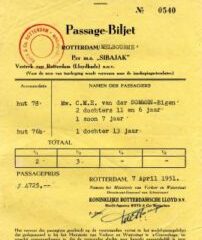
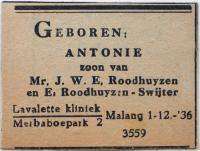
Post-war Dutch and other migration to Australia 1945 – 1970
This illustrated research presentation examines the contrast between the expectations created by post-war migration campaigns and the realities experienced by Dutch migrants arriving in Australia between 1945 and 1970.
Historian Dr Nonja Peters explores how government policies in the Netherlands and Australia encouraged emigration, often presenting Australia as a country of abundant employment, prosperity and opportunities for home ownership. For many families, however, the migration journey was followed by difficult accommodation conditions, financial hardship and considerable pressure to assimilate into Australian society.
The presentation also examines the Dutch response to assimilation, particularly the concept of aanpassen (adapting), and its long-term consequences for Dutch language, cultural identity and family relationships.
The research was originally presented at the Association of European Migration Institutions (AEMI) annual conference, Migration History Matters, held at the Danish Emigration Archives and Utzon Center in Aalborg, Denmark, from 28 September to 2 October 2011. A related paper was published in the AEMI Journal in 2012.
The original presentation, including its historical illustrations, personal accounts and references, is preserved below.
Read the related 2012 paper on ResearchGate
Post-war Immigration 1945- 1970
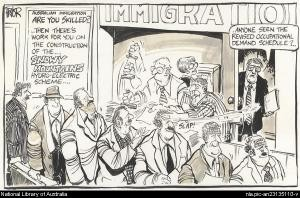
After the Second World War, Australia pursued a large-scale immigration programme to increase its population for economic development and national defence. Migrants were needed to address labour shortages in skilled trades, heavy industry, building and construction, and public utilities.
The government’s population growth objective was approximately 2 per cent annually, with immigration expected to contribute around half that increase. This translated into an initial target of approximately 70,000 migrants each year.

Wanted: Britons?
The Australian Government initially preferred migrants from Britain, but British post-war reconstruction needs and shortages of passenger shipping limited recruitment.
Australia subsequently expanded its immigration programme to include displaced persons from Europe and migrants from other European countries. Dutch migrants were particularly attractive to Australian immigration authorities because they were considered culturally and racially compatible with the predominantly British population. Contemporary recruitment policies frequently reflected racial stereotypes, including preferences for migrants with northern European physical characteristics.
Following the recruitment of approximately 180,000 displaced persons through international resettlement arrangements, Australia concluded further migration agreements with European countries, including the Netherlands, Italy and Germany.
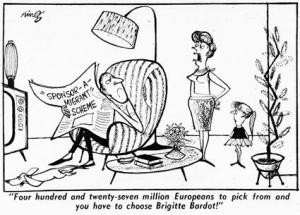
Recruiting Europeans but who? European ‘Good Types’

The European Influx!
Leaving the Netherlands
For Dutch families emigrating to Australia after the Second World War, departure involved leaving behind relatives, friends and familiar communities, often with little expectation of an early return. Most travelled by sea, taking whatever possessions they could transport and beginning a journey that would transform their family lives.
The following photographs and documents illustrate aspects of departure, the voyage and arrival in Australia during the post-war migration period.


Large Dutch Families wanted!
Compared with many other migrant groups, Dutch post-war migration was strongly family-oriented. Women generally accompanied their husbands, not always out of choice, but often because they were expected to follow wherever their husbands sought employment.
Australia valued Dutch migrants for their occupational skills, work practices and comparatively large families. Children were regarded as future contributors to the workforce, while the expense of relocating a large family made permanent settlement more likely.
Dutch Calvinist and Catholic communities also encouraged family emigration.[3] Religious leaders emphasised the responsibility of wives for their husbands’ and children’s spiritual welfare and for creating a gezellige (convivial and welcoming) home in Australia, regardless of the family’s circumstances.[4]
Overpopulation Concerns? Dutch Overpopulation
Post-war emigration from the Netherlands, as from several other Western European countries, was strongly influenced by concerns about overpopulation. Governments encouraged emigration as a response to economic difficulties, unemployment, underemployment and severe housing shortages.
Post-war emigration from the Netherlands, as from several other Western European countries, was strongly influenced by concerns about overpopulation. Governments encouraged emigration as a response to economic difficulties, unemployment, underemployment and severe housing shortages.
The Dutch government and monarchy actively encouraged citizens to consider emigration, supported by a network of offices established throughout the Netherlands to provide information and facilitate departure.[5]
Australia, meanwhile, recruited Dutch migrants for their skills in the trades, building and construction, manufacturing and other expanding industries. Semi-skilled workers were also sought, although recruitment for unskilled employment was less prominent.
Prospective emigrants were lured to Australia at information evenings organised at these centres where Commonwealth Department of Information propaganda was also vigorously promoted.


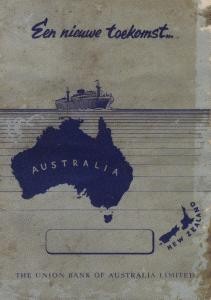
New Future!
Designed to encourage European migrants to travel to Australia, government posters, leaflets and brochures presented Australia as a land of opportunity, offering expanding industries, full employment, favourable working conditions and the prospect of owning a motor vehicle and a home equipped with modern household appliances. For many people living in the Netherlands during the difficult post-war years, such material prosperity seemed almost unimaginable.
Assisted passage schemes, supported by the Australian and Dutch governments, made emigration more affordable. Prospective migrants nevertheless had to satisfy eligibility requirements relating to race, age and health. Australia’s White Australia policy continued to influence admission, while employment obligations varied according to the migration scheme. Some assisted migrants were required to remain in designated employment for two years, irrespective of their previous qualifications or professional experience.[6]
Conditions differed between migration schemes. For example, displaced persons recruited through international resettlement arrangements were often assigned employment as domestic workers or labourers, regardless of their previous education or professional qualifications.
Dutch nationals from the Netherlands East Indies faced additional racial restrictions under Australia’s immigration policies. Those of mixed European and Indonesian ancestry could encounter particular difficulties obtaining admission, despite holding Dutch nationality.[7]
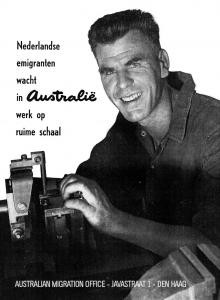
Images below: Nederlandse emigranten wacht in Australia werk op ruime schaal – Australian Migration Office

Work on grand scale
A reporter from the Dutch newspaper De Waarheid (The Truth) attended one of the information evenings organised by the local Labour Office in Amsterdam. The reporter questioned the contrast between the optimistic picture of Australia presented to prospective emigrants and the difficulties they might encounter after arrival.
In an article published on 28 January 1950, the reporter wrote:
In an article on 28 January 1950, he writes:
“It was the twenty-third evening, and the small room was full to overflowing. The 500 people present were seated not only on the seats but also on the window ledges, the stairs, and on tables. Hundreds succeeded in obtaining standing room only. At these meetings people are told, among other things, how large Australia is and how small Holland is. It is also said our country is too densely populated. Many of the audience, already determined to emigrate visualise the Australian landscape; extensive wide fields, steppes carrying millions of sheep, mountains, primeval forests, and extensive industrial centres; skies are blue, clouds are white, the mountains are purple, and the fields green – just as on the poster. The more the listener hears about this land the more he is lured on by visions of wide-open spaces. Each of the un-or underemployed in the room hopes to be among those to leave for the vision.”[8]
The De Waarheid reporter also observed that discussions about the practical difficulties of migration remained superficial. Although prospective emigrants were informed about the considerable paperwork involved, few participants raised questions about the challenges awaiting them. The reporter suggested that their reluctance to speak publicly allowed organisers to conclude the meetings on an optimistic note.[9]
Of particular concern was the limited attention given to the emotional consequences of migration: leaving family and friends, confronting an unfamiliar language and culture, and beginning a new life in a distant country with little certainty of returning home.
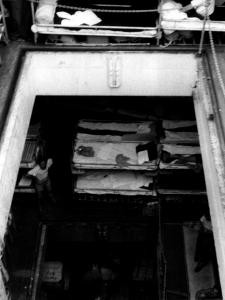
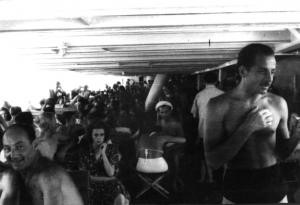
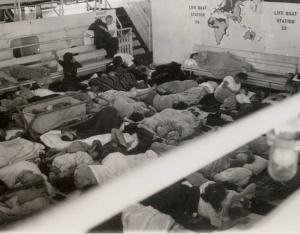
Migrants’ impressions were formulated further by experiences and discussions on the journey over, which in the 1950s was mainly by sea.
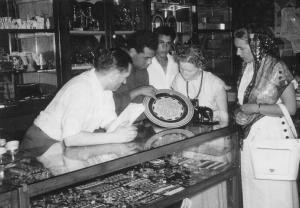
The Good Trip (images)

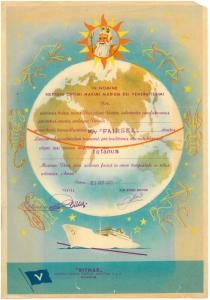
The Bad Trip – Troop ship accommodation (images)
Migrant Camps
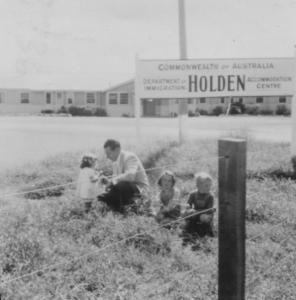
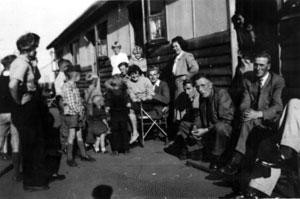
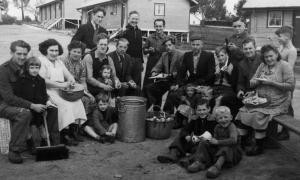
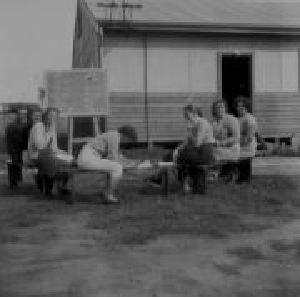
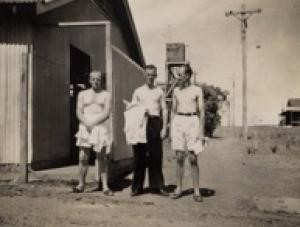
On arrival in Australia, many assisted migrant families, particularly larger families, were accommodated in Department of Immigration reception centres. In Western Australia, some of these centres occupied former military facilities, which could be adapted for migrant accommodation at a time when labour and building materials were in short supply.[10]
The primitive conditions in migrant camps were particularly confronting for Dutch families who had travelled aboard relatively comfortable passenger liners, including the Himalaya and Johan van Oldenbarnevelt.
Some migrants described the shock of moving from well-appointed cabins to overcrowded accommodation in converted military barracks, where partitions provided little privacy and families could hear the conversations and activities of their neighbours.
One Dutch girl recalled the contrast between her former home in The Hague and the conditions she encountered at Bonegilla:
“From living in a three storey house in The Hague, a city of distinction, to unlined army barracks where walls were of Hessian to separate families, the beds were hard with grey blue-striped cheap blankets. Privacy was non-existent as conversations could be heard from one end of the army hut to the other.“[11]
The Dutch and Australian governments continued to promote the idea that migrants with the right attitude would succeed in Australia despite the difficulties of resettlement. In practice, this meant expecting newcomers to work hard and persevere through considerable hardship.
Protests over conditions at Bonegilla prompted a visit by Dr Pieters, cultural attaché at the Dutch Embassy, who reportedly advised the migrants: “See those hills around us? At first the climb will be difficult but, once you get to the top and see the other side, you will be so happy”![12] The notion of having failed at migration – and there was little sympathy for migrants who returned to the Netherlands – was also a strong driving force.
The many complaints about the reality compared to propaganda prompted the then Minister for Immigration Harold Holt, to instruct his staff at the Department of Information to paint a ‘grimmer picture’ in propaganda booklets about Australia than had been the case in 1950, because it was giving people the wrong impression.[13]
After this debacle the Dutch government did also began to employ ‘Escort Officers’ on board Dutch ships to handle further enquiries. Mr H.P. Francissen on the Grote Beer noted:
“In my candid opinion the information these people receive in Holland is far from satisfactory. They are entirely without practical knowledge about the country in which they hope to make a new start in life.”[14]
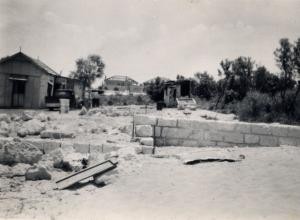
Leaving the migrant camps presented further difficulties. With housing in short supply and limited financial resources, many families initially moved into substandard rental accommodation or makeshift dwellings, including old tram carriages, tents, garages, caravans and verandas.
Saving for a home required considerable sacrifices. Family members contributed their earnings and spent evenings and weekends preparing building materials, cleaning second-hand bricks or making their own bricks from the limited quantities of cement available during the post-war shortages.
Some families first constructed a garage or rear veranda on their block of land and lived there while gradually building the remainder of their house. For larger Dutch families, this often meant accommodating several children in extremely confined spaces.
From the old to the new – From crowded Europe to Australia’s wide open spaces!

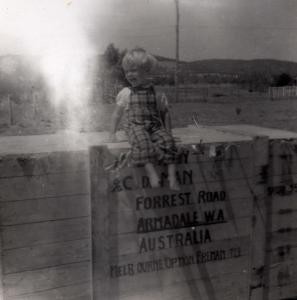
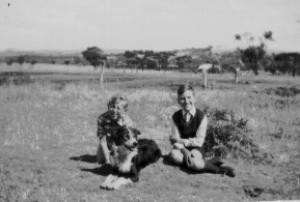
From Migrant camp to building your own home 1949 – 1970
Birss Family Residences, Albany, Western Australia 1952
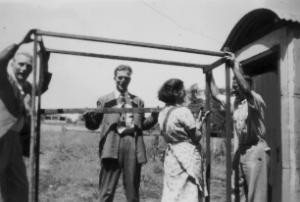
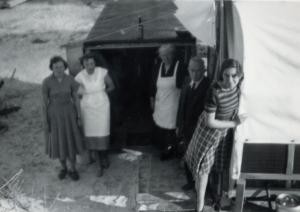
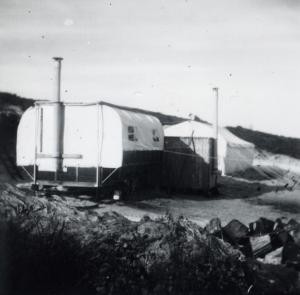

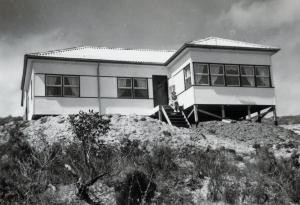
By this time, the myth of finding ‘gold nuggets lying on the streets’ had been dispelled. Migrants were coming to terms with the reality that establishing a better life in Australia would require hard work, considerable financial sacrifice and adaptation to unfamiliar social conditions.
Many assisted Dutch migrants had contributed much of their available savings towards the costs of emigration. Some arrived with little more than their permitted landing money, which in 1950 amounted to £10 for single migrants and £20 for families, together with a packing crate containing a limited quantity of household possessions.
Without substantial savings or assets, obtaining a bank loan or other financial assistance was difficult. Families therefore relied heavily on their own labour and resources to secure accommodation and eventually build or purchase a home.[15]
Alongside these economic challenges, migrants faced considerable pressure to assimilate into Australian society.
Assimilation
Orientation & Language Acquisition – learn both languages !

Australia’s post-war immigration policy placed considerable emphasis on assimilation, often described as ‘Anglo-conformity’. In a society that was overwhelmingly Australian-born and English-speaking, newcomers were expected to adopt Australian cultural practices, values and social behaviour as quickly and completely as possible.
This expectation implicitly asserted the superiority of the dominant Australian culture and sought to preserve the country’s predominantly British cultural identity. Migrants were encouraged to become ‘New Australians’, with little recognition of the cultural traditions and identities they had brought with them.[16]
The strength of these expectations was reflected in the Dutch Catholic newspaper De Tijd, which commented on 1 September 1950:
“Only for the man and woman who have given up all ideals of a Dutch home life, and are capable of putting themselves on the level of the average Australian, is there a chance of success. The authorities in Holland should warn migrants that on arrival in Australia they have no rights but only responsibilities to become ‘New Australians’ in the shortest possible time.”[17]
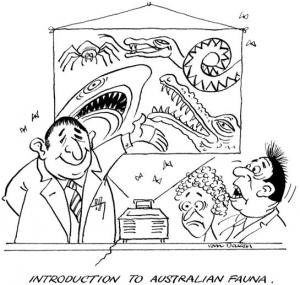
The Dutch Response to the Assimilation Imperative
Aanpassen (to adjust or adapt) was how the Dutch responded to the Australian imperative to assimilate. Dutch attitudes and practices were distinctive because, throughout the assimilation period, the majority of Dutch migrants appeared willing to conform to Australian expectations, whether or not they agreed with them, at least in the public sphere.
In public settings, many Dutch migrants sought to minimise or conceal characteristics that Australians might identify as ‘ethnic’, including the use of their native language. Anglo-conformity thus became a defining characteristic of Dutch identity in Australia.[18]
This attitude was reflected in the view expressed by many Dutch migrants:
“… if people come out here to make this their new country, they should … adapt themselves under all circumstances. When you are in Rome, do as the Romans do. You must fit in. After all, if you expect to further yourself economically and this country is prepared to give you a chance, then you have no right to be different.”
These patterns of adaptation contributed to the Dutch being described as among Australia’s most ‘assimilated’ immigrant communities. Their apparent cultural ‘invisibility’ earned them a reputation as ‘model migrants’.
Dutch invisibility
By the 1970s, the perceived ‘invisibility’ of Dutch migrants had become a widely accepted feature of accounts of their settlement in Australia. Their apparent willingness to assimilate was frequently attributed to characteristics supposedly inherent in the Dutch national character.
For example, on 2 February 1978, The Advertiser in Adelaide noted:
“The typical Dutchman who came to Australia and assimilated for all his individualistic reasons, is a man without and out of history. He is ‘strong willed, fast thinking, often stubborn and possessed with a fanaticism tosucceed’. (1) His migration and assimilation, it seems, are natural expression of his character. Yet, this same Dutchman has only been in Australia since the 1950s: His migration was part of historic changes happening in both Australia and the Netherlands, and was negotiated and to a large extent financed by those governments.”[19]
However, the stereotype of the successfully assimilated Dutch migrant was not universally accepted within the Dutch community. Some migrants regarded assimilation less as a transformation of identity than as a practical strategy for establishing themselves in Australian society.
As reported in The Canberra Times on 13 May 1978, one Dutch migrant suggested that the Dutch were simply the best of all migrant groups at playing the ‘assimilation game’.
Integration: Balancing both cultures

Van den Berghe associates the tendency of immigrant groups to assimilate with the advantages they gain from doing so. He argues that assimilation is encouraged in societies where ethnic groups occupy clearly defined positions within a social hierarchy.[20] From this perspective, Dutch ‘invisibility’ in Australia can be understood as a strategy that helped migrants maintain their relatively privileged position, second only to British migrants in the immigration preference hierarchy.[21]
This adaptive strategy also facilitated access to economic opportunities and potentially more favourable treatment in the workplace.[22] As long as Australia and other Commonwealth countries sought more immigrants than Britain alone could supply, Dutch migrants benefited from their position as a preferred European migrant group, frequently regarded as ‘second best’ after the British.[23]
Dutch sociologists have offered another explanation. They suggest that the ability of Dutch migrants to make themselves socially ‘invisible’ reflected a culturally ingrained means of protecting their inner identity within a society that emphasised conformity. Socialisation in the Netherlands had encouraged respect for hierarchy, self-discipline and self-possession, reinforced by Calvinist and Stoic values such as frugality, industry, responsibility, obedience and loyalty to authority.
I associate the aanpassen behaviour of first-generation Dutch Australians with their socialisation within the pillarised (verzuilde) society they had left behind. Dutch society had been organised into distinct religious and ideological communities, or ‘pillars’, including Catholic, Protestant and secular groupings. Each maintained its own institutions and leadership structures, shaping education, social life and community relationships. Interaction between the pillars was often mediated through their respective leaderships.
This background encouraged a distinctive adaptation strategy among first-generation Dutch migrants: maintaining their cultural integrity by developing separate public and private identities.[24]
De Longh maintains that, in the public sphere, Dutch migrants in Australia tried to be more Australian than the Australians themselves.[25] Research has nevertheless shown that, despite their determined imitation of Australian customs, many first-generation migrants remained steadfastly Dutch within the privacy of their homes. This contrast between public conformity and private cultural continuity has led some social scientists to describe Dutch culture in Australia as a ‘closet culture’.[26]
One consequence was that many Dutch parents did not pass their native language on to their children or involve them in Dutch clubs and community organisations. Public conformity to Australian assimilation expectations became a defining characteristic of Dutch identity in Australia, even while elements of Dutch culture continued to be maintained privately.[27]
Dutch children – Language and assimilation

As one child migrant recalled, ‘assimilation was the policy and it certainly buried many feelings of Dutchness.’ For many migrant children, the consequences of assimilation were conflicting values and loyalties between their country of origin and their new homeland. Australian culture was presented as something to embrace, while their Dutch heritage was often devalued or discouraged.
Fitting in was particularly difficult for children who were not fully accepted by Australians as Australian, yet did not want to be associated with those labelled ‘New Australians’, a term that could carry connotations of inferiority. Foreign names, limited English, different clothing and unfamiliar food preferences marked them as outsiders.
Dutch migrant children therefore faced difficult questions of belonging and identity, caught between the sometimes conflicting expectations of home and school.
For some adult children of Dutch migrants, the importance of their heritage became particularly apparent when caring for ageing parents. Some parents reverted increasingly to speaking Dutch following serious illness or in later life, making communication difficult for children who had never learned the language or had lost their fluency.
Following their parents’ deaths, many also discovered that they could not read the letters, documents and personal records left behind. This loss of language created barriers to understanding their family histories and recovering the experiences of earlier generations.
In this respect, the Dutch emphasis on conformity and aanpassen had unintended and sometimes tragic consequences. What Australian authorities regarded as a successful example of assimilation could also involve a significant loss of cultural and linguistic continuity between generations.
Nevertheless, Dutch migrants made substantial contributions to Australian economic and social development, particularly through entrepreneurship and skilled trades in building, construction, manufacturing, shipbuilding, services and hospitality.
The second generation subsequently established itself across a broad range of professions and occupations, including the arts, literature, filmmaking and politics. Their achievements became part of the wider Dutch contribution to Australian society.
So what has changed?
The Netherlands, once a country of substantial emigration, has also become a country of immigration. This raises interesting questions about how Dutch society now responds to newcomers and whether expectations of cultural conformity resemble those encountered by Dutch emigrants in Australia.
In his 2011 book Immigrant Nation, Paul Scheffer describes the Netherlands as a relatively conformist society. He also comments on what he sees as the limited explicit ambition among second-generation Dutch Muslims to assume leadership within the communities to which they are presumed to belong (p. 127).
These observations invite comparison with the experiences of Dutch migrants in Australia. How do immigrants and their children negotiate the expectations of the wider society while maintaining their cultural identity? What role does language play in this process, and to what extent does integration require cultural conformity?
The experiences of Dutch migrants in post-war Australia suggest that successful integration cannot be measured solely by outward conformity. The preservation of language, family history and cultural identity also deserves consideration.
Conclusion
Understanding the history and cultural traditions that shaped their parents’ lives can help second-generation Dutch Australians make sense of their family relationships and their own struggles with identity and belonging.
Equally, understanding the difficulties and achievements of earlier migrant communities under different resettlement policies provides valuable lessons for contemporary immigration and settlement programmes.
One particularly important lesson is the need to support the acquisition of both the language of the country of origin and that of the receiving society, especially among first- and second-generation migrants. Such an approach can facilitate integration without unnecessarily sacrificing cultural identity, family communication and intergenerational continuity.
In this respect, migration history should continue to inform the development of settlement policies and services. The central message of the conference at which this paper was presented — ‘Migration History Matters’ — remains relevant.
For the approximately 270,000 Australians who identified as having Dutch ancestry at the time of the original research, that history continues to matter.
Footnotes
Editorial note (DACC): Footnotes [1] and [2] appear in the original 2011 DAAAG presentation, but their corresponding references in the main text could not be identified. They have been retained for completeness. The original footnote numbering has been preserved.
[1] At the beginning of September 2011, Australia’s resident population was 22,695,356.
[2] This figure includes approximately 600,000 humanitarian programme entrants admitted as displaced persons or refugees.
[3] Walker-Birckhead, 1996, p. 2; J. H. Elich, p. 112. Both religious traditions encouraged the emigration of large families, which were considered less likely to return to the Netherlands.
[4] Ibid.; van Campen, Emigratie, 1954, p. 132.
[5] J. H. Elich, Aan de ene kant, aan de andere kant: De emigratie van de Nederlanders naar Australië, 1946–1986. Delft, 1987.
[6] Nonja Peters, Milk and Honey – But No Gold: Postwar Migration to Western Australia, 1945–1964. University of Western Australia Press, 2001.
[7] Wim Willemsen, ‘Breaking Down the White Wall: The Dutch from Indonesia’, in Nonja Peters (ed.), The Dutch Down Under, 1606–2006. University of Western Australia Press, Perth, 2006, pp. 132–149.
[8] ‘The False Bait: Australia, Land of Tomorrow’, De Waarheid, 28 January 1950. [English rendering of the newspaper article’s title; original Dutch title to be confirmed.]
[9] See also J. Menges, Geschiktheid voor emigratie: Een onderzoek naar psychologische aspecten der emigrabiliteit. Staatsuitgeverij, The Hague, 1959, p. 1. [Title spelling to be checked against the original publication.]
[10] Peters, Milk and Honey – But No Gold, 2001.
[11] Hendrik K. van Leeuwen, ‘A Retrospective on Dutch Migration to Australia in the 1950s: A Media Perspective and the Reflections of Selected Dutch Migrants in Victoria’. MA thesis, Deakin University, Victoria, 1995.
[12] Ibid.
[13] The Argus, 4 August 1951.
[14] Ibid.
[15] Wim Blauw, ‘Explanations of Postwar Dutch Migration to Australia’, in Nonja Peters (ed.), The Dutch Down Under, 1606–2006. University of Western Australia Press, Perth, 2006, pp. 168–183.
[16] Jeannie Martin, The Migrant Presence: Australian Responses, 1947–1977. George Allen & Unwin, Sydney, 1978.
[17] Cited in van Leeuwen, ‘A Retrospective on Dutch Migration to Australia in the 1950s’, 1995, p. 44.
[18] Nonja Peters, ‘Just a Piece of Paper: Dutch Women in Western Australia’, Studies in Western Australian History, August 2000.
[19] The Advertiser (Adelaide), 2 February 1978.
[20] Pierre L. van den Berghe, The Ethnic Phenomenon. New York, 1981, p. 259.
[21] Janis Wilton and Richard Bosworth, Old Worlds and New Australia: The Post-war Migrant Experience. Sydney, 1984.
[22] Sociologist Pierre van den Berghe associates the tendency of immigrant groups to assimilate with the advantages of doing so. He identifies the existence of a clear hierarchy between ethnic groups as one of the conditions encouraging assimilation.
Many migrants were unaware that the Commonwealth Government’s invitation to settle in Australia incorporated preferential treatment for particular nationalities.
Between 1947 and 1974, approximately 85 per cent of British migrants received passage assistance, compared with 60 per cent of Dutch, German, Maltese, Yugoslav and Eastern European migrants, 34 per cent of Greek migrants and 20 per cent of Italian migrants.
These differences reflected a hierarchy of preference within Australian immigration policy. From this perspective, Dutch ‘invisibility’ can be interpreted partly as an adaptive strategy that helped Dutch migrants maintain their relatively privileged position and obtain more favourable treatment in the Australian labour market and wider society.
The original source of the passage-assistance statistics requires verification.
[23] Hendrik K. van Leeuwen, ‘A Retrospective on Dutch Migration to Australia in the 1950s: A Media Perspective and the Reflections of Selected Dutch Migrants in Victoria’. MA thesis, School of Visual, Performing and Media Arts, Deakin University, Victoria, 1995.
[24] Walker-Birckhead, 1996. [Full publication details not provided in the original footnotes.]
[25] De Longh, cited in ‘It’s the Dutchness of the Dutch’, The Bulletin, Sydney, 1976.
[26] Ibid.
[27] Harald Eidheim, pp. 41–42. Eidheim observes that in Norway, Sámi (Lapp) identity was treated as socially illegitimate in certain settings, leading some Sámi to avoid publicly expressing their ethnic identity in interactions with the wider society. [Full publication details not provided in the original footnotes.]
About the author
Dr Nonja Peters is a historian, anthropologist and museum curator whose research has made a significant contribution to the understanding of Dutch-Australian migration, cultural identity and heritage.
This article is based on her research into post-war migration and assimilation, presented at the Association of European Migration Institutions (AEMI) conference, Migration History Matters, held in Aalborg, Denmark, in 2011.
For further information about her research, publications, exhibitions and international collaborations, see the DACC biography:
Dr Nonja Peters – Historian of Dutch-Australian migration, heritage and cultural identity