From Amsterdam and England to wartime service in Australia
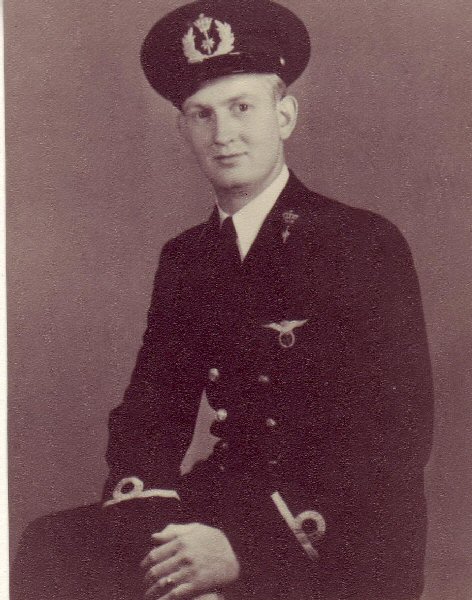
Gerard Johan Lugt was a young Dutch engineer and pilot whose wartime journey took him from the Netherlands to England, the Netherlands East Indies, Australia and the United States before he joined No. 18 (Netherlands East Indies) Squadron RAAF.
His extensive correspondence, preserved by his family, provides an unusually personal record of this journey. The letters reveal not only the development of a military pilot but also a son and brother separated from his family by war and determined to contribute to the liberation of his country.
Gerard was killed with the other five members of his crew when their B-25 Mitchell, N5-214, was lost during a mission over the Kei Islands on 1 September 1944.
Early life and aircraft engineering
Gerard Johan Lugt was born in Amsterdam on 9 August 1917 and grew up in Amsterdam and Bussum.
After completing his schooling and compulsory military service, he travelled to England to study aircraft engineering at Loughborough College. His interest in aviation extended beyond his formal studies. His sisters later recalled that he owned and repaired a small two-seat aircraft.
During the general mobilisation of the Netherlands in September 1939, Gerard was recalled for military service. He served with the infantry at Hilversum but, because he was studying abroad, was permitted to return to Loughborough College in February 1940.
Gerard was still in England when Germany invaded the Netherlands on 10 May 1940. He could no longer return home and was separated from his parents and sisters in the occupied Netherlands.
His letters describe the uncertainty of those first days. He attempted to make himself available for Dutch military service in Britain and assisted Dutch refugees arriving in England. Like many Dutch people outside the occupied country, he had very limited information about the safety of his family in the ocupied country, he had very limited information about the safety of his family.
To the Netherlands East Indies
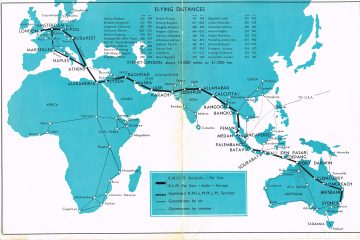
In August 1940, Gerard obtained an opportunity to leave Britain for the Netherlands East Indies. He initially worked in Bandung and, from January 1941, was employed by Werkspoor in Surabaya.
This was also a family connection. Gerard’s father worked for Werkspoor in Amsterdam as chief engineer of its large diesel-engine division.
Gerard was called up for military service several times while living in the Netherlands East Indies. In Surabaya, he also began recreational flying and joined the Aspirant Reserve Officier Vlieger, or AROV—an organisation for aspiring reserve officer pilots.
His participation in the AROV placed him on the path towards becoming a military pilot just as the threat of Japanese invasion was increasing.
Escape to Australia
Following the Japanese invasion of the Netherlands East Indies, Gerard and other members of the AROV group were evacuated aboard the Tjinegara.
They reached Australia, where their flying instruction initially continued. The group was subsequently sent to the United States to complete its training as military officers and pilots.
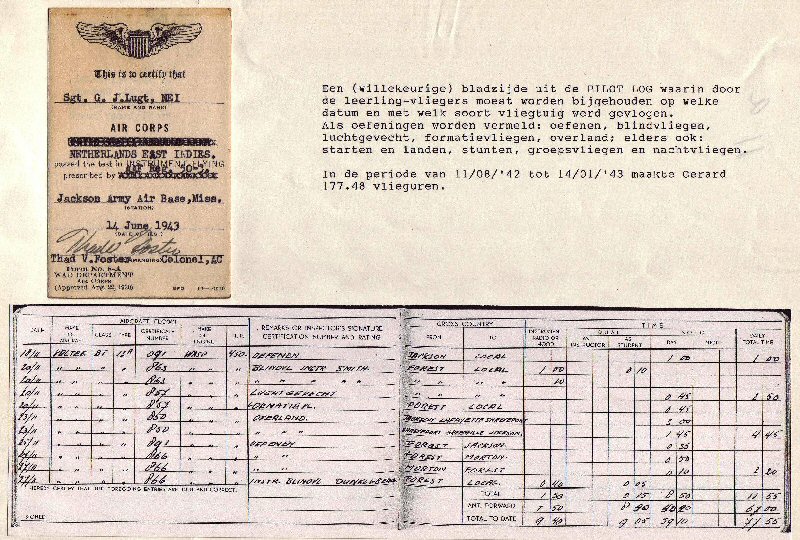
Gerard’s surviving correspondence follows his journey through Australia and the United States, including periods at Leavenworth and Jackson, Mississippi. He completed his officer and pilot training at Jackson before undertaking further preparation at Grass Valley and Fairfield in California.
At the beginning of 1944, Gerard travelled across the Pacific through Honolulu and returned to Australia.
Some members of his training group were sent to Europe. Gerard and others were assigned to the campaign against Japan and joined No. 18 (Netherlands East Indies) Squadron RAAF in northern Australia.
No. 18 Squadron at Batchelor
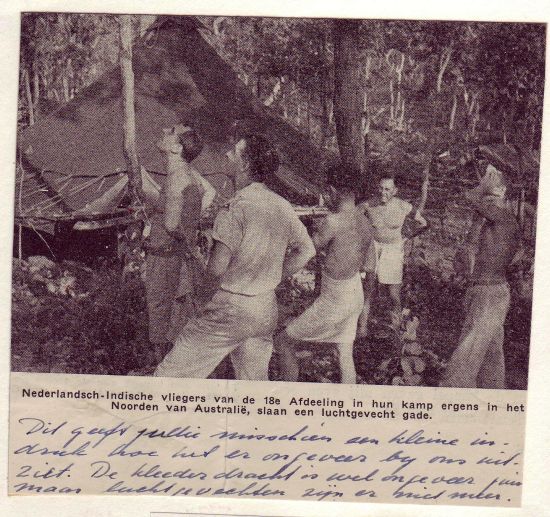
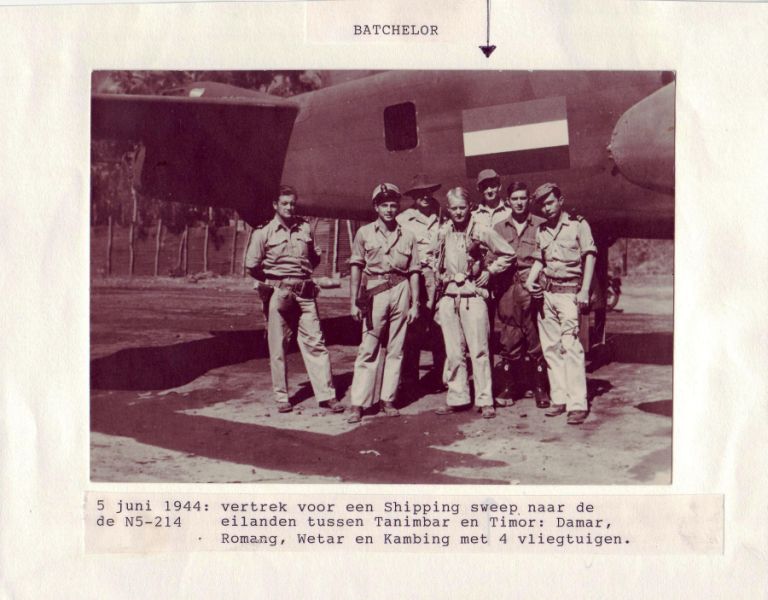
No. 18 Squadron was a combined Dutch–Australian unit operating North American B-25 Mitchell bombers. Dutch and Netherlands East Indies personnel generally provided the pilots, observers and wireless operators, while many of the air gunners and ground personnel were Australian.
From Batchelor in the Northern Territory, the squadron attacked Japanese airfields, shipping, military installations and supply positions across the occupied Netherlands East Indies.
Gerard joined the squadron towards the end of 1943 or early in 1944. He served as a pilot and was the second pilot aboard B-25 Mitchell N5-214 on its final mission.
His surviving letters offer a personal perspective on life within the squadron and the risks faced by the crews flying long missions over Japanese-occupied territory.
Read the broader history of the unit in the related DACC article No. 18 (Netherlands East Indies) Squadron RAAF.
Gerard’s wartime letters
Gerard maintained an extensive correspondence throughout his wartime journey. Because direct communication with his family in the occupied Netherlands was extremely difficult, he wrote particularly frequently to his sister Willemien in Bombay and to his uncle Frits and aunt To in Oberlin, Ohio.

These letters were carefully preserved.
In 1991, Gerard’s sisters Willemien, Pans and Marianne assembled his letters, photographs and documents into a family book titled:
Het Vaderland Getrouwe, … en zo denk ik er ook over, 12 juni 1940.
The title may be translated as Faithful to the Fatherland, … and that is how I feel about it too, 12 June 1940.
The collection allows Gerard’s experiences to be followed from England in 1940, through the Netherlands East Indies, Australia and the United States, to his final months with No. 18 Squadron.
The letters have subsequently been published online by TracesOfWar with the family’s permission. They transform Gerard’s story from a short military record into a personal account of separation, training, friendship, uncertainty and service.
The final mission of N5-214
On the night of 31 August–1 September 1944, B-25 Mitchell N5-214 took part in a bombing operation against Japanese positions at Langgoer in the Kei Islands.
The aircraft’s crew comprised:
- Augustus Alfred Dreher—pilot;
- Gerard Johan Lugt—second pilot;
- Waldemar Guido Franken—bombardier and navigator;
- Robbert Willem Marsman—wireless telegraphy operator;
- Annes Edward Donk—turret gunner; and
- Thomas Hugh Barclay RAAF—tail gunner.
The aircraft was lost to enemy action over the target area.
The Lugt family account and other records identify Japanese anti-aircraft fire as the cause. Operational evidence indicates that N5-214 was seen descending after apparently being hit, followed by an explosion and falling debris. Reports also mentioned the possible presence of a Japanese night fighter. It is therefore safest to record that the aircraft was lost to enemy action, most probably anti-aircraft fire.
All six crew members were killed.
Only a few days earlier, on 23 August, Gerard had ended a short letter to his aunt and uncle with the words:
“Keep your fingers crossed, we need it.”
For Gerard’s family in the occupied Netherlands, definite news came slowly. They learned of his death only in April 1945 and were initially told that the burning wreckage had fallen into the sea.
Finding Gerard’s grave
For many years, Gerard’s sisters did not know that he had an identified grave.
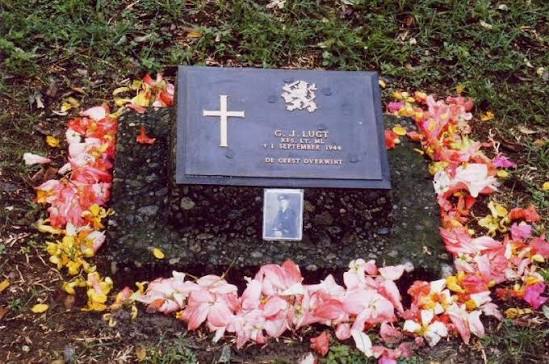
In 1985, more than forty years after his death, Gerard’s nephew Koos enquired through a contact associated with the Netherlands War Graves Foundation. A registration card was subsequently located showing that Gerard had been buried at the Galala War Cemetery on Ambon.
In May and June 1991, his three sisters travelled to Ambon. They visited Gerard’s grave and those of his crewmates, laid flowers and photographed the cemetery.
After returning to the Netherlands, Marianne Lugt brought together Gerard’s surviving letters, photographs and documents. Willemien and Pans contributed their recollections.
The resulting family book was symbolically presented to Gerard at his grave on Ambon on 3 June 1991.
Remembering Gerard Lugt and his crew
Gerard Johan Lugt’s life reflects the extraordinary wartime journeys made by Dutch and Netherlands East Indies airmen.
He began the war as an engineering student stranded in England, travelled to the Netherlands East Indies, escaped to Australia, trained in the United States and returned to serve from an Australian air base against Japanese forces occupying Dutch territory.
His surviving letters add an important human dimension to the operational history of No. 18 Squadron. They preserve the thoughts of a young man separated from his family who continued serving despite the growing dangers confronting the squadron.
Gerard’s story should also be remembered as part of the shared history of the entire N5-214 crew—five Dutch servicemen and one Australian air gunner who died together on 1 September 1944.
Related DACC articles
- DACC Air Force Research Portal
- No. 18 (Netherlands East Indies) Squadron RAAF
- Batchelor airfield and the Dutch presence during World War II
- Australian and Dutch personnel of No. 18 Squadron
- Major B.J. Fiedeldij and No. 18 Squadron
Sources and further reading
- TracesOfWar, Gerard Johan Lugt, brieven van een vliegenier. The letters and photographs are reproduced on the DACC website with permission and source attribution.
- Australian War Memorial, Flight Sergeant Thomas Hugh Barclay.
- Aviation Heritage Museum of Western Australia, Thomas Hugh Barclay—N5-214.
- Commonwealth War Graves Commission, Flight Sergeant Thomas Hugh Barclay.
- No. 18 (Netherlands East Indies) Squadron RAAF.
Source and more information: TracesOfWar