About the collection
Evert Herman van Hummel worked as a ground engineer and flight engineer from 1938 until approximately 1970. His aviation career encompassed the Netherlands East Indies civil airline KNILM, wartime service associated with the Royal Netherlands Navy Air Service, postwar employment with KLM, and later flying with Schreiner Airways and Transavia.
The photographs, postcards and documents reproduced here form part of the Evert Herman van Hummel Collection donated to the Dutch Australian Cultural Centre.
Many of the photographs arrived without captions or accompanying information. They are published as an historical research collection so that aircraft, locations, occasions and people may eventually be identified.
Van Hummel’s life and aviation career are described in the related article Evert Herman van Hummel: from KNILM’s last escape flight to a Catalina crash.
Early aviation career
The following photographs appear to document Van Hummel’s early aviation career during the 1930s and early 1940s. This period included his technical training in the Netherlands and his work with KNILM in the Netherlands East Indies.
Known or provisionally identified people include Geert Hag and Han Vierdag. Further information concerning the people, aircraft, locations and dates shown in these photographs is welcomed.
Photographs below are from the early aviation career of Evert Herman van Hummel, probably dating from the 1930s and early 1940s. Most of the people, aircraft and locations have not yet been identified. DACC Evert Herman van Hummel Collection.


Wartime service
After escaping from Java aboard the Douglas DC-3 Wielewaal in March 1942, Van Hummel continued working in Allied aviation. He subsequently served as a flight engineer with Dutch naval aviation personnel operating Catalina flying boats.
On 23 October 1945, he survived the crash landing of Catalina Y-62 at Biak in Netherlands New Guinea.
Photographs associated with Evert Herman van Hummel’s wartime aviation service. Further identification of the personnel, aircraft, locations and dates is welcomed. DACC Evert Herman van Hummel Collection.
The complete account of the accident is included in Evert Herman van Hummel: from KNILM’s last escape flight to a Catalina crash.


Wartime postcards
Postcards preserved in the Evert Herman van Hummel Collection. Some may relate to his wartime movements between Australia, Ceylon and the Netherlands East Indies. DACC Evert Herman van Hummel Collection.


Postwar career with KLM
Van Hummel returned to civil aviation after the war and resumed employment as a KLM flight engineer on 1 August 1948. His work took him across Europe, the Middle East, Asia and Australia.
The following photographs document the early postwar period of his KLM career.


Veel groeten van Evert Herman


Schreiner Airways and later aviation
Van Hummel later flew for Schreiner Airways and, from 1968 until 1971, for Transavia. His Schreiner work included relief operations associated with the Nigerian–Biafran conflict.
Photographs and postcards relating to the later aviation career of Evert Herman van Hummel, including his employment with Schreiner Airways. Further identification is welcomed. DACC Evert Herman van Hummel Collection.


Reunion with the Wielewaal
In 2000, Van Hummel visited the Queensland Air Museum at Caloundra and was reunited with the former KLM and KNILM Douglas DC-3 Wielewaal. He had escaped from Java aboard this aircraft on 7 March 1942.
The aircraft’s history is described in From Wielewaal to VH-ANR: a Dutch DC-3 preserved in Queensland.
Evert Herman van Hummel reunited with the former KLM and KNILM Douglas DC-3 Wielewaal at the Queensland Air Museum in Caloundra in 2000. Van Hummel escaped from Java aboard this aircraft on 7 March 1942. It is preserved under its postwar Australian registration VH-ANR and in Airlines of New South Wales colours. DACC Evert Herman van Hummel Collection.

An unidentified photograph connected with early flights to the East Indies
One photograph in the collection carries information connecting it with an early flight between the Netherlands and the Netherlands East Indies. The accompanying notes refer to the aircraft Postduif, Hendrik van Weerden Poelman, engine trouble in Allahabad and Koos Roos.
These details may combine information about more than one pioneering flight.
The first flight from the Netherlands to the Netherlands East Indies was undertaken in 1924 using the single-engine Fokker F.VII H-NACC. Its crew comprised Jan Thomassen à Thuessink van der Hoop, Lieutenant Hendrik van Weerden Poelman and flight engineer Pieter van den Broeke. Engine trouble at Philippopolis—present-day Plovdiv in Bulgaria—delayed that journey for approximately one month.
The later aircraft known as the Postduif belonged to a different period of Dutch aviation. Further research is therefore required before the photograph and its handwritten information can be connected with a particular flight.

Luchtvaartafdeling training group
Another photograph shows a group associated with the Netherlands Army Aviation Department—the Luchtvaartafdeling or LVA—during the 1930s. Dr Peter Boer identified the aircraft as a Fokker C.V and the man seated second from the right as Sergeant-Major Flying Instructor J.J. Buwalda.
Family information suggests that Evert Herman van Hummel may be the fifth man from the right in the back row, although this has not been confirmed.
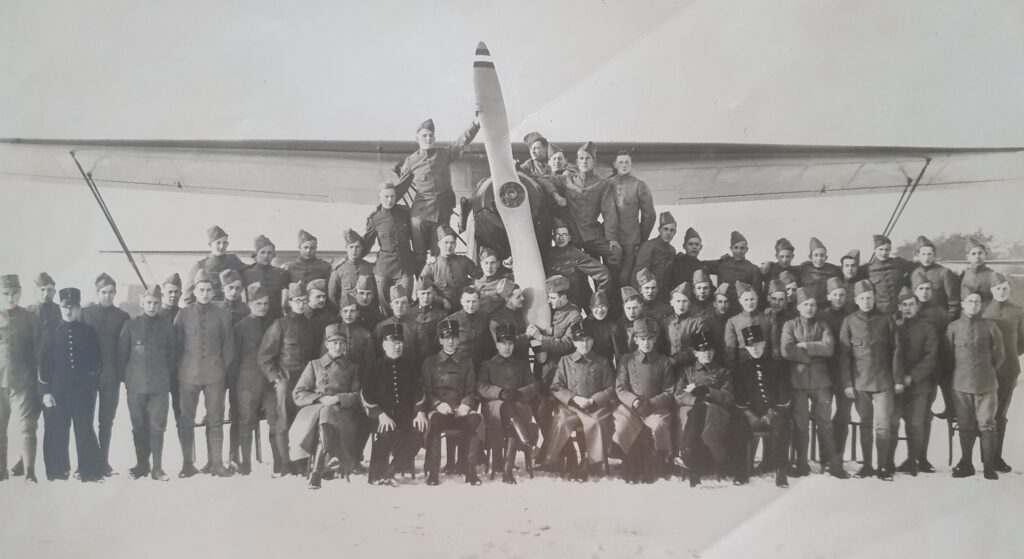
Group of Luchtvaartafdeling personnel with a Fokker C.V during the 1930s. Sergeant-Major Flying Instructor J.J. Buwalda is seated second from the right. Evert Herman van Hummel may be the fifth man from the right in the back row. Identification: Dr Peter Boer and the Van Hummel family. DACC Evert Herman van Hummel Collection.
Assistance with identification
The Dutch Australian Cultural Centre welcomes assistance from former aviation personnel, researchers and family members who may recognise:
- individuals appearing in the photographs;
- aircraft types and registrations;
- airports and other locations;
- military or airline units;
- particular flights or events; and
- approximate dates.
When supplying information, please identify the relevant photograph as clearly as possible and indicate the source of the identification.
Related DACC articles
- Evert Herman van Hummel: from KNILM’s last escape flight to a Catalina crash
- From Wielewaal to VH-ANR: a Dutch DC-3 preserved in Queensland
- KNILM and its Australian connection
- Royal Netherlands Navy flying-boat operations in Australia during WWII
- KLM’s return to Australia: the Constellation and the first postwar civilian service
- DACC Air Force Research Portal