Dutch servicewomen train in wartime Brisbane
In 1944, members of the newly formed Women’s Corps of the Royal Netherlands East Indies Army—the VK-KNIL—trained with American servicewomen at Yeronga Park in Brisbane. Their meeting brought together two separate military organisations: the Dutch VK-KNIL and the United States Women’s Army Corps (WAC).
This article forms part of the VK-KNIL Research Portal.
An American camp in a Brisbane park
The US Army established Camp Yeronga Park in 1942. Military police, signallers, supply personnel and members of the American WAC were among those stationed there. A public park that had previously accommodated sport and recreation thus became part of Brisbane’s extensive Allied military network.
The Queensland World War II Historic Places account of Camp Yeronga Park records that Dutch servicewomen joined the American WAC personnel for training there in July 1944.
The VK-KNIL had been formally established in Melbourne only a few months earlier, on 5 March. Training alongside the Americans gave its members contact with an established women’s military organisation. It did not, however, make the Dutch women members of the US WAC. Although they were sometimes informally called “Dutch WACs”, they remained part of the Royal Netherlands East Indies Army.
When did the Dutch women arrive?
The evidence suggests that Dutch women reached Brisbane in stages, rather than as a single contingent.
The Queensland site history dates the start of joint training at Yeronga to July 1944. Joan van Embden-Butler’s surviving movement order directed her and fellow Western Australian recruits Dina Freese and Johanna Mol to arrive in Brisbane by 15 August. In Chapter 7 of Allies in a Bind, historian Jack Ford describes the Women’s KNIL Corps as moving from Melbourne to Brisbane in September. Personal stories of these women are available from the VK-KNIL Research Portal.
These dates may refer to different stages—early arrivals, further recruits and the movement of the organised unit. The surviving evidence does not yet establish precisely how long each woman trained at Yeronga or whether every member of the Brisbane contingent trained there.
A welcome at the WAC mess
One event can be dated precisely. On 26 September 1944, the American WAC personnel hosted a welcome lunch for the Dutch women in their mess at Yeronga Park. Ford records that the Dutch unit then numbered 26 women and was led by a male officer.
Photographs of the Dutch and American servicewomen together make this meeting a visible part of Brisbane’s wartime history. They also help explain why the names of the two corps have sometimes been confused. The women met and trained together, but served under different national commands.
Photographs below. American WACs welcome Dutch VK-KNIL members at Camp Yeronga, 26 September 1944. Reproduced by Australia @ War; original photographer and collection not yet identified.


Kruyswijk-van Thiel records a separate episode in which selected VK-KNIL women undertook cadre training in Brisbane before three officers took the oath on 16 May 1945. She describes the instructors as “Australian WACs.” This terminology is uncertain because Australia’s corresponding organisation was officially the Australian Women’s Army Service, while the Women’s Army Corps was American. It is therefore not yet clear whether this later cadre course was conducted by Australian servicewomen, American WAC personnel or a combination of Allied instructors. It should not be confused with the documented cooperation between the VK-KNIL and American WACs at Yeronga Park in 1944.
Yeronga and Camp Columbia
Yeronga Park was a training location, while Camp Columbia at Wacol was another important centre of VK-KNIL activity in Brisbane. Some women who trained at Yeronga subsequently lived and worked at Camp Columbia. The two sites should not be treated as one camp.
The photographs of the joint training and welcome lunch belong with the Yeronga Park story. Photographs documenting accommodation, offices, messes, social activities and civilian employees at Camp Columbia are included in the separate DACC and Camp Columbia articles about that site.

Remembering their presence
The American military presence at Yeronga Park is commemorated locally, including the service of the US Women’s Army Corps. The Dutch women’s period of training is less visible at the site.
Their story is nevertheless distinctive. For a brief period in 1944, a new Dutch women’s corps and its more experienced American counterpart met in a Brisbane public park converted into an Allied military camp. The welcome lunch, movement records and surviving photographs allow us to recover that moment without confusing the two organisations or overstating what is known about the training itself.
Photo gallery
The VK-KNIL was established in Melbourne on 5 March 1944. Its members served in transport, communications, medical, clerical, administrative and supply roles, releasing other military personnel for operational duties.
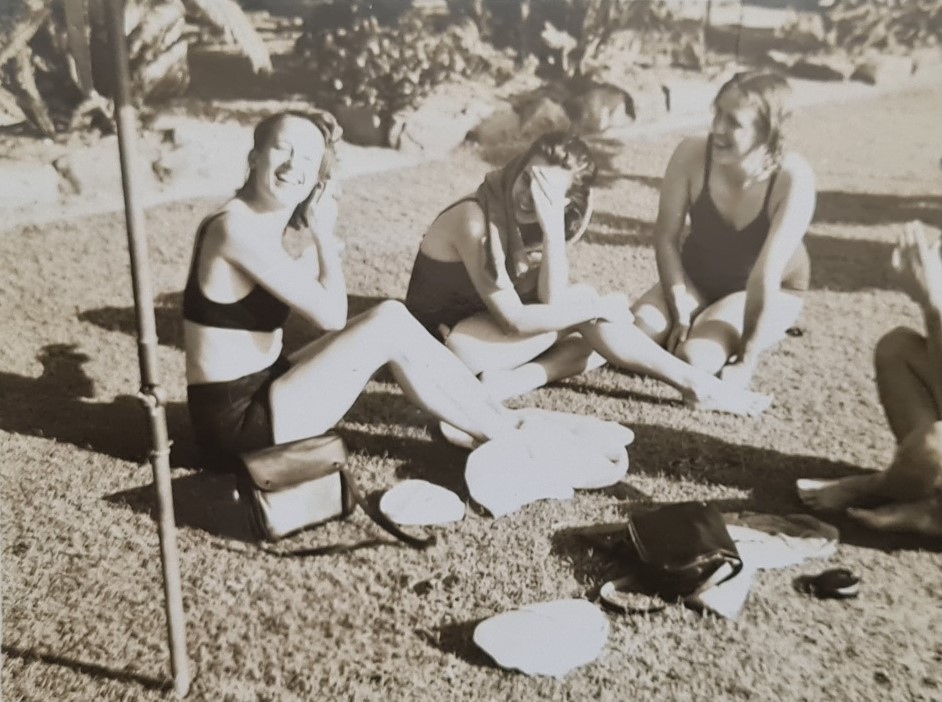
The first two photographs below record Dutch VK-KNIL members with American Women’s Army Corps personnel at Yeronga Park in 1944. The recreational photographs provide a less formal glimpse of women associated with the Dutch wartime community in Brisbane. Because not everyone has been identified, these images may include both VK-KNIL members and civilian employees connected with Camp Columbia.
Sources: Netherlands Ministry of Defence, Australia @ War and the Joan McConachy collection.


Recreation and social life in Brisbane
Women serving or working with Dutch organisations in Brisbane also participated in picnics, swimming excursions and other recreational activities. Surviving photographs do not always identify the women or distinguish VK-KNIL members from Australian civilian employees. They nevertheless provide valuable evidence of the social life surrounding the Dutch military community.
The two foto’s below are from photo the collection Ms Joan McConaghy, secretary at Camp Columbia.

Sources and further reading
- Jack Ford, Allies in a Bind: Australia and the Netherlands East Indies in the Second World War, Chapter 7, on the Women’s KNIL Corps in Brisbane and the welcome lunch of 26 September 1944.
- Queensland Government, Camp Yeronga Park (US).
- Joan van Embden-Butler’s movement order and recollections, reproduced in the Camp Columbia Heritage Association collection.
- Sophia Kruyswijk-van Thiel, Het Vrouwenkorps-KNIL, Dutch University Press, Amsterdam, 2004.
This article is part of the DACC VK-KNIL Research Portal, which brings together the history and personal stories of Dutch women in military service during and after the Second World War.
Paul Budde, January 2023; last updated October 2026