In his forthcoming book Bloedrode dageraad: De Tweede Wereldoorlog en de geboorte van het moderne Azië (Blood Red Dawn: The Second World War and the Birth of Modern Asia), historian Hans van de Ven argues that the Second World War should not only be viewed as a struggle against Nazi Germany and Imperial Japan. From an Asian perspective, the war was also the catalyst for the collapse of colonial empires and the birth of the modern Asian nations that today play a central role in world affairs. This prompted me to write the following story.
For many people in Europe and North America, the Second World War is remembered primarily as a military conflict that ended with the defeat of Germany and Japan. In Asia, however, the war is often seen as the beginning of a profound political transformation. The conflict accelerated the collapse of European colonial rule and laid the foundations for the independent nations that dominate much of the region today.
Understanding this Asian perspective is important because many of the geopolitical realities that shape our world—from Indonesia’s emergence as a regional power to tensions in the Taiwan Strait and on the Korean Peninsula—can be traced back to the upheavals of the 1940s and 1950s.
The collapse of the colonial order
Before the war, much of Asia remained under European colonial rule. Britain governed India, Burma and Malaya; France controlled Indochina; and the Netherlands ruled the Dutch East Indies. European power appeared secure and unchallenged.
Japan’s rapid victories between 1941 and 1942 changed that perception dramatically. The fall of Singapore, the conquest of the Dutch East Indies and the defeat of Western colonial armies shattered the image of European invincibility.
For many Asian nationalists, the war became more than a conflict between the Allies and the Axis powers. It became an opportunity to challenge colonial rule. Nationalist leaders such as Sukarno in Indonesia, Aung San in Burma and Subhas Chandra Bose in India sought to use the changing balance of power to advance the cause of independence.
While Japanese occupation often proved harsh and oppressive, it nevertheless exposed the vulnerability of the colonial powers and accelerated demands for self-government across the region. Many people saw them as liberators.
The war accelerated the emergence of a new Asia. India, Pakistan, Burma (Myanmar), Ceylon (Sri Lanka), the Philippines, Indonesia, Vietnam, Laos and Cambodia all emerged as independent nations in the years following the conflict. The European colonial order that had dominated much of Asia for centuries was rapidly dismantled.
A war that did not end in 1945
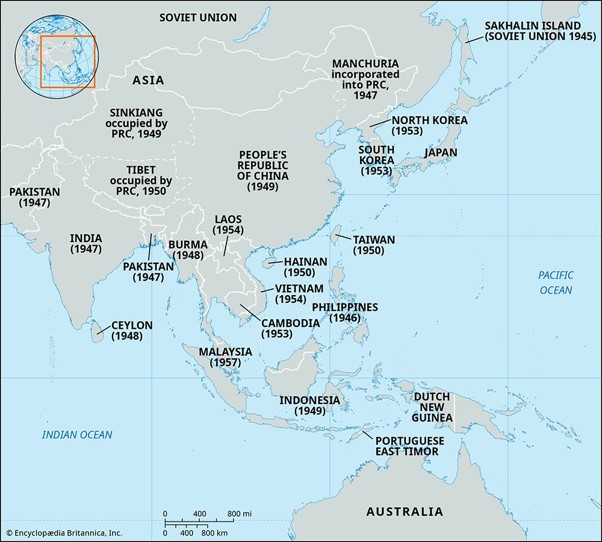
In Europe, the war largely ended with Germany’s surrender in May 1945. In Asia, however, the Japanese surrender marked not the end of conflict but the beginning of a new and often violent phase.
China descended into civil war between Nationalists and Communists. India experienced partition and communal violence.
In Indonesia, the declaration of independence in August 1945 was followed by the turbulent Bersiap period, during which revolutionary youth groups targeted Europeans, Eurasians, Chinese and others perceived as linked to the colonial order. The violence left deep scars on Indonesian-Dutch relations and was followed by a four-year war between the Republic of Indonesia and the Netherlands before sovereignty was formally transferred in 1949.
French attempts to regain control of Indochina led to prolonged warfare that would eventually draw in the United States. On the Korean Peninsula, the division between North and South eventually erupted into the Korean War, one of the first major conflicts of the Cold War.
Australia’s place in the transformation
Australia occupied a unique position in these developments. Following the Japanese advance through Southeast Asia, the country became the principal Allied base in the Southwest Pacific. General MacArthur established his headquarters in Brisbane, from where American operations across the region were coordinated.
At the same time, Dutch military forces, intelligence services and civil administrators relocated to Australia after the fall of the Dutch East Indies. Brisbane became home to significant Dutch wartime operations, linking Australia directly to the future political developments of Southeast Asia. The Nederlands East Indies Government-in-Exile, the Netherlands East Indies administration, military units and intelligence organisations all operated from Australian soil during the war. Readers interested in this aspect can find extensive coverage elsewhere on this website.
The war also transformed Australia itself. For decades Australian security had rested on the assumption that Britain would provide protection in times of crisis. The fall of Singapore in 1942 exposed the weakness of that assumption and fundamentally altered Australia’s strategic outlook.
Prime Minister John Curtin increasingly looked towards the United States as Australia’s principal security partner. The close wartime cooperation between Australian and American forces evolved into a long-term alliance that was later formalised through the ANZUS Treaty.
Although Australia did not experience decolonisation in the same way as its Asian neighbours, it nevertheless underwent a profound strategic transition. The war marked the beginning of Australia’s shift from a predominantly British orientation towards a closer engagement with both the United States and the emerging nations of Asia.
Bandung and the emergence of a new Asia
A powerful symbol of the new post-war Asia emerged in 1955 with the Bandung Conference in Indonesia.
Representatives from twenty-nine Asian and African countries gathered to discuss cooperation, development and freedom from colonial domination. Many of the leaders present had been directly shaped by the upheavals unleashed during the Second World War. The conference signalled that the political centre of gravity in Asia was shifting from the former colonial powers towards newly independent nations determined to chart their own course.
Significantly, none of the former European colonial powers were invited to participate. Neither Britain, France, the Netherlands, Belgium nor Portugal were represented. Australia was also absent. Despite its growing involvement in Asia and its important wartime role in the Southwest Pacific, Australia was still largely seen as part of the Western alliance system rather than as a participant in the emerging post-colonial movement.
There was also a certain historical irony in the choice of Bandung as the venue. Before the Second World War, Bandung had been one of the principal centres of Dutch colonial administration and culture in the Dutch East Indies. Often referred to as the “Paris of Java”, the city contained a substantial Dutch community and many of the educational, military and government institutions that underpinned colonial rule. Only a decade later the same city became the gathering place for leaders determined to move beyond the colonial era and establish a new role for Asia and Africa in world affairs.
For Indonesia, which had secured international recognition of its independence only six years earlier, the conference represented its arrival on the world stage as a sovereign nation. For many other Asian and African countries, Bandung became a symbol of a future no longer defined by colonial powers or Cold War superpowers.
The legacy today
The modern Asia that emerged from the aftermath of the Second World War has become one of the most dynamic regions in the world. Japan rebuilt itself into a global economic power. South Korea, Taiwan, Singapore and Hong Kong became the so-called Asian Tigers. China emerged as the world’s second-largest economy. India has become a major global player, while Indonesia has developed into one of the world’s largest democracies and an increasingly influential regional power.
At the same time, some of the unresolved issues of the wartime and post-war period remain visible. The division of Korea, tensions between China and Taiwan, territorial disputes in the South China Sea, memories of Japanese occupation, and competing interpretations of colonial and wartime history continue to influence regional politics. The trauma of the Bersiap period and the Indonesian struggle for independence also remain part of the complex historical relationship between Indonesia, the Netherlands and the wider Dutch-Indonesian diaspora.
Australia, which served as the principal Allied base in the Southwest Pacific and became deeply involved in the region’s post-war developments, remains closely connected to this history. The wartime cooperation between Australia and the Netherlands also left a lasting legacy. Defence and security links established during the war continue to this day, reflected in ongoing military cooperation and the presence of a Dutch Defence Attaché at the Embassy of the Kingdom of the Netherlands in Canberra.
Viewed from Europe, the Second World War ended with the defeat of Germany and Japan. Viewed from Asia, it marked the birth of a new era — one in which colonial empires gave way to independent nations and the foundations were laid for the Asian century that is now unfolding before our eyes.
Paul Budde
June 2026