Lieutenant Colonel B.J. Fiedeldij commanded No. 18 (Netherlands East Indies) Squadron RAAF during the difficult period in which it was transformed from a collection of evacuated personnel and newly delivered aircraft into an operational medium-bomber squadron.
Fiedeldij assumed command at Canberra on 1 May 1942. He remained commanding officer during the squadron’s training in southern Australia, its transfer to McDonald Airfield in the Northern Territory and its first months of operations against Japanese targets in the Netherlands East Indies.
Early life and military career
He pursued a career in Dutch military aviation and became a qualified pilot-observer with the Military Aviation of the Royal Netherlands East Indies Army—the Militaire Luchtvaart van het Koninklijk Nederlands-Indisch Leger, or ML-KNIL.
Following the Japanese invasion of the Netherlands East Indies, Fiedeldij reached Australia with other surviving Dutch military personnel. During the initial reorganisation of the KNIL in Australia, he served with the air-force staff at KNIL headquarters. He headed its flying-service office, assisted by Captain R.E. Jessurun.

On 28 April 1942, Fiedeldij was transferred to Canberra to take command of No. 18 Squadron. He formally assumed command on 1 May and was promoted from captain to major at approximately the same time.
The second photograph appears to be another copy or crop of the same portrait. I would use only the stronger landscape version—0807-067A-132-001—and omit 0807-067A-132-002 unless it shows some detail you particularly want to retain.
The information about his brothers, sister, Catholic upbringing and schooling can be preserved in your research notes, but I would not publish it until we identify the genealogical source. His birthplace, birth date, parents and military career provide sufficient personal context for this article.
Formation of No. 18 Squadron
No. 18 Squadron was formed at Canberra on 4 April 1942 as a joint Netherlands East Indies–Australian unit. The Netherlands East Indies authorities provided most of its pilots and other flying personnel, while the RAAF supplied Australian aircrew, ground staff, administration and operational support.
Captain W.F. Boot initially served as the squadron’s provisional commander. Difficulties soon developed within the unit, however, and Major B.J. Fiedeldij was sent to Canberra to assess the situation.
Fiedeldij visited the squadron approximately one week before his formal appointment. He identified a range of urgent organisational, personnel and equipment problems. He arrived with the unit on 28 April and assumed command from Boot on 1 May 1942, being promoted to major at about the same time.
Building an operational squadron
Fiedeldij inherited an organisation facing substantial difficulties. Its Dutch and Netherlands East Indies personnel had escaped from different locations during the collapse of Java, while its Australian contingent operated under a separate RAAF administrative structure.
Aircraft, weapons, spare parts, training facilities and qualified personnel were all in short supply. The squadron’s first B-25 Mitchells were also transferred to the United States Army Air Forces, requiring the crews to convert to a replacement group of aircraft.
Fiedeldij had to coordinate two parallel systems. Netherlands East Indies personnel remained subject to Dutch military authority, while Squadron Leader Leslie Roy Dawson administered the Australian component. Responsibility for discipline, postings, equipment and operations consequently required continual negotiation between Dutch, Australian and American authorities.
Under Fiedeldij, a more workable command and administrative organisation gradually emerged. Captain R.E. Jessurun became the senior Netherlands East Indies administrative officer and acted as deputy commander when Fiedeldij was absent.
Training in southern Australia
The squadron trained principally from Canberra during 1942. Its program included conversion to the B-25 Mitchell, navigation, formation flying, bombing, air-to-air firing and anti-submarine patrols.
Crews also operated from Moruya and undertook bombing and gunnery exercises at Nowra. Poor weather, shortages of practice bombs, unsuitable bombsights and problems with the B-25 gun turrets repeatedly disrupted the program.
Fiedeldij pressed for the aircraft, weapons, personnel and equipment required to make the squadron operational. By late 1942, eighteen B-25 Mitchells had been assembled, armed and prepared for the move north, although some aircrew still required further training.
Moving to McDonald Airfield
The transfer of No. 18 Squadron to McDonald Airfield in the Northern Territory began in December 1942.
Moving a large mixed Dutch–Australian squadron and hundreds of tonnes of equipment across the continent was a major undertaking. Advance, main, air and rear parties travelled by aircraft, rail, road and sea.
McDonald was an isolated and incompletely developed airfield. Squadron personnel erected tents, enlarged aircraft dispersal bays, improved drainage, constructed water facilities and established communications while preparing for operations.
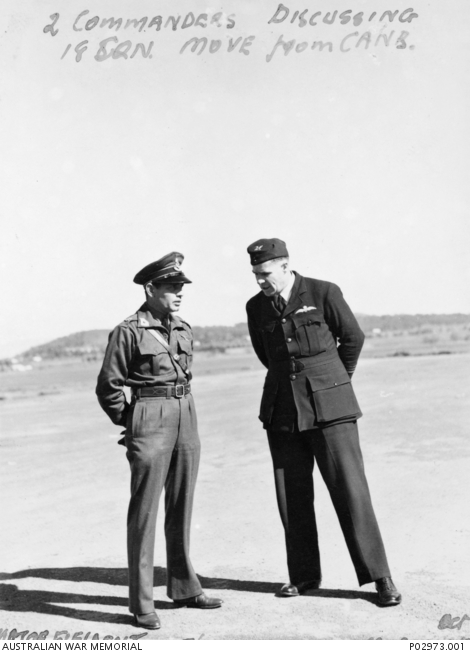
Fiedeldij worked closely with Squadron Leader Dawson in organising the move. An Australian War Memorial photograph taken at Canberra in October 1942 shows the two officers discussing the squadron’s transfer to the Northern Territory.
First combat operations
No. 18 Squadron began flying operations from McDonald in January 1943. Its B-25s conducted reconnaissance, bombing and anti-shipping missions against Japanese positions in Timor and other parts of the occupied Netherlands East Indies.
Although his principal responsibility was command, Fiedeldij sometimes accompanied operational missions as a second pilot. His participation allowed him to observe the difficult conditions encountered by the crews and helped maintain morale.
The squadron was being asked to fly missions close to the limits of the B-25’s range. Aircraft carried heavy bomb loads and ammunition while requiring enough fuel for the outward flight, combat manoeuvring and a safe return to Australia.
Following several dangerous incidents, Fiedeldij argued that the operational radius demanded of the squadron was excessive. He also sought improvements to the B-25s’ forward-firing armament, fuel capacity and defensive protection.
These concerns contributed to the reduction of the squadron’s required operational range and the modification of its Mitchells for low-level attacks.
Transfer to Batchelor
In April and May 1943, No. 18 Squadron transferred from McDonald to Batchelor Airfield. Batchelor offered better facilities and became the squadron’s principal operational base.
By this stage, the unit had survived its most difficult formative period and had developed into an experienced operational squadron. Dutch, Indonesian and Australian personnel had learned to work within its unusual combined command structure despite shortages, administrative disagreements and demanding operational conditions.
Fiedeldij relinquished command on 11 June 1943. He was succeeded by Lieutenant Colonel E.J.G. te Roller.
Later career

Fiedeldij continued his career in Dutch military aviation after his service with No. 18 Squadron.
He ultimately attained the rank of commodore pilot-observer in the Royal Netherlands Air Force and served as Commandant of Aviation Training. Training material preserved by the National Military Museum records his association with instruction for pilots flying the Harvard training aircraft.
Fiedeldij retired from active service on 1 March 1956. A photograph of his farewell reception shows him with Lieutenant General Observer A. Baretta, Chief of the Netherlands Air Staff and Commander of the Royal Netherlands Air Force.
Historical significance
Fiedeldij’s importance lies particularly in his leadership during No. 18 Squadron’s formative year.
He oversaw:
- the reorganisation of the unit at Canberra;
- cooperation between its Netherlands East Indies and Australian components;
- the arrival and preparation of its replacement B-25 Mitchells;
- the squadron’s bombing and gunnery training;
- its complex transfer to the Northern Territory;
- its first combat operations from McDonald;
- efforts to reduce the excessive range demanded of its aircraft; and
- proposals to improve the armament and operational effectiveness of its B-25s.
By the time Fiedeldij relinquished command in June 1943, No. 18 Squadron had developed from a hastily assembled formation into an operational bomber unit capable of carrying the war back into the occupied Netherlands East Indies.

Related DACC articles
- DACC Air Force Research Portal
- No. 18 (Netherlands East Indies) Squadron RAAF
- No. 18 Squadron’s bombing and gunnery training at Nowra
- No. 18 Squadron moves to McDonald Airfield
- The Dutch at Batchelor Airport
Sources and further reading
National Military Museum, Harvard II B: instructions for pilots by B.J. Fiedeldij.
P.C. Boer, No. 18 (N.E.I.) Squadron RAAF: the first difficult year, 4 April 1942–May 1943.
Australian War Memorial, No. 18 (NEI) Squadron RAAF.
Australian War Memorial, B.J. Fiedeldij and Leslie Roy Dawson at Canberra, October 1942.