At the turn of the 20th century, as Australia’s ports and rivers underwent significant development to support growing trade and migration, Dutch engineering quietly played a foundational role. Central to this was the Dutch firm A.F. Smulders, an industrial and shipbuilding company based in Schiedam, near Rotterdam.
Dutch ingenuity and global reach
Founded in the mid-19th century by Albert Frans Smulders, the company quickly established itself as one of the Netherlands’ leading producers of heavy machinery, cranes, steam engines, and especially dredging equipment. With extensive facilities along the Nieuwe Maas, A.F. Smulders became a key exporter of modular-built vessels and industrial components, which could be disassembled, shipped abroad, and reassembled at their destination.
This flexible approach found a ready market in rapidly industrialising regions of the world, including colonial outposts in Southeast Asia, Africa, and Australasia.

The South Australian: a Dutch dredge on Australian waters
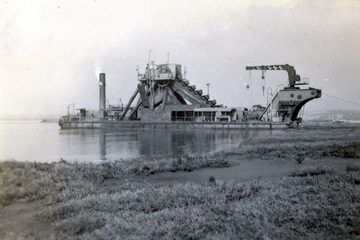
The steam dredge South Australian was built by A.F. Smulders at Schiedam in the Netherlands in 1910–1911 for the South Australian government. Its hull was launched in April 1910, and the completed vessel commenced dredging operations at Port Adelaide in 1912. The bucket dredge subsequently served South Australia’s ports for approximately 70 years, undergoing major modernisation in 1971 when its steam engines were replaced by diesel machinery.
The South Australian was a steam-powered bucket dredge, designed to deepen and maintain shipping channels along the Port River and other strategic waterways. It played a vital role in expanding South Australia’s maritime infrastructure and remained in operation well into the 20th century.
Today, it is recognised by maritime historians and heritage organisations as a rare example of early international engineering collaboration.
Smulders’ broader impact
A.F. Smulders was part of the internationally active Dutch engineering industry that supplied specialised machinery and equipment for harbour construction, dredging and industrial development during the late nineteenth and early twentieth centuries.
The company’s ability to manufacture complex dredging equipment in the Netherlands and transport it overseas for assembly demonstrated the international reach of Dutch industrial engineering.
The steam dredge South Australian provides a documented example of this expertise being applied to Australian maritime infrastructure. It also illustrates how Dutch manufacturers contributed to Australia’s industrial development well before the larger Dutch dredging companies established their operations in Australia during the twentieth century.
A shared industrial heritage
The story of A.F. Smulders highlights the role of Dutch engineering in the development of modern Australia. It reminds us that the Dutch contribution to Australia’s progress went beyond migration and agriculture to include world-class industrial know-how.
As efforts grow to preserve and document industrial heritage, the legacy of companies like A.F. Smulders offers an important perspective on the shared history of innovation between the Netherlands and Australia.
For the wider history and related company, project and personal stories, see the Dutch dredging in Australia – Research Portal.
See also Gusto – formerly A.F. Smulders