By Julia Weisz
This article outlines the journey of Heinrich (Heini) Kuhn and Josefine (Fini) Kuhn, whose lives reflect the experience of many European Jewish families displaced by war, persecution, and political upheaval, and who later became part of Australia’s post-war migrant community.
Early life and migration to the Netherlands East Indies
Both Heini and Fini were born in Central Europe in the early twentieth century and came from families already shaped by migration and economic hardship. Rising antisemitism and political radicalisation in the 1930s made continued life in Europe increasingly untenable. In 1935, Heini left Vienna for the Netherlands East Indies (NEI), where his professional skills as a dental technician were in demand. Fini followed in 1937, leaving close family members behind in Europe, many of whom would later perish during the Holocaust.
Heini and Fini married in Surabaya and made their home in Bandung, a cooler mountain city with a strong Dutch presence. They lived largely within a small circle of Jewish European émigrés rather than within Dutch colonial society at large. Their home became a place of hospitality and informal refuge for newly arrived refugees, reflecting the mutual support networks that developed among displaced Europeans in the NEI.
As German-speaking Austrians living in a Dutch colonial environment after the German invasion of the Netherlands, they were conscious of growing suspicion and the risk of being misidentified as aligned with Nazi Germany. To avoid ostracism, they took on Dutch citizenship while living in the NEI, a pragmatic decision made by a number of refugees at the time.
War and internment in the Netherlands East Indies
Following the Japanese invasion of the Netherlands East Indies in 1942, this decision had unintended consequences. Dutch nationals were classified as enemy civilians and were interned by the Japanese authorities. Heini and Fini were separated and held in Japanese internment camps for the duration of the war. Conditions in these camps were harsh, marked by overcrowding, malnutrition, forced labour, illness, and strict discipline.
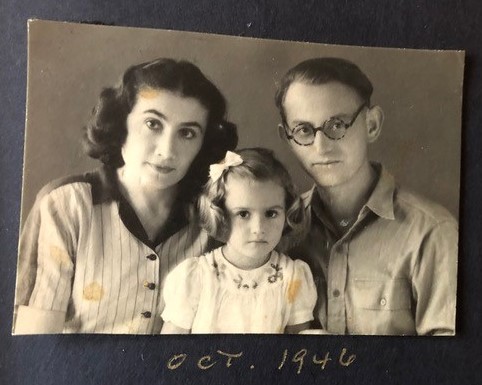
During this period, the couple’s daughter Judith, born in Bandung, survived infancy in the camps against all odds. One enduring object from this time is a small embroidered cloth book created for her by women in the camp. The book depicts animals, toys, and colour — elements absent from camp life — and remains a quiet testament to humanity, solidarity, and care under extreme conditions.
Post-war displacement and migration to Australia
After the end of the war, the family returned briefly to Bandung, only to find that their former life had effectively vanished. Their second daughter Julia (me) was born in Bandung in 1948. The Bersiap period of political violence and instability surrounding the Indonesian struggle for independence made continued residence unsafe. As with many displaced families, the Kuhns attempted to resettle more than once, including a period in South America, before concluding that a permanent future there was not viable.
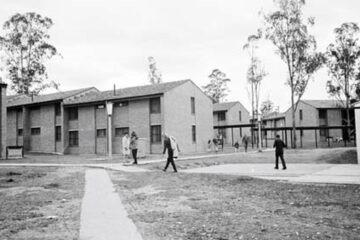
In 1958, the family decided to leave Indonesia permanently and migrate to Australia. The journey itself was uncertain and unsettling. Flights were delayed, movement was closely supervised, and soldiers escorted departing passengers. They arrived with few possessions and little certainty about what awaited them. On arrival, the family was sent to the Bonegilla migrant reception centre. Conditions there — temporary accommodation, regimented routines, and a highly institutional environment — triggered memories of earlier wartime imprisonment. Fini and Heini decided almost immediately that they would not remain there and began seeking alternatives.
With assistance from Jewish welfare organisations, the family moved on to Sydney. Their settlement followed a familiar post-war migrant pathway: reliance on community support networks, the challenge of re-establishing professional life, and the task of rebuilding family stability in an unfamiliar country. Over time, they became part of Australia’s growing post-war migrant population.
The Kuhn family’s story illustrates broader historical patterns shared by many Dutch–Australian and Jewish families: forced migration, wartime internment, repeated displacement, and the long process of rebuilding lives across continents. It highlights how global conflict, shifting national identities, and wartime classifications shaped individual lives in ways that were often arbitrary and deeply consequential.
See also
Migration and Repatriation issues after the liberation of NEI
Japanese concentration camp Palembang and the Paradise Road Women Choir
Japanese internees and Dutch migrants: the story of the Lawant family
Eugenie Blackney survived the Japanese camps
Displays from Japanese prisoners camp Kareës at Australian War memorial