Introduction
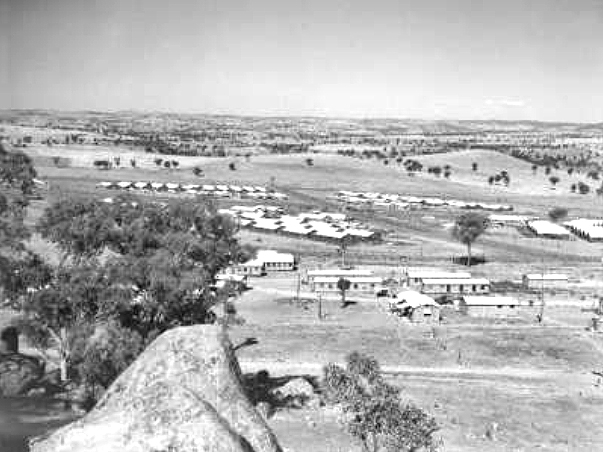
During the Second World War, the internment complex at Cowra became one of Australia’s most significant wartime detention sites. While best known for housing Italian and Japanese prisoners of war, Cowra also played a lesser-known but historically important role in the detention of Indonesians under Dutch authority.
As documented by Jack Ford in Allies in a Bind, Cowra became a key location where labour conflict, colonial policy and emerging Indonesian nationalism intersected. Over time, it evolved from a site of wartime control into a focal point of political tension that contributed to a broader shift in Australian attitudes towards Indonesia and Dutch colonial rule.
From labour dispute to internment
Cowra first entered the Dutch–Indonesian story in 1942 following the Indonesian seamen’s strike . The dispute, involving approximately 2,000 Indonesian crewmen employed on Dutch merchant vessels in Australia, arose over wages and working conditions.
The Dutch authorities responded by arresting large numbers of strikers. According to Ford, around 800 Indonesian seamen were initially imprisoned in Sydney before being transferred to internment camps, including Cowra and Loveday. At Cowra, these detainees were held within the broader prisoner-of-war camp system.
This marked a significant escalation. What had begun as a labour dispute was transformed into a matter of detention and control, bringing Indonesian workers under a system designed primarily for enemy nationals.
The arrival of political prisoners
The role of Cowra expanded further in 1943 with the arrival of Indonesian political detainees evacuated from Tanah Merah (Boven-Digoel). These individuals, many of whom were associated with nationalist and left-wing movements, had been held by the Dutch colonial administration prior to the war.
Ford records that these internees were transported to Australia and held in facilities including Cowra, where they were placed within designated compounds of the prisoner-of-war camp. This created a highly unusual situation: political detainees, not enemy combatants, were being held in a camp designed for prisoners of war.
The implications were significant. The detention of Indonesian nationalists on Australian soil raised questions about legality, jurisdiction and the extent to which Dutch colonial authority could be exercised within Australia.
Dutch authority and Australian limits
The presence of Indonesian detainees at Cowra exposed fundamental tensions between Dutch and Australian approaches. The Dutch sought to maintain control over their colonial subjects, including the application of their own legal and disciplinary systems.
Australia, however, was a sovereign state with its own legal framework. While willing to cooperate with a wartime ally, the Australian government became increasingly uneasy about the detention of individuals without clear legal justification under Australian law.
This tension was particularly evident in the classification of certain detainees as “dangerous”. The Dutch authorities argued that some internees posed a political threat, particularly due to their communist affiliations. However, Australian authorities were not convinced.
On 6 April 1944, the bulk of the remaining Indonesian internees at Cowra were released. The Netherlands East Indies Commission retained 18 individuals classified as “dangerous”, although on appeal four of these were also released. The Australian Government noted that “no factual evidence was brought forward by the Dutch to justify the claim that these 18 men were in fact dangerous”, as their only admitted offence was their identification as communists. The Dutch subsequently returned the remaining 13 internees (one having died) to Tanah Merah before the end of the war.
This episode marked a clear assertion of Australian authority. It demonstrated that Dutch colonial classifications would not be accepted without evidence and that Australian legal and political standards would ultimately prevail.
Human consequences: the Cowra graves
The detention of Indonesians at Cowra also had human consequences. The Indonesian war graves at Cowra, which include the graves of 13 political detainees, provide tangible evidence of the conditions and hardships experienced by those held in the camp.
These graves serve as a reminder that the policies applied by the Dutch authorities in Australia were not merely administrative but had real and lasting impacts on individuals.
From detention to political mobilisation
The release of detainees did not mark the end of their influence. On the contrary, it marked the beginning of a new phase.
Former internees, including figures such as Sardjono and Boerhanoedin, became active within Netherlands East Indies organisations operating in Australia. Many gravitated towards the Netherlands Indies Government Information Service (NEIGIS/NIGIS), an organisation intended to support Dutch wartime objectives.
This development was deeply ironic. NIGIS, which had been designed as an instrument of Dutch political warfare, became a space in which Indonesian nationalist and left-wing ideas could circulate. Its membership included individuals with strong political convictions, as well as figures such as the Dutch filmmaker Joris Ivens, whose presence further heightened concerns about ideological influence.
Communist and nationalist involvement reached a peak with the formation of the Serikat Indonesia Baroe (SIBAR) in Melbourne in September 1944. This organisation brought together various Indonesian groups and established branches in Sydney and Casino.
Dutch authorities viewed these developments with alarm. In December 1944, Hubertus van der Plas warned H. V. Evatt that former internees had established links with the Australian Communist Party and had taken leadership roles within these organisations.
A turning point in Dutch–Australian relations
As Chapter 6 of Ford’s work makes clear, the detention and subsequent political activity of Indonesian internees became a focal point in the deterioration of Dutch–Australian relations.
What had begun as a wartime arrangement based on cooperation increasingly revealed deeper disagreements:
- the Dutch sought to maintain colonial authority
- Australians became more sensitive to issues of legality, fairness and self-determination
The events at Cowra contributed directly to this shift. They exposed the contradictions inherent in supporting a European ally while simultaneously hosting and interacting with individuals advocating independence from colonial rule.
Conclusion
Camp Cowra occupies a unique place in the history of wartime Australia. It was not merely an internment site but a point of intersection between labour conflict, colonial policy and emerging political change.
Through the detention of Indonesian seamen and political prisoners, Cowra became a site where Dutch authority was tested and ultimately challenged. The response of Australian unions, civil society and government institutions demonstrated a growing willingness to question colonial practices.
Perhaps most importantly, Cowra became a place of transformation. Individuals who had been detained as labour agitators or political prisoners went on to play active roles in shaping political awareness and organisation within Australia.
In this sense, Cowra was not just a place of confinement. It was a catalyst — one that contributed to the broader shift in Australian attitudes that would, in the post-war years, see Australia move from supporting Dutch authority to backing Indonesian independence.
Source: Dr. Jack Ford Allies in a Bind – Australia and the Netherlands East Indies in the Second World War
See also: WWII Camp Victory Casino