Flying boats designed for the Netherlands East Indies
The Dornier Do 24 was a three-engined flying boat designed by the German Dornier company to meet requirements established by the Royal Netherlands Navy.
The Netherlands needed an aircraft capable of patrolling the enormous maritime territory of the Netherlands East Indies. The Do 24’s long range, seaworthiness and ability to operate without conventional airfields made it particularly suitable for reconnaissance, patrol, rescue, transport and evacuation work throughout the Indonesian archipelago.
The Dutch version, designated Do 24K, was powered by three Wright Cyclone radial engines. It had a broad parasol wing and distinctive stabilising sponsons attached to the sides of its hull.
Thirty-seven Do 24s were delivered for service in the Netherlands East Indies before further Dutch production was interrupted by the German occupation of the Netherlands in May 1940.
Wartime losses and evacuation
Following Japan’s entry into the war in December 1941, the Marine Luchtvaartdienst—the Royal Netherlands Navy Air Service—used its Dorniers for reconnaissance, bombing, transport and evacuation operations.
Many were destroyed during the fighting or abandoned during the retreat. Five Dutch Dorniers—X-1, X-3, X-20, X-23 and X-28—were destroyed on Roebuck Bay during the Japanese attack on Broome on 3 March 1942.
The detailed history of those losses is covered in The Drama of Broome, 3 March 1942.
The six Dorniers that became associated with the Australian organisation arrived under different circumstances.
Five older aircraft—X-5, X-7, X-8, X-9 and X-10—were flown to Australia on 19 February 1942 as part of the planned evacuation of the MLD flying school. They were intended to permit Dutch naval aircrew training to continue in Australia.
The sixth aircraft, X-24, made the final Dornier evacuation flight from the Netherlands East Indies on 8 March 1942. Running short of fuel, it landed near Wallal on the Western Australian coast, approximately 320 kilometres south of Broome. After refuelling, it continued to Perth and subsequently to Rathmines.
The Dutch flying school at Rathmines
The six Dorniers assembled at RAAF Rathmines on Lake Macquarie in New South Wales, where Dutch naval aviation personnel had regrouped.
Personnel and Ryan STM floatplane trainers evacuated from the Netherlands East Indies also operated from Rathmines. Dutch cadet pilots briefly continued their training there before many were transferred to the United States.
The Dorniers reached Rathmines in poor condition. They had been heavily used during the retreat and evacuation and arrived without adequate beaching equipment, specialised tools, documentation or spare parts.
No. 41 Squadron pilot Philip Matheson later recalled that the aircraft were run into the mud at the edge of the lake because no beaching gear was available. He also remembered badly damaged hulls and temporary repairs reportedly made with concrete during the evacuation.
This recollection demonstrates the condition in which at least some of the aircraft reached Australia, although the extent to which concrete repairs were used on each individual Dornier has not been established.
Transfer to the RAAF
The six aircraft were formally taken over by the RAAF effective 29 April 1942 and assigned the serials A49-1 to A49-6.
The transfer was subsequently approved at a total price of £A56,280. The Air Board considered using the aircraft for seaplane training, transport and air-sea rescue, thereby preserving more capable Catalinas for operational duties.
Their former Dutch and new Australian identities were:
| Dutch identity | RAAF identity | Construction number | Principal role |
|---|---|---|---|
| X-5 | A49-1 | 765 | Training and transport |
| X-7 | A49-2 | 767 | Training and transport |
| X-8 | A49-3 | 768 | Transport with No. 41 Squadron |
| X-9 | A49-4 | 769 | Transport with No. 41 Squadron |
| X-10 | A49-5 | 770 | Transport; destroyed by fire at Darwin |
| X-24 | A49-6 | 785 | Dutch intelligence and special-duty flights |
Although X-24 was assigned the serial A49-6 as part of the acquisition, it initially remained in Dutch operational use and was not employed as an ordinary RAAF transport.
Repairing the aircraft
Restoring the Dorniers to service required substantial Australian effort. Their electrical wiring, engines and hulls all required attention, while spare parts and specialised equipment were extremely scarce.
RAAF technicians stripped and replaced wiring, repaired hull plating and rebuilt aircraft systems. No. 1 Flying Boat Repair Depot at Lake Boga in Victoria became particularly important in maintaining and overhauling the Dorniers.
The electrical condition of the aircraft caused such concern that in August 1942 orders were issued that they were not to be armed until repairs had been completed.
Even after overhaul, the aircraft suffered very low serviceability. For example:
- A49-1 spent approximately 60 per cent of its period with No. 41 Squadron unserviceable; and
- A49-4 was unserviceable for approximately 68 per cent of its period with the squadron.
Despite these difficulties, the surviving aircraft performed valuable transport duties.
No. 41 Squadron operations
Five Dorniers were eventually associated with No. 41 Squadron RAAF, which operated maritime transport services from Townsville.
The aircraft carried personnel, freight and supplies between northern Australia and Allied bases in Papua and New Guinea. Destinations included Port Moresby, Milne Bay and Goodenough Island.
Because of their age, condition and limited availability, they were employed principally as transports rather than in their original armed maritime-patrol role.
Available operational figures record the following contribution:
| Aircraft | Flying hours | Passengers | Freight |
|---|---|---|---|
| A49-1 | 236 hours 45 minutes | 168 | 57,821 lb |
| A49-2 | 62 hours 25 minutes | 45 | 14,049 lb |
| A49-3 | 516 hours 45 minutes | 733 | 259,882 lb |
| A49-4 | 463 hours 40 minutes | 700 | 289,888 lb |
| A49-5 | 418 hours 33 minutes | 322 | 147,230 lb |
Collectively, the five aircraft flew approximately 1,697 hours, carried 1,968 passengers and transported more than 768,000 pounds—approximately 349 tonnes—of freight.
These totals demonstrate that, despite their chronic mechanical problems and comparatively short Australian service, the Dutch Dorniers made a substantial contribution to Allied transport operations.
The six Australian Dorniers
X-5—A49-1
X-5 became A49-1. After being allotted initially to the training organisation at Rathmines, it suffered a landing accident in September 1942 and required extensive repairs.
It was eventually returned to service and operated with No. 41 Squadron before being transferred to Lake Boga for storage in 1944.
X-7—A49-2
X-7 became A49-2. It spent prolonged periods under repair at Rathmines and was reportedly the first Dornier used there for the conversion training of RAAF pilots.
It later joined No. 41 Squadron with the code DQ-E, but continuing defects and a leaking hull severely restricted its service.
X-8—A49-3
X-8 became A49-3. Following overhaul, it served with No. 41 Squadron and became the most heavily used of the Australian Dorniers.
It carried 733 passengers and almost 260,000 pounds of freight before being withdrawn and placed in storage at Lake Boga.
X-9—A49-4
X-9 became A49-4 and operated with No. 41 Squadron under the code DQ-G.
Although it spent much of its service life under repair, it carried 700 passengers and almost 290,000 pounds of freight—the greatest freight total recorded for any of the five operational RAAF Dorniers.
X-10—A49-5
X-10 became A49-5 and carried the squadron code DQ-H.
On 11 March 1944, it was destroyed by an overnight fire at Darwin while undergoing minor electrical work in preparation for a mission. The aircraft’s persistent electrical problems may have contributed to the fire.
X-24—A49-6
X-24 followed a different path from the other five aircraft. Although included in the RAAF acquisition and allocated the serial A49-6, it remained with the Dutch special-duty organisation originally known as Groep Aernout.
Operating from bases including Rathmines and Rose Bay, X-24 carried Dutch officials, intelligence personnel, agents, equipment and communications to Merauke, Tanah Merah, the Digul region, the Wissel Lakes and the Tanimbar, Kai and Aru islands.
On 8 June 1942 it departed on a mission associated with the recovery of Dutch naval officer Commander A.J. de Bruin from the Wissel Lakes area. De Bruin subsequently helped establish a Dutch special-duty organisation operating through Netherlands New Guinea.
X-24 continued these special flights until it was replaced by a newly delivered Dutch Catalina in 1943. It was handed back for RAAF disposal in June 1943 but required further work at Rose Bay before receiving its Australian markings.
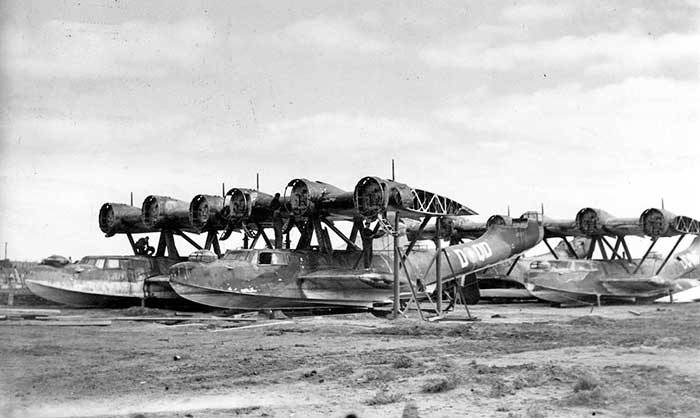
It never operated as an ordinary RAAF transport. When photographed at Lake Boga after withdrawal, it still retained much of its Dutch colour scheme.
Read more in The secret and dangerous operations of Australian and Dutch flying-boat crews.
Withdrawal at Lake Boga
By the middle of 1944, the remaining RAAF Dorniers had been withdrawn from operational service. Increasing mechanical problems and the absence of spare parts made their continued use impractical.
Five surviving aircraft were assembled at Lake Boga. On 20 December 1944, RAAF Headquarters authorised their conversion to components. Engines and reusable equipment were removed, and most of the remaining airframes were sold as scrap.
- Royal Netherlands Navy flying-boat operations from Australia, 1942–1945
- The Drama of Broome, 3 March 1942
- The secret and dangerous operations of Australian and Dutch flying-boat crews
- Lake Boga Flying Boat Museum and the Dutch Dornier Do 24K
- A Dutch flying boat remembered: the Dornier Do 24 engine at Broome
- DACC Air Force Research Portal
Sources and further reading
- Geoff Goodall—Dornier Do 24 aircraft in Australia
- ADF Serials—Dornier Do 24K, A49 series
- South Australian Aviation Museum—The Dornier Do 24K in RAAF service
During the dark days of 1942, as the Japanese advance swept through Southeast Asia, a remarkable group of Dutch flying boats found their way to Australia. These aircraft — the Dornier Do 24K flying boats of the Netherlands East Indies (NEI) — became part of the wider Dutch wartime presence in Australia and formed an important, though often overlooked, chapter in Dutch–Australian wartime cooperation.
The story of the Dorniers is particularly significant because it reflects the broader experience of Dutch military exile in Australia. Like many Dutch naval, air force and civilian personnel, the surviving aircraft and their crews escaped the collapse of the Netherlands East Indies and regrouped in Australia to continue the Allied war effort.
The story also highlights the shared wartime heritage of Indonesia, the Netherlands and Australia. These aircraft had originally operated across the vast Indonesian archipelago under Dutch colonial administration, before becoming part of the Allied war effort based from Australia after the Japanese invasion.
The Dornier Do 24K
The Dornier Do 24 was a German-designed flying boat developed in the 1930s. Although built by the German company Dornier, the Do 24K variant was specifically designed for Dutch requirements in the Netherlands East Indies.
The geography of the Indonesian archipelago — with its thousands of islands and enormous stretches of ocean — made flying boats ideal for maritime patrol, reconnaissance and rescue missions. The aircraft became one of the most important long-range patrol aircraft operated by the Marine Luchtvaartdienst (MLD), the Netherlands Naval Aviation Service.
The Do 24K was a large three-engine monoplane flying boat powered by Wright Cyclone radial engines. It featured a broad parasol wing mounted above the fuselage and stabilising side sponsons rather than conventional floats. These sponsons also doubled as fuel storage compartments, an innovative feature that extended operational range.
Before WWII, the Dutch ordered seventy-two Do 24Ks. However, by the time Germany invaded the Netherlands in 1940, only thirty-six had been delivered to the Netherlands East Indies.
War in the Netherlands East Indies
When Japan launched its offensive across Southeast Asia in late 1941 MLD aircraft, including Dorniers were used in battel of Malay and Singapore. Many were lost when the planes were needed for the defence of NEI in early 1942. The Dutch air and naval forces were rapidly overwhelmed and again more planes were lost.
The Dorniers participated in reconnaissance missions, anti-shipping patrols, transport operations and evacuation flights during the desperate final months of the defence of the Netherlands East Indies.
Aircraft were destroyed during Japanese bombing attacks. Others were lost during the chaotic retreat southwards through the archipelago.
One of the most devastating moments came during the Japanese attack on Broome in Western Australia on 3 March 1942, when several Dutch aircraft were destroyed while evacuating military personnel and civilians fleeing the collapsing colony.
Despite these losses, several Dorniers managed to escape to Australia.
Escape to Australia
On 19 February 1942 six MLD Dorniers — X-5, X-7, X-8, X-9, X-10 and X-24 — flew from the collapsing Netherlands East Indies to Australia.
The surviving aircraft became rare and valuable Allied assets. According to wartime records, twelve Dorniers reached Australia overall, although six were destroyed during the Broome attack, leaving only a handful operational.
Most of the surviving aircraft were eventually transferred to the Royal Australian Air Force (RAAF), where they received the serial numbers A49-1 through A49-6.
The aircraft initially retained their Dutch “X” registrations before being incorporated into Australian service.
Emergency arrival and restoration in Australia
The Dorniers arrived in Australia in extremely poor condition.
When they reached Rathmines in New South Wales, the aircraft had no beaching gear or maintenance equipment. After landing, they were deliberately run ashore into the mud, with some personnel believing they would never fly again.
Several aircraft hulls had suffered severe damage during the retreat from the Netherlands East Indies. In the book ” Lake Boga at War” it was mentioned that holes in the hulls had been patched using concrete simply to keep the aircraft operational long enough to escape.
Rather than abandon the flying boats, the RAAF undertook a major restoration effort.
Australian ground crews stripped the aircraft completely of electrical wiring, repaired and replated the hulls, rebuilt systems and gradually restored the aircraft to operational condition.
Because spare parts and armaments were increasingly difficult to obtain, the aircraft were eventually used mainly as transport aircraft rather than combat flying boats.
The restoration effort itself became an extraordinary example of wartime improvisation and Dutch–Australian cooperation.
Lake Boga and the Flying Boat Repair Depot
The Dorniers became closely associated with Lake Boga in northern Victoria, where the RAAF established No. 1 Flying Boat Repair Depot.
Lake Boga was chosen because of its relative safety from Japanese attack and its suitability for flying boat operations. During the war it became a major repair and maintenance base for Allied flying boats operating across the Pacific theatre.
Conditions at Lake Boga were initially primitive. Before proper beaching gear became available, large bays had to be dug into the foreshore to accommodate the flying boats during maintenance work.
No. 41 Squadron and New Guinea operations
Once restored, the Dorniers served mainly with RAAF No. 41 Squadron in transport and communication roles.
The aircraft operated supply flights between Australia and Allied bases in Papua and New Guinea, including Milne Bay, Goodenough Island and Port Moresby.
These were dangerous operational areas during the height of the Pacific War. The flights supported Allied troop movements, logistics and communications during the New Guinea campaigns.
The aircraft were no longer used primarily as armed patrol bombers. Much of their original Dutch armament had been removed, although traces of their military configuration remained.
When originally operated by the Dutch, the Dorniers carried machine guns in the bow, waist and tail positions, along with bomb racks.
Australian maintenance crews also encountered major ammunition supply problems. One wartime account recalled how armourers converted American .30 calibre Browning machine guns to Australian .303 ammunition because suitable American ammunition was unavailable.
The individual aircraft
X-5 / A49-1
Dornier X-5 (construction number 765) was transferred from Dutch MLD service to the RAAF on 29 April 1942, becoming A49-1.
The aircraft underwent restoration in Australia before entering operational service. It was mainly used in transport operations supporting Allied activities in New Guinea and northern Australia.
A49-1 remained in service until 20 December 1944, when it was withdrawn from use.
X-7 / A49-2
Dornier X-7 (c/n 767) became A49-2 after transfer to the RAAF on 29 April 1942.
Like the other surviving aircraft, it arrived in poor condition but was restored sufficiently for operational use.
The aircraft served with No. 41 Squadron in the transport role, flying cargo and supplies into operational areas such as Goodenough Island, Milne Bay and Port Moresby.
Due to increasing maintenance difficulties and shortages of spare parts, the aircraft was withdrawn from use during 1944 and was probably scrapped at Lake Boga.
X-8 / A49-3
Dornier X-8 (c/n 768) entered RAAF service as A49-3 on 29 April 1942.
After a lengthy overhaul, the aircraft made its first RAAF flight on 4 June 1942. The crew consisted of Squadron Leader Monkton, Sergeant Emes, Sergeant McKnight, Sergeant Canny, Corporal Aubin and Lance Corporal During. The flight lasted four hours and twenty minutes.
A49-3 later served with No. 41 Squadron in transport operations into New Guinea.
On 14 May 1944 the aircraft was transferred to Lake Boga and placed into storage at the Flying Boat Repair Depot. It was officially withdrawn from service on 20 December 1944 and subsequently scrapped.
X-9 / A49-4
Dornier X-9 (c/n 769) entered RAAF service as A49-4 on 29 April 1942.
The aircraft operated with No. 41 Squadron and reportedly carried the operational code DQ-G.
Like the other Dorniers, it supported Allied operations in Papua and New Guinea before increasing maintenance problems limited further operational use.
A49-4 was transferred to Lake Boga on 14 May 1944 for storage and was withdrawn from use on 20 December 1944.
X-10 / A49-5
Dornier X-10 (c/n 770) became A49-5 after its transfer to the RAAF on 29 April 1942.
The aircraft served in operational transport and communication duties before being withdrawn from use at Darwin on 11 March 1944.
X-24 / A49-6
The most unusual aircraft of the group was Dornier X-24 (c/n 785).
Unlike the other Dorniers, X-24 initially remained under Dutch MLD control after arriving in Australia.
The aircraft escaped to Perth following the Japanese bombing attack on Broome and was reportedly used by Dutch intelligence services on clandestine flights to New Guinea. During this period it also used the Australian radio call sign VHPHB.
Only in October 1943 was X-24 formally transferred to the RAAF, becoming A49-6.
After entering Australian service, the aircraft continued operating until it was transferred into storage at No. 1 Flying Boat Repair Depot at Lake Boga on 14 May 1944.
Like the other surviving Dorniers, it was eventually withdrawn from use on 20 December 1944 and scrapped because spare parts and maintenance support had become impossible to sustain.
Dutch forces in exile in Australia
The story of the Dorniers cannot be separated from the broader Dutch wartime presence in Australia.
Following the fall of the Netherlands East Indies, Australia became the centre of Dutch military and governmental operations in exile in the Pacific region.
Brisbane in particular became a major Dutch hub. Camp Columbia at Wacol hosted the Netherlands East Indies government-in-exile, Dutch military headquarters and numerous Dutch service personnel. Dutch naval units operated alongside the US Seventh Fleet, while Dutch air force personnel regrouped in Australia to continue operations against Japan.
The Dorniers symbolised this continuing Dutch resistance in exile. Although the Netherlands East Indies had fallen, Dutch military operations continued from Australia.
Flying boats in the Pacific War
Flying boats played a vital role during WWII in the Pacific theatre.
The enormous distances, lack of airfields and island geography made aircraft such as the Dornier highly valuable. Australia became a major centre for Allied flying boat operations, with aircraft from many nations operating from Australian waters.
Catalinas, Sunderlands and Dorniers formed part of a wider Allied flying boat network operating across the Pacific and Indian Oceans.
The Dutch contribution to this network is often overlooked in mainstream Australian wartime history. Yet the Dutch flying boats and their crews played an important role during a critical phase of the Pacific War.
Legacy
Today, the Dutch Dornier story survives largely through archives, photographs and scattered wartime records.
Few Australians are aware that Dutch flying boats once operated from Australian waters as part of the Allied war effort.
For Dutch Australians, however, the Dorniers represent something larger than aviation history alone. They reflect the resilience of a displaced military force, the close wartime relationship between Australia and the Netherlands, and the broader shared heritage of Indonesia, the Netherlands and Australia during WWII.
The surviving records from Rathmines, Lake Boga and other wartime locations provide a glimpse into a remarkable period when Dutch crews, Australian ground personnel and Allied forces worked together under difficult wartime conditions.
The Dorniers may have been rare aircraft, but they became part of a much larger story — one of exile, cooperation and continued resistance during the Pacific War.
Paul Budde (Update October 2026)
Sources:
ADF-SERIALS – NEI Aircraft in Australia
See also:
Lake Boga Flying Boat Museum and the Dutch Dornier Do-24K
A Dutch flying boat remembered: the Dornier Do-24 engine at Broome
Royal Netherlands Navy flying boat operations in Australia during WWII
Seaplane crash saved people from Japanese attack on Broome – Gerard Lemmens 1942
Fleeing Dutch mistakenly attacked at Karumba during WWII
The Dutch Flying Boat Behind MacArthur: Identifying a Dornier on the Brisbane River