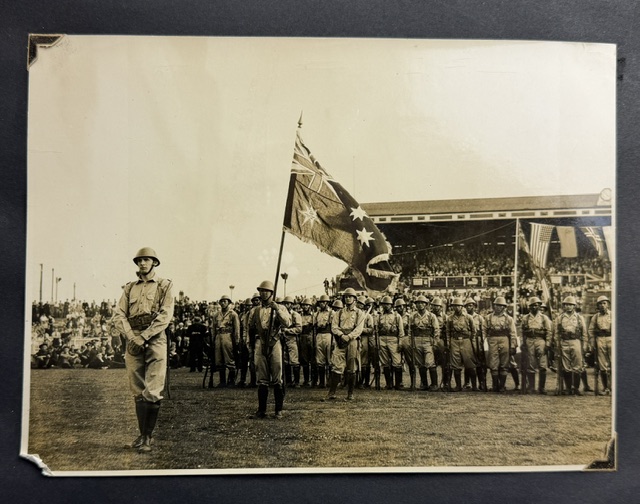
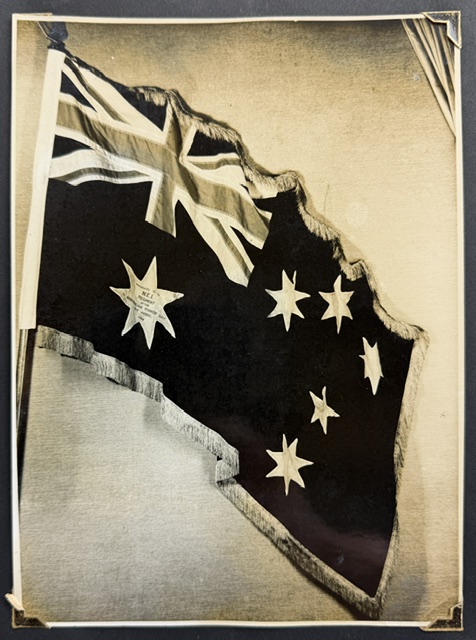
Among the many stories of Dutch–Australian cooperation during the Second World War, some are preserved not in official histories but in photographs and personal collections. A remarkable set of photographs and documents from Melbourne in 1944 records one such occasion: the presentation of an Australian national flag to troops of the Netherlands East Indies Army (KNIL).The flag – now part of the Bronbeek collection – itself contains an embroidered dedication:
PRESENTED TO THE N.E.I. REGIMENT BY THE AUSTRALIAN PIONEER BATT. A.I.F. ASSOC. 1944
That story is told here: A flag stitched with shared sacrifice: Australian POW families and the N.E.I. Regiment in exile
The documents and photographs are part of the collection of Bronbeek Museum in Arnhem the Netherlands (collection number 1999/00-645/2) and we are reproducing them below with their permission.
The event took place on Sunday 19 March 1944 during the Grand Allied Patriotic and Mardi Gras Festival—a large Allied wartime carnival and patriotic celebration—held at the Melbourne Cricket Ground. At a time when Australia and the Netherlands East Indies were fighting a common enemy in the Pacific, the ceremony symbolised the close cooperation that had developed between the two nations following the Japanese occupation of the Netherlands East Indies in 1942.
After the fall of the Netherlands East Indies, thousands of Dutch military personnel, government officials, civilians and refugees found temporary refuge in Australia. Australian cities such as Brisbane, Melbourne, Sydney and Perth became important centres for Dutch military and administrative activities. Australia provided facilities, training grounds and logistical support, while Dutch forces continued their contribution to the Allied war effort from Australian soil.
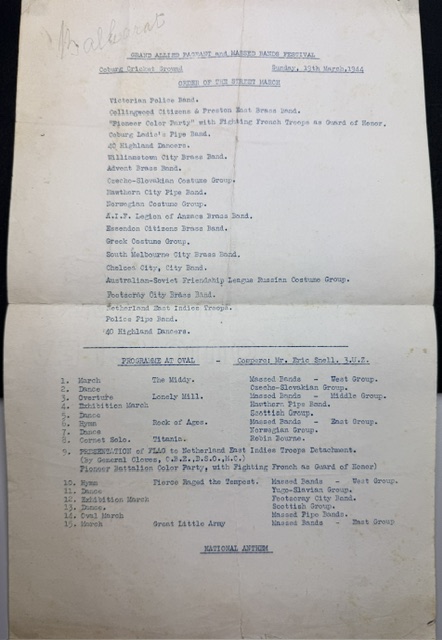
The surviving programme from the festival illustrates the scale of the event. The day featured a colourful parade involving Allied military units, police bands, Scottish pipe bands, national costume groups representing numerous Allied nations, and detachments of military personnel from across the Allied coalition. The festival was designed to celebrate Allied unity and boost public morale during a critical stage of the war in the Pacific.
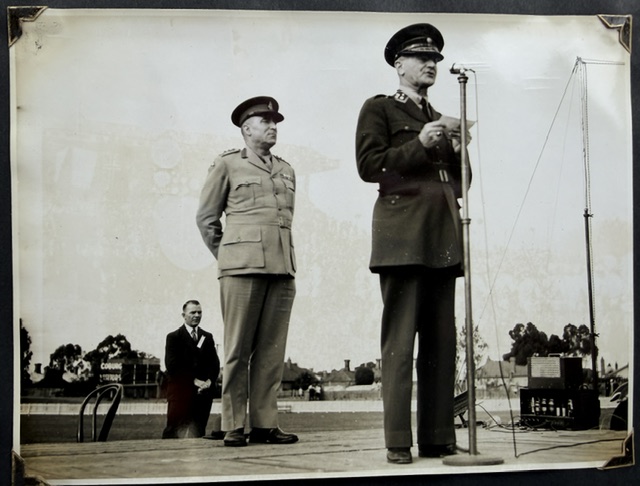
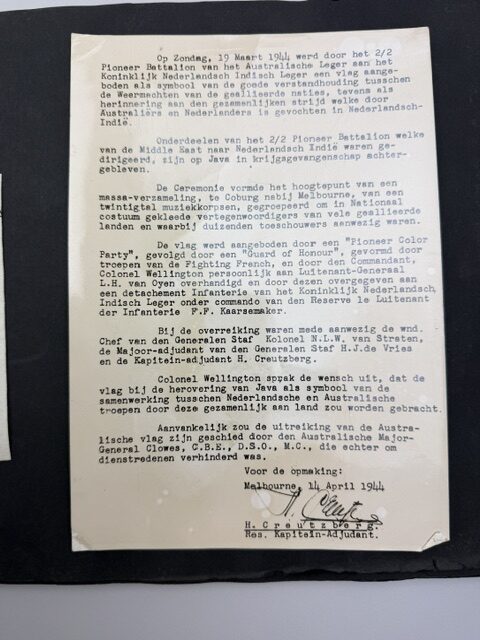
One of the highlights was the formal presentation of an Australian flag to the KNIL contingent. A contemporary Dutch-language memorandum accompanying the photographs explains the significance of the occasion.
According to the document, the flag was presented by Colonel Wellington, commander of the 2/2 Pioneer Battalion of the Australian Army. The flag was received by Colonel Nico Leonard Willem van Straten on behalf of Lieutenant-General Hein ter Poorten, Commander of the Netherlands East Indies Army (KNIL). Van Straten was one of the most senior Dutch military commanders stationed in Australia during the war and played an important role in the reorganisation of Dutch military forces in exile, becoming a key figure in Dutch–Australian wartime cooperation. Ter Poorten had commanded the KNIL during the desperate defence of the Netherlands East Indies against the Japanese invasion in early 1942. Although forced to surrender after the collapse of Allied resistance in Java, he remained a highly respected figure among Dutch military personnel and continued to serve as an important symbol of Dutch resistance in exile.
The memorandum noted that the ceremony took place before an audience estimated at more than 50,000 people. The Melbourne Cricket Ground was filled with military bands, national costume groups representing Allied countries, and large numbers of spectators.
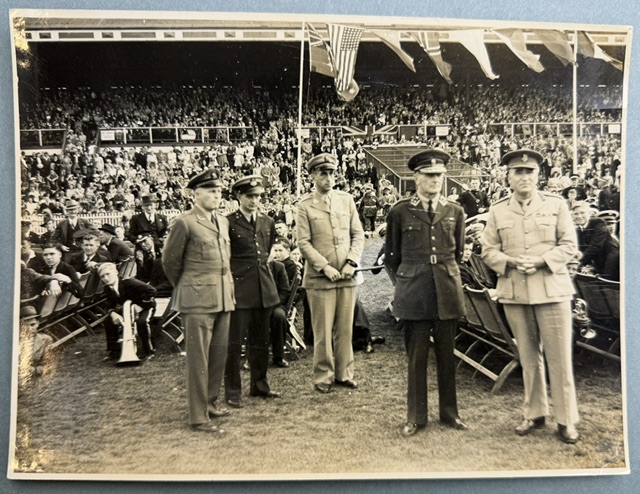
In his speech, Colonel Wellington described the Australian flag as a symbol of the cooperation between Australian troops and the armed forces of the Netherlands East Indies. The document records that the presentation was intended to commemorate the common struggle against Japan and the friendship that had developed between the two nations during the war.
Particularly striking is the image of the Australian flag itself. At a time when the future of the Netherlands East Indies remained uncertain and much of its territory was still under Japanese occupation, the presentation of Australia’s national symbol carried considerable emotional significance. It demonstrated that the Dutch forces in exile were recognised as valued partners in the Allied campaign.
The event also reflected the multicultural nature of the Allied war effort in Australia. The festival programme lists representatives from many Allied nations and ethnic communities, including Czech, Greek, Estonian, Norwegian and Indo-European groups. Such gatherings helped reinforce the sense that the war against Japan was an international undertaking involving peoples from across Europe, Asia, North America and the Pacific.
For Dutch personnel stationed in Australia, public recognition of their contribution was important. Many had lost their homeland to occupation, while others had experienced the traumatic evacuation from the Netherlands East Indies. Ceremonies such as this provided reassurance that their sacrifices were acknowledged by their Australian allies.
The size of the audience also illustrates that Dutch forces were not an obscure or hidden presence in wartime Australia. Before a crowd of more than 50,000 people, the ceremony publicly acknowledged the contribution of Dutch military personnel to the Allied cause. Such recognition is often absent from later Australian and Dutch wartime narratives, making these photographs and documents particularly valuable historical records.
Today these photographs and documents offer more than a record of a ceremonial event. They provide a tangible reminder of the close wartime relationship that developed between Australia and the Netherlands. They also highlight the role of Melbourne, alongside Brisbane and other Australian cities, as an important centre of Allied cooperation in the Pacific War.
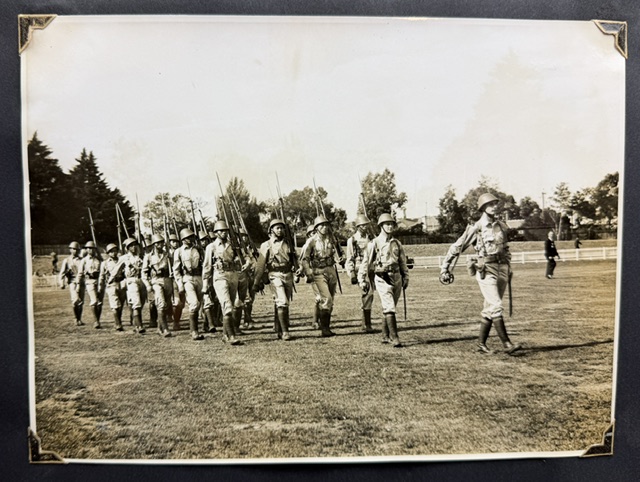
The photographs vividly capture the occasion. One image shows the Australian flag being carried during the ceremony before ranks of KNIL personnel. Another depicts a procession of Dutch East Indies troops participating in the parade. Additional photographs show senior Australian and Dutch military officers standing together on the ceremonial platform, reflecting the close working relationship between the two Allied forces.
The presentation of an Australian flag to the Netherlands East Indies forces in March 1944 was a symbolic gesture, but symbols matter. In the midst of a global conflict, it expressed solidarity, friendship and a shared determination to defeat a common enemy. More than eighty years later, it remains a powerful illustration of the enduring historical connections between Australia, the Netherlands and the former Netherlands East Indies.
Today the flag survives in the collection of Museum Bronbeek in Arnhem, together with a remarkable album of photographs and documents recording its presentation in Melbourne in March 1944.
See also: A flag stitched with shared sacrifice: Australian POW families and the N.E.I. Regiment in exile