The KPM steamship ’s Jacob was the first of three Dutch merchant vessels lost during Operation Lilliput. On 8 March 1943, while carrying troops and supplies from Milne Bay towards Oro Bay, she was attacked by Japanese bombers near Porlock Harbour.
Three direct hits and numerous near misses caused serious damage and a rapidly spreading fire. The ship sank within approximately 18 minutes, leaving its crew and passengers in the water.
The Australian corvette HMAS Bendigo rescued more than 150 survivors. Among those who died were First Mate Hubertus Hendrik van Dierendonck and United States Army Private George Watson, who sacrificed his life helping soldiers who could not swim reach floating wreckage and life rafts.
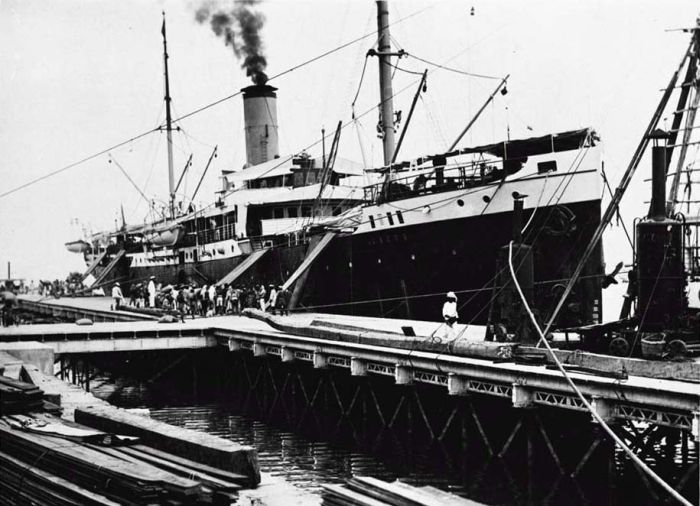
A KPM inter-island vessel
’s Jacob was built for the Koninklijke Paketvaart-Maatschappij by Maatschappij voor Scheeps- en Werktuigbouw Fijenoord in Rotterdam. She was launched on 25 July 1907 and completed later that year.[1]
The ship was named after Frederik Bernard ’s Jacob, a nineteenth-century Dutch colonial administrator who served as Governor-General of the Netherlands East Indies from 1881 to 1884.
’s Jacob was a passenger and cargo steamship of approximately 2,839 gross tons. She was powered by a three-cylinder triple-expansion engine and had a service speed of about ten knots.[2]
Her accommodation reflected the KPM’s inter-island role. She could carry a relatively small number of first- and second-class passengers but a much larger number of deck or steerage passengers. Her cargo holds transported produce, machinery, mail and general merchandise among the ports of the Netherlands East Indies.
The correct rendering of the ship’s name is ’s Jacob, with the apostrophe before the lower-case “s”. Historical registers sometimes contracted it to ’sJacob, while Australian and American records frequently shortened it simply to Jacob.
Earlier wartime service
In August 1940, the Royal Netherlands Navy requisitioned ’s Jacob for possible use as a blockship at Tanjung Priok, the principal port of Batavia. She was returned to the KPM in February 1941.[3]
Following Japan’s entry into the Pacific War, the ship supported Allied attempts to reinforce the Netherlands East Indies.
On 31 January 1942, ’s Jacob left Sydney as part of Convoy MS4. The convoy carried supplies towards the American-British-Dutch-Australian Command fighting to hold the Malay Barrier.[4]
As Japanese forces advanced through Sumatra and Java, most of the convoy was ordered to turn back. ’s Jacob initially continued with the Australian cruiser HMAS Perth and other Dutch vessels, but on 21 February she too was ordered to return to Fremantle.[5]
The decision saved the ship from the destruction that overtook much of the merchant fleet in the Netherlands East Indies during the following weeks.
Under Allied control in Australia
After the fall of Java, ’s Jacob became one of the original 21 KPM-operated ships incorporated into the Southwest Pacific Area’s local transport fleet.
On 26 March 1942, the United States Army Forces in Australia arranged interim charters for these ships while final agreements were negotiated with the Netherlands Government-in-Exile in London.[6]
’s Jacob remained Dutch-owned and sailed under the Dutch flag. Her senior officers were Dutch, while her maritime crew was predominantly Indonesian, particularly Javanese. Operationally, however, the ship was employed according to United States Army and Allied shipping requirements.
She was also defensively armed with a naval gun to provide limited protection against aircraft and surface attack.
Reinforcing New Guinea
During 1942, ’s Jacob participated in the movement of troops and supplies to Port Moresby and Milne Bay.
In September she sailed from Townsville as part of Convoy Q2 with the British merchant ship Anshun. The convoy was initially escorted by HMAS Swan and later by HMAS Arunta.[7]
The ships approached Milne Bay soon after Australian forces had defeated the Japanese invasion force. Reports that Japanese warships might enter the bay forced the convoy to wait temporarily in the China Strait.
Anshun was escorted into Milne Bay on 6 September to unload, while ’s Jacob remained outside with Swan. Japanese warships subsequently entered the bay and shelled Anshun, causing her to capsize at the wharf.[8]
The episode demonstrated the dangers faced by merchant ships supplying the New Guinea bases even after the principal land fighting had ended.
Operation Lilliput
By the end of 1942, the Allies needed a regular supply route from Milne Bay to Oro Bay to support the fighting around Buna and Gona.
Operation Lilliput used relatively small merchant vessels capable of navigating poorly charted coastal waters and entering undeveloped anchorages. Nineteen Dutch ships participated, supported principally by Australian corvettes.[9]
’s Jacob became one of these transports. She carried troops, ammunition, weapons, engineering equipment and general supplies along the New Guinea coast.
In February 1943, she left Sydney and sailed north through Townsville and Cairns. After visiting Port Moresby, she proceeded to Milne Bay to join the Lilliput supply service.[10]
The final voyage
On 8 March 1943, ’s Jacob left Milne Bay carrying troops, weapons and supplies for Oro Bay. She was escorted by the Australian corvette HMAS Bendigo.
As the ships approached Cape Nelson and Porlock Harbour, they passed SS Karsik and her escort HMAS Kapunda, which were returning towards Milne Bay.[11]
At approximately 1 pm, nine Japanese bombers accompanied by twelve fighters attacked the convoy. One group targeted ’s Jacob and Bendigo, while other aircraft attacked Karsik and Kapunda.
SS Karsik escaped damage, but ’s Jacob was struck repeatedly.
Accounts record three direct bomb hits and at least fifteen near misses. The explosions caused severe structural damage and started a major fire in the forward part of the ship. Damage to the water pumps made it impossible for the crew to fight the fire effectively.[12]
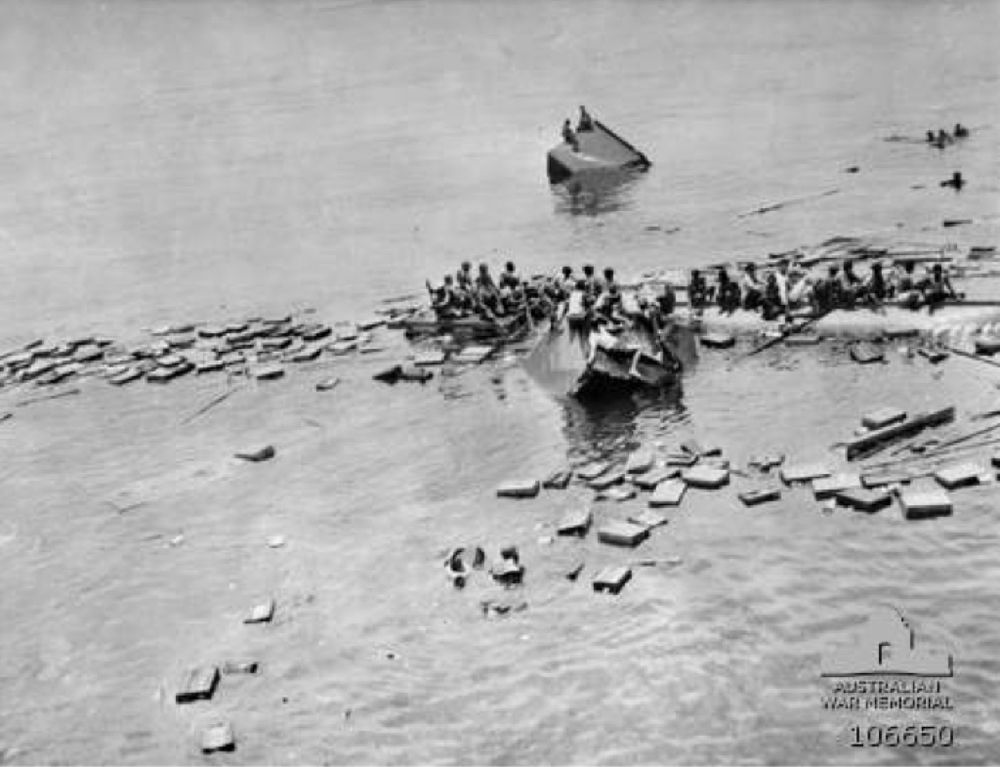
The captain gave the order to abandon ship. Crew members and passengers jumped into the sea and clung to life rafts, wreckage and floating cargo.
At approximately 1.16 pm—only 16 to 18 minutes after the attack—’s Jacob sank near Porlock Harbour.[13]
The rescue by HMAS Bendigo
HMAS Bendigo immediately began rescuing survivors from the water despite the continuing danger of air attack.
HMAS Bendigo’s official history records that the corvette rescued 153 survivors. Some other detailed operational accounts give a figure of 158. The difference may reflect whether particular casualties, transfers or people who subsequently died were included. It can therefore be stated with confidence that Bendigo rescued more than 150 people.[14] The difference may reflect whether particular casualties, transfers or people who subsequently died were included in the count.
Rather than selecting one figure without qualification, it is safest to state that Bendigo rescued more than 150 people.
Many survivors were wounded, and some had suffered burns. Two of those brought aboard Bendigo reportedly died while the corvette was returning to Milne Bay.[15]
The rescue demonstrated the importance of the Australian naval escorts. Their role extended beyond defending the transports: when a ship was lost, the escort could be the only vessel available to rescue people from the sea and provide immediate medical assistance.
The Dutch and Indonesian casualties
At least five people were killed during the sinking. Contemporary accounts identify ’s Jacob’s First Mate Hubertus Hendrik van Dierendonck among the dead.[16]
Van Dierendonck was born in Vlissingen on 30 September 1902. He had served as one of the ship’s senior Dutch officers and was forty years old when he died.
Indonesian crew members were also among those killed. Their names are less consistently recorded in readily accessible English-language accounts, reflecting the wider problem of incomplete recognition of Indonesian merchant seafarers who served aboard Dutch ships.
Some operational accounts record five deaths during the sinking and two further deaths among those rescued. On that basis, the final death toll was seven. Published sources do not always distinguish between those killed during the attack and sinking and those who subsequently died from their wounds.[17]
Private George Watson
One of the best-documented individual stories from the sinking is that of Private George Watson of the United States Army’s 2nd Battalion, 29th Quartermaster Regiment.
Watson was one of seven African American servicemen from the Second World War awarded the Medal of Honor by President Bill Clinton at a White House ceremony on 13 January 1997. Six of the seven awards were posthumous.
Instead of concentrating on his own survival, Watson helped soldiers who could not swim reach life rafts and floating wreckage. He continued assisting others until exhaustion overcame him. The suction created as the ship sank pulled him beneath the surface, and his body was never recovered.[18]
Watson’s actions were initially recognised with the Distinguished Service Cross. Decades later, a United States Army review examined whether racial discrimination had prevented African American servicemen from receiving the country’s highest award for bravery during the Second World War.
On 13 January 1997, President Bill Clinton posthumously awarded Watson the Medal of Honor. Watson became the first African American serviceman of the Second World War to receive the award.[19]
His story gives the sinking of ’s Jacob significance extending beyond Dutch and Australian maritime history. The people aboard represented several parts of the Allied war effort: Dutch officers, Indonesian seafarers, American soldiers and their Australian naval rescuers.
The first ship lost during Operation Lilliput
’s Jacob was the first of three KPM vessels lost during Operation Lilliput.
Twenty days later, on 28 March, Bantam was destroyed during a Japanese air attack at Oro Bay. Van Heemskerk was lost at Milne Bay on 14 April while unloading fuel and ammunition.
The three ships had been part of the original group of 21 KPM vessels incorporated into the Southwest Pacific Area’s local transport fleet. Their destruction represented the loss of one-seventh of that original group.[20]
These were not the only KPM ships lost during the Pacific War. The company had already lost most of its fleet during the Japanese conquest of the Netherlands East Indies. The importance of ’s Jacob, Bantam and Van Heemskerk is that they were the three KPM ships lost while maintaining the specific supply operation between Australia, Milne Bay and the New Guinea battlefront.
The wreck and its remembrance
The wreck of ’s Jacob was located by divers in 1986 approximately nine nautical miles from Porlock Harbour, at a reported depth of about 49 metres. The ship’s bell was recovered and later presented to the Lae Yacht Club.[21]
The Australian War Memorial photograph of survivors awaiting rescue by HMAS Bendigo above provides a direct visual record of the sinking and the difficult rescue operation.[22]
A multinational wartime story
The loss of ’s Jacob demonstrates the multinational character of the KPM contribution.
A Dutch-owned ship, operated by Dutch officers and Indonesian seafarers, was carrying American soldiers and Allied supplies along the New Guinea coast under United States Army control. When Japanese aircraft sank her, an Australian warship rescued the survivors.
The courage shown that day was similarly multinational. It included the ship’s officers and crew, the men of HMAS Bendigo and Private George Watson, who gave his life helping others escape drowning.
Placing ’s Jacob alongside Bantam and Van Heemskerk completes the account of the three KPM vessels lost during Operation Lilliput and gives appropriate recognition to the people who served and died aboard them.
Related DACC articles
- The KPM lifeline: Operation Lilliput and the Allied advance in Papua
- SS Bantam: From KPM service to destruction at Oro Bay
- SS Van Heemskerk: From Convoy ZK8 to its loss at Milne Bay
- Dutch Merchant Fleet and the Allied War Effort in Australia – Portal
Endnotes
[1] Lloyd’s Register of Shipping, entry for ’s Jacob; Stichting Maritiem-Historische Databank, vessel record for ’s Jacob. She was built as yard number 211 by Maatschappij voor Scheeps- en Werktuigbouw Fijenoord, Rotterdam.
[2] Lloyd’s Register of Shipping. Contemporary records give approximately 2,839 gross tons, a triple-expansion steam engine rated at 1,300 indicated horsepower and a service speed of about ten knots.
[3] KPM and Royal Netherlands Navy vessel records. ’s Jacob was requisitioned in August 1940 for possible use as a blockship and returned to the KPM in February 1941.
[4] G. Hermon Gill, Royal Australian Navy 1939–1942, Australia in the War of 1939–1945, Series 2, vol. I (Canberra: Australian War Memorial, 1957), account of Convoy MS4.
[5] Gill, Royal Australian Navy 1939–1942, pp. 580–581; contemporary convoy records.
[6] James R. Masterson, U.S. Army Transportation in the Southwest Pacific Area, 1941–1947 (Washington: Transportation Unit, Historical Division, Special Staff, United States Army, 1949), pp. 321–323.
[7] Gill, Royal Australian Navy 1942–1945, Australia in the War of 1939–1945, Series 2, vol. II (Canberra: Australian War Memorial, 1968), account of Convoy Q2.
[8] Gill, Royal Australian Navy 1942–1945, account of the attack on Milne Bay and the loss of Anshun, September 1942.
[9] Gill, Royal Australian Navy 1942–1945, pp. 268–283.
[10] Contemporary port and convoy records for ’s Jacob, February–March 1943.
[11] Gill, Royal Australian Navy 1942–1945, p. 269.
[12] Gill, Royal Australian Navy 1942–1945, p. 269; HMAS Bendigo operational history.
[13] HMAS Bendigo operational account; Australian corvette historical records. Accounts variously state that the ship sank within 16 or 18 minutes.
[14] Royal Australian Navy, Sea Power Centre Australia, “HMAS Bendigo (I),” recording 153 survivors; other detailed operational summaries record 158 people recovered.
[15] Gill, Royal Australian Navy 1942–1945, p. 269.
[16] Netherlands War Graves Foundation, record for Hubertus Hendrik van Dierendonck, First Mate, merchant service, killed aboard ’s Jacob on 8 March 1943.
[17] Gill, Royal Australian Navy 1942–1945, p. 269; Jonathan Ford, “The Netherlands Merchant Navy in the Pacific War,” Journal of Australian Naval History, vol. 6, no. 1 (2009).
[18] United States Army Center of Military History and US Army Quartermaster Museum, account of Private George Watson aboard the United States Army transport Jacob, 8 March 1943.
[19] Congressional Medal of Honor Society, “George Watson”; United States Army records concerning the 1997 review and award.
[20] Gill, Royal Australian Navy 1942–1945, pp. 268–283; Masterson, U.S. Army Transportation in the Southwest Pacific Area, appendix 30.
[21] Postwar wreck-diving records for ’s Jacob. The wreck was reportedly found in 1986 off Porlock Harbour and its bell recovered.
[22] Australian War Memorial, collection item 106650, “Survivors from the Netherlands merchant ship ’sJacob about to be rescued by HMAS Bendigo.”