Among the many stories of Dutch–Australian cooperation during the Second World War, few are as moving as the story of an Australian flag presented to Dutch troops in exile. More than a ceremonial gift, the flag symbolised a shared experience of war, defeat, captivity and resilience that connected Australians and Dutch servicemen in a deeply personal way.
Today the flag survives in the collection of Museum Bronbeek in Arnhem, together with a remarkable album of photographs and documents recording its presentation in Melbourne in March 1944. These records reveal a little-known chapter in the wartime relationship between Australia and the Netherlands East Indies.
A gift from Australia
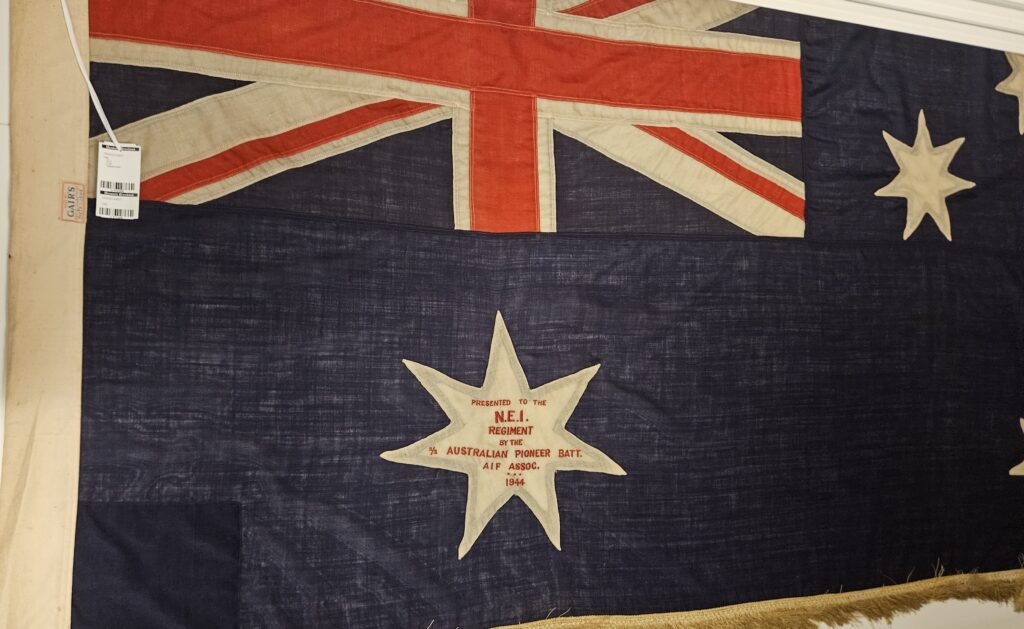
The story begins with an Australian national flag presented to the Netherlands East Indies (N.E.I.) Regiment in Australia during 1944.
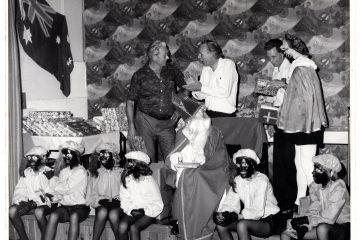
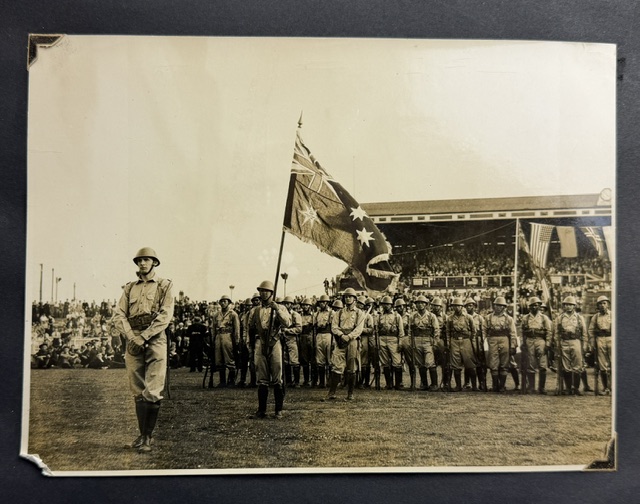
Photographs from the collection show the flag being formally presented during the Grand Allied Patriotic and Mardi Gras Festival held at the Melbourne Cricket Ground on 19 March 1944. The ceremony took place before an audience estimated at more than 50,000 people and formed part of a broader celebration of Allied unity during the war in the Pacific.
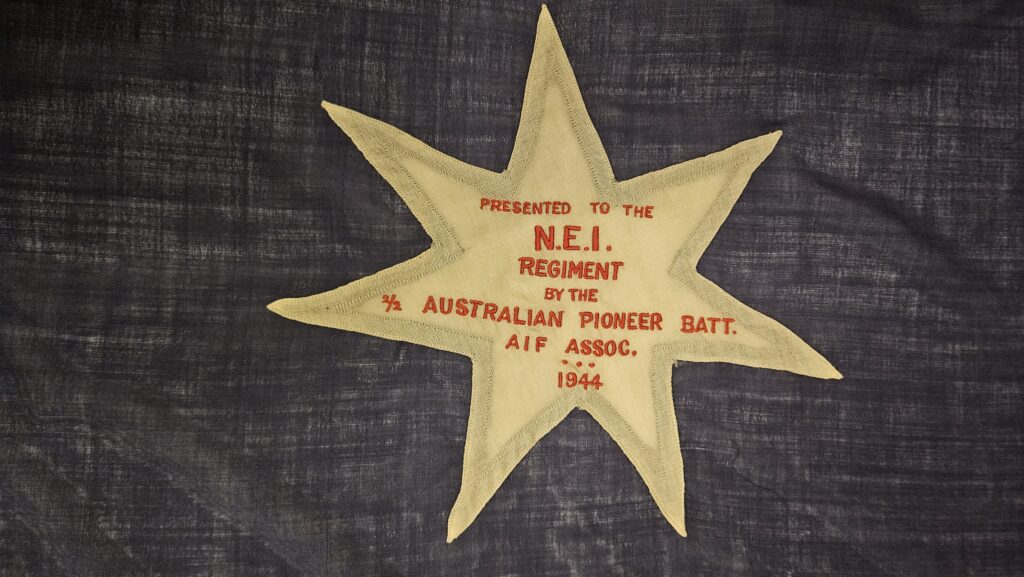
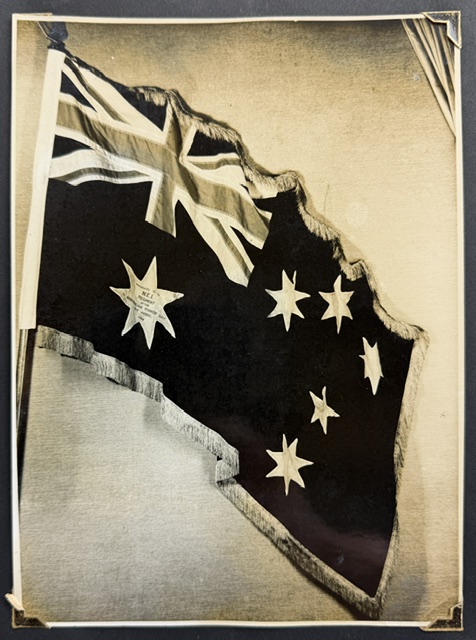
The surviving flag itself contains an embroidered dedication:
PRESENTED TO THE
N.E.I. REGIMENT
BY THE
AUSTRALIAN PIONEER BATT.
A.I.F. ASSOC.
1944
The inscription immediately raises an important question: why would an Australian veterans’ organisation present its national flag to Dutch troops serving in exile?
The answer lies in a shared wartime experience that began two years earlier during the Japanese conquest of Southeast Asia.
Shared defeat in the Netherlands East Indies
In early 1942 Australian and Dutch forces fought alongside one another during the desperate defence of the Netherlands East Indies.
Among the Australian units involved was the 2/2nd Pioneer Battalion, commanded by Lieutenant Colonel Nelson Wellington. After fighting in Malaya and Java, the battalion shared the fate of many Allied forces when the Netherlands East Indies collapsed under Japanese attack.
The consequences were severe. Hundreds of Australian soldiers became prisoners of war in the former Dutch colony. More than 800 members of the battalion entered Japanese captivity, while many never returned home.
For Australian families, the Netherlands East Indies became associated with uncertainty, separation and loss. Thousands of wives, mothers and children waited for years with little knowledge of the fate of their loved ones.
Dutch military personnel experienced a similar tragedy. Their homeland had fallen under German occupation in Europe, while the Netherlands East Indies had been conquered by Japan. Many Dutch servicemen, government officials and civilians escaped to Australia, where they continued the struggle as part of the Allied war effort.
The result was a unique bond between Australians and Dutch troops. Both had fought in the same campaign. Both had lost their territories to occupation. Both had seen comrades disappear into Japanese prison camps.
More than a military ceremony
A catalogue description preserved at Bronbeek adds an important and emotional dimension to the story.
It records that the flag was presented by women whose husbands had become prisoners of war in the Netherlands East Indies. These women were associated with Australian servicemen who had endured the same campaign and captivity as many Dutch soldiers.
Viewed in this light, the presentation was far more than a formal military event.
The flag represented solidarity between families who had suffered because of the Japanese conquest of the Netherlands East Indies. It acknowledged the sacrifices of Dutch troops while expressing support from Australians whose own husbands and relatives remained prisoners of war.
The embroidered dedication indicates that the Australian Pioneer Battalion Association acted as the formal donor. The women mentioned in the catalogue may well have been closely connected to the association and to the battalion’s former members.
Together they transformed a national flag into a symbol of friendship and remembrance.
The Melbourne presentation
The formal presentation took place during a major Allied festival at the Melbourne Cricket Ground on 19 March 1944.
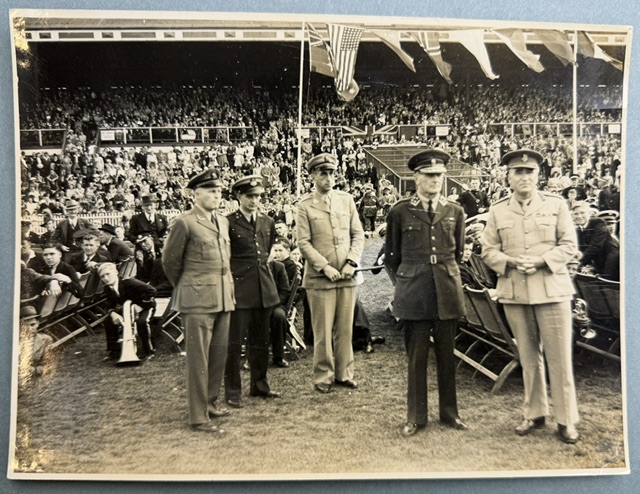
The flag was presented by Colonel Wellington, commander of the 2/2nd Pioneer Battalion. Accepting the flag on behalf of the Netherlands East Indies Army was Colonel N.L.W. van Straten, one of the most senior Dutch military officers stationed in Australia. Van Straten received the flag on behalf of Lieutenant-General Hein ter Poorten, former Commander of the Netherlands East Indies Army.
- Major H.J. de Vries
- Reserve Captain-Adjutant H. Creutzberg
- Colonel N.L.W. van Straten
- Lieutenant-General M.R. van Oijen
- Colonel Wellington of the Australian Army
The images capture a moment of Allied cooperation, but they also reflect something more personal. Behind the uniforms stood men whose countries had suffered occupation and whose families were still enduring the uncertainties of war.
Australia as a refuge and partner
Following the fall of the Netherlands East Indies, Australia became a centre for Dutch military and administrative activity.
Dutch naval personnel, airmen, soldiers and government officials established headquarters and training facilities across Australia. Brisbane became home to the Netherlands East Indies government-in-exile, while Melbourne, Sydney and other cities hosted Dutch military organisations and support services.
Throughout this period Australian authorities and communities provided extensive assistance.
The presentation of the flag demonstrates that support was not limited to governments and military institutions. It also came from ordinary Australians, including families directly affected by the war.
For them, the struggle of the Dutch people was not a distant conflict. It was connected to the fate of husbands, sons and brothers imprisoned throughout the former Netherlands East Indies.
A symbol preserved
Today the flag survives in the collection of Museum Bronbeek in Arnhem.
The embroidered dedication remains clearly visible, preserving the memory of the relationship between Australian and Dutch servicemen during one of the darkest periods of the war.
Equally valuable is the accompanying photograph album and documentation, which record the circumstances of the presentation and identify many of the individuals involved.
Together, the flag and album tell a story that extends beyond military cooperation. They reveal the human connections that emerged from shared hardship and common sacrifice.
Remembering a shared heritage
The Australian flag presented to the N.E.I. Regiment in 1944 represents far more than a patriotic symbol.
It commemorates Australians who became prisoners of war in the Netherlands East Indies. It honours Dutch soldiers who continued the fight from exile. It recognises the contribution of Australian families who supported the Allied war effort despite their own uncertainty and grief.
Most importantly, it reminds us that the wartime relationship between Australia and the Netherlands was built not only through governments and military commands, but also through personal bonds forged in adversity.
More than eighty years later, the flag remains a powerful symbol of friendship between two nations whose wartime histories became closely intertwined.
Bronbeek collection reference
Museum Bronbeek, Arnhem, The Netherlands.
Collection reference: 1999/00-645
Album relating to the presentation of an Australian flag to Netherlands East Indies troops in Australia, March 1944. The collection contains 22 pages, 11 photographs and 4 documents. The original Australian flag presented to the N.E.I. Regiment in 1944 is also preserved in the Museum Bronbeek collection.