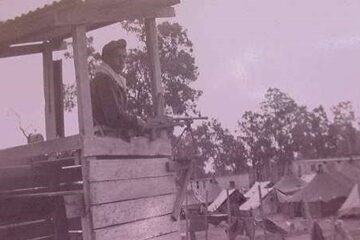
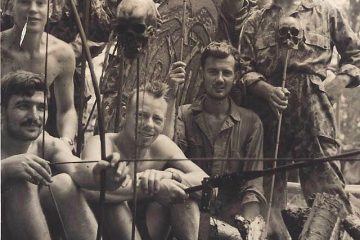
In 2007, members of Adelaide’s Dutch community published a booklet that made an important contribution to preserving one of the lesser-known chapters of Australian wartime history. Titled The Dutch Contribution to the Defence of Australia during the War in the Pacific, 1941–1945, it was compiled by Ben van Essen and Jan Vel to coincide with the unveiling of a commemorative plaque on Adelaide’s Pathway of Honour.
Although modest in size, the publication was ambitious in scope. Its purpose was to explain to a wider Australian audience the significant role played by Dutch servicemen and women who, following the fall of the Netherlands East Indies in 1942, continued the war from Australia alongside Australian and other Allied forces.
The booklet provides a concise overview of the Dutch military presence in Australia during the Pacific War. It describes the operations of the Royal Netherlands Navy, whose surviving cruisers, destroyers and submarines continued fighting from Australian ports. It highlights the important contribution of the Royal Netherlands East Indies Army (KNIL), the Royal Netherlands East Indies Air Force (ML-KNIL), and the Dutch Merchant Navy, whose ships became an indispensable part of Allied logistics throughout the South-West Pacific.
Beyond the military contribution, the authors also explain how Australia became the temporary home of the Netherlands East Indies Government-in-Exile. Dutch military headquarters, training establishments and administrative organisations were established across the country, while thousands of Dutch servicemen, merchant seamen and civilians found refuge in Australia. The publication reminds readers that the wartime relationship between Australia and the Netherlands extended far beyond the battlefield.
One of the booklet’s strengths is its accessible style. Rather than being an academic study, it presents a clear and well-illustrated overview of the many ways in which the Dutch contributed to Australia’s defence. For members of the Dutch community, descendants of wartime participants and Australians interested in Allied cooperation during the Pacific War, it remains an excellent introduction to the subject.
The booklet was produced to accompany the unveiling of the Dutch commemorative plaque on Adelaide’s Pathway of Honour in November 2007. Donated by the Dutch community in South Australia, the plaque honours the Dutch servicemen and women who joined in the defence of Australia during the Second World War. Together, the publication and the memorial represent a lasting contribution by South Australia’s Dutch community to preserving this shared history.
Since the booklet appeared, research into the Dutch wartime presence in Australia has expanded considerably. Organisations such as the Dutch Australian Cultural Centre have documented hundreds of individual stories, while Australian and Dutch historians have continued to uncover new aspects of the close wartime cooperation between the two countries. Nevertheless, the work of Ben van Essen and Jan Vel deserves recognition as one of the early community initiatives that helped bring this important history to a wider audience.
Nearly two decades after its publication, The Dutch Contribution to the Defence of Australia during the War in the Pacific, 1941–1945 remains a valuable reminder that the defence of Australia was a truly Allied effort, and that the Dutch community in South Australia played an important role in ensuring this contribution would not be forgotten.
See also: The Long Voyage of the MS Abbekerk (an abstract from the book)