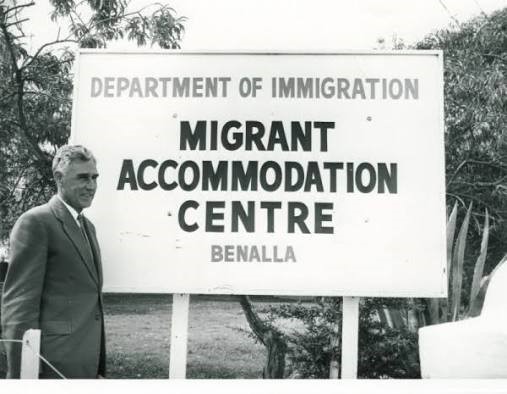
The Benalla Migrant Camp in north-eastern Victoria provided temporary accommodation for approximately 60,000 European migrants between 1949 and 1967. Although less well known than the nearby Bonegilla Migrant Reception and Training Centre, Benalla played a distinctive role in Australia’s post-war immigration program.
For many migrants, including families with Dutch connections, Benalla was not their first point of arrival in Australia. They were generally processed at Bonegilla and subsequently transferred to Benalla while employment and more permanent accommodation were arranged.
This article forms part of the Dutch Australian Cultural Centre’s research series on the migrant reception centres and hostels through which Dutch migrants began their lives in Australia.
From wartime airfield to migrant camp
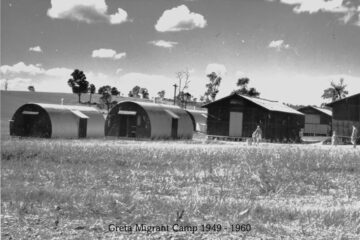
The camp was established in September 1949 at Benalla Airport, using buildings that had previously formed part of the Royal Australian Air Force’s No. 11 Elementary Flying Training School.
There is also a direct Dutch wartime connection to the site. Bernhard Jan Ruesink, who served in Dutch military aviation in the Netherlands East Indies, Australia and Indonesia, undertook flying training at Benalla during 1944.
After the war, the former military accommodation, administrative buildings and service facilities were adapted for use as a migrant holding centre. This transformation from a wartime training base into temporary accommodation for new arrivals reflected Australia’s transition from military mobilisation to post-war immigration and development.
Benalla’s role in the migration program
Benalla operated from September 1949 until 8 December 1967, making it one of Australia’s longest-running post-war migrant centres. It functioned primarily as a holding centre associated with Bonegilla.
Migrants arriving under Australia’s assisted migration program were commonly registered and processed at Bonegilla. Some were then transferred to Benalla after work had been allocated in nearby factories, farms, orchards or other industries in north-eastern Victoria and the Goulburn Valley. Assisted migrants were generally required to work for two years in employment determined by the Australian Government.
This system could separate families. Men were sometimes sent elsewhere to work while their wives and children remained at Benalla. The camp consequently became particularly important for women caring for children, widows, single mothers and families awaiting reunification or permanent housing.
At various times, approximately one-third of the residents were supporting mothers. The arrangements developed at Benalla to provide accommodation, employment and childcare for these women became known as the “Benalla Experiment”.
Life at the camp
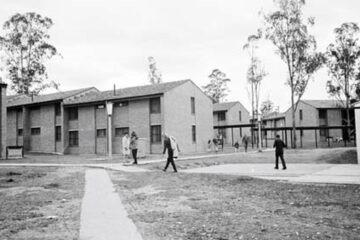
At full capacity, Benalla accommodated approximately 500 people. Around 60 accommodation and service huts once stood on the site.
Facilities included a hospital, canteen, shop, theatre and cinema. The Benalla Aerodrome School operated at the camp from 1949 until 1963, providing education for the children living there. Local factories, including clothing and engineering businesses, employed both male and female residents. Others found work on farms and in the orchards of the Goulburn Valley.
The accommodation was basic. Families lived in former military huts that offered little insulation, heating or privacy. During summer, the metal walls of the Nissen huts could become extremely hot. Residents tried to make their temporary rooms more comfortable by hanging rugs, lining walls and ceilings, planting small gardens and adding personal possessions.
Adult memories of Benalla were often shaped by wartime displacement, family separation and the difficulties of adjusting to unfamiliar surroundings. Children sometimes remembered the experience differently. For them, the camp could provide freedom, companionship and the security of living among many other families undergoing the same transition.
Dutch connections: the Sanders family
The DACC’s principal documented Dutch connection with Benalla is the story of the Sanders family.
Antonius “Tony” Sanders and Elizabeth “Liz” van Stein married in Indonesia in 1950. Their family history crossed several parts of the former Dutch world, including the Netherlands, Indonesia and Dutch New Guinea, before they migrated to Australia.
After arriving in Australia, the family passed through Bonegilla and Benalla. Their story illustrates that post-war Dutch migration was not limited to people travelling directly from the Netherlands. It also included Dutch citizens, Indo-Europeans and families whose lives had been shaped by the Netherlands East Indies, Indonesian independence and the dissolution of the Dutch colonial world.
The Sanders family’s experiences at Bonegilla and Benalla are documented in the DACC article The Sanders Family: Bonegilla and Benalla Migrant Camps via the Netherlands, Indonesia and Dutch New Guinea.
Their story gives a personal dimension to Benalla’s history. The camp was more than an administrative component of the immigration system. It was a temporary home in which families waited, adapted and prepared for lives that would eventually take them into towns and communities across Australia.
Further DACC research may identify other Dutch and Dutch East Indies families who passed through Benalla.
A diverse migrant community
Benalla initially housed many refugees and Displaced Persons from Central and Eastern Europe, including migrants from Poland, Latvia, Lithuania, Estonia and Germany. Later residents included assisted migrants from a wider range of European countries.
The different backgrounds of the residents made Benalla a multilingual and multicultural community. Although the official policy of the period emphasised assimilation into Australian society, daily life at the camp was also shaped by migrants helping one another, maintaining family traditions and developing friendships across national boundaries.
Benalla therefore represents both the opportunities and the difficulties associated with Australia’s post-war immigration program. Migrants were offered security, employment and the possibility of a new future, but they also encountered primitive accommodation, loss of privacy, restricted choices and pressure to adapt quickly to Australian customs.
Preserving the site
Most of the former camp buildings were demolished during the 1980s, partly to make way for the adjoining Cooinda retirement village. However, nine huts, the main entrance gates, sections of roadway and several other physical features survived.
The former Benalla Migrant Camp was added to the Victorian Heritage Register in May 2016. Its heritage significance lies not only in the remaining buildings but also in the memories of the tens of thousands of migrants who lived there.
The Benalla Migrant Camp online archive preserves photographs, documents, family histories and personal recollections. This community-led work has restored public recognition to a place that, despite its scale and importance, was largely overlooked for many years.
Part of the Dutch migration story
Benalla was not primarily a Dutch migrant camp. Its residents came from many parts of Europe, and people from Central and Eastern Europe formed a particularly significant part of its population.
Nevertheless, the Sanders family demonstrates that Dutch and Dutch East Indies migrants were among those whose Australian journey included Benalla. Their experience connects the camp to the broader and increasingly diverse story of Dutch migration to Australia.
Together with Bonegilla, Wacol, Woodside and other migrant reception centres and hostels, Benalla formed part of the national infrastructure through which post-war migrants entered Australian society. By connecting the history of these places with individual family stories, the DACC aims to preserve the human experiences behind Australia’s post-war migration program.