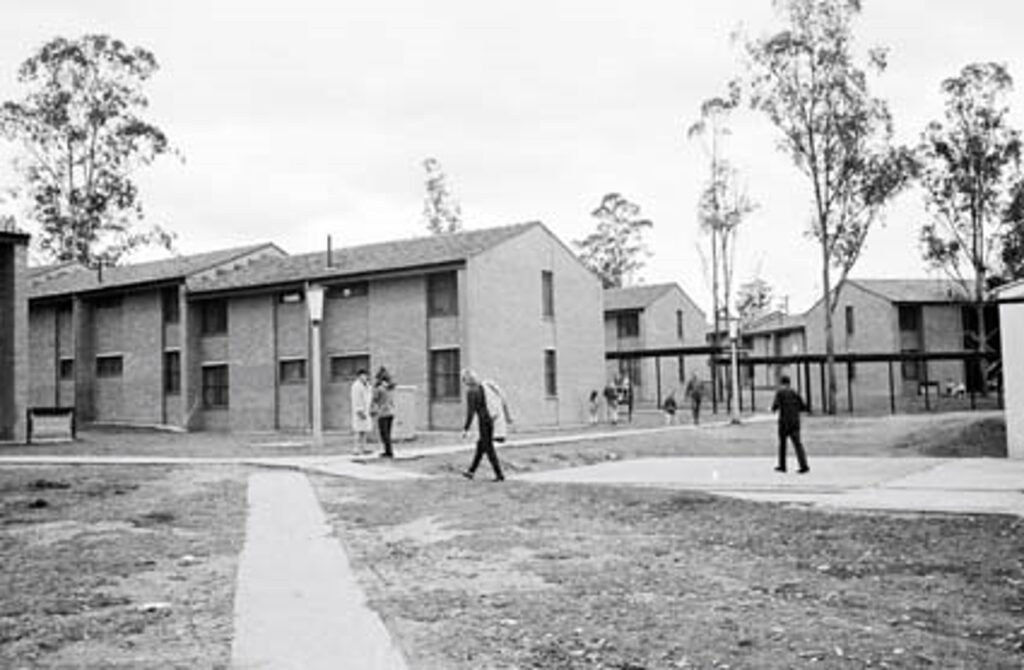
National Archives of Australia (A12111 – 1/1970/22/25)
For more than three decades, the Villawood Migrant Hostel was one of Australia’s largest and most significant migrant accommodation centres. Located in Sydney’s south-west, it became a temporary home for tens of thousands of migrants arriving under Australia’s post-war immigration programme.
For many migrants, Villawood represented their first experience of Australia. It was where they adjusted to a new country, learnt English, found employment and began building new lives. Among them were many Dutch migrants whose later contributions to Australian society are now reflected in the growing collection of stories preserved by the Dutch Australian Cultural Centre (DACC).
This article forms part of the DACC research series Dutch Gateways to Australia, documenting the migrant reception centres and hostels that played an important role in the post-war migration of Dutch families to Australia.
From munitions factory to migrant hostel
The Villawood Migrant Hostel opened in 1949 on the site of the former Leightonfield munitions complex in Sydney’s western suburbs. Existing wartime buildings were converted into migrant accommodation as Australia expanded its ambitious post-war immigration programme.
Unlike Bonegilla, which primarily served as Australia’s main reception and processing centre, Villawood functioned as both a reception and settlement hostel. Some migrants stayed only a few weeks before moving into permanent accommodation, while others remained for many months awaiting employment or housing.
During the 1950s and 1960s, Villawood became one of the largest migrant hostels in Australia, housing families from the Netherlands, Britain, Germany, Italy, Yugoslavia, Greece and many other European countries. Later, the hostel welcomed migrants and refugees from an even wider range of nations as Australia’s immigration programme evolved.
Life at Villawood
Villawood functioned as a small multicultural community. Residents lived in modest accommodation, sharing dining rooms, laundries, recreational facilities and community spaces. English language classes, welfare services and employment assistance helped families begin adapting to Australian life.
For adults, life often centred on finding work and establishing financial security. For children, the hostel became a place where friendships quickly developed across cultural and linguistic boundaries. Sporting activities, dances, concerts and community events helped create a sense of belonging during what was often an uncertain period of transition.
Although living conditions were basic and privacy was limited, many former residents later remembered Villawood as a place where lifelong friendships were formed and where migrants from many different backgrounds supported one another as they adjusted to life in Australia.
Dutch migrants at Villawood
Like the other major migrant hostels, Villawood welcomed many Dutch migrants arriving under Australia’s assisted migration schemes during the 1950s and 1960s. Some remained in Sydney, while others settled elsewhere in New South Wales or moved interstate after completing their hostel stay.
The hostel became an important starting point for many Dutch Australians whose later lives reflected the remarkable diversity of post-war migration. Their achievements demonstrate that migrant hostels were far more than temporary accommodation—they were communities where new Australians began building lives that would contribute to every aspect of Australian society.
Among the Dutch migrants whose stories are documented elsewhere on the DACC website are:
- Harry Vanda (Hans van den Berg) and Dick Diamonde (Dingeman van der Sluijs), whose time at Villawood preceded the formation of Australia’s legendary 1960s rock group, The Easybeats.
- Joop Mul, whose migration story reflects the experiences of many Dutch families arriving under the assisted migration programme.
- Adriana Taylor, whose journey through Villawood formed part of a lifetime of contribution to Australian society.
- Dr Ray Kerkhove, whose family’s migration story began at Villawood before establishing a new life in Australia.
- Glen op den Brouw, whose distinguished service to the Sydney community was recognised through the Order of Liverpool.
- The family story told in The Road from Wagga Wagga, which provides another perspective on the post-war Dutch migrant experience.
Together these stories illustrate the many different paths taken by Dutch migrants after leaving Villawood. Some became musicians, others academics, businesspeople, community leaders, teachers or volunteers. Each story adds another chapter to the broader history of Dutch migration to Australia.
Can you help us?
We are keen to receive stories, photographs, documents and memories from people who stayed at this migrant centre. With your permission, we would be delighted to include them in this article, helping to preserve this important chapter of Australia’s and the Dutch-Australian community’s migration history. Contac: dutchaustraliancc@gmail.com
From migrant hostel to immigration detention
During the late twentieth century, Villawood underwent a profound change. Parts of the former migrant hostel were progressively redeveloped as an immigration detention facility, and today the name “Villawood” is often associated with immigration detention rather than with the post-war migration programme that helped build modern Australia.
This later history has tended to overshadow Villawood’s earlier role as one of Australia’s principal migrant hostels. Yet for tens of thousands of families—including many Dutch migrants—it was the place where their Australian journey truly began.
Remembering Villawood
Today, Villawood occupies an important place in Australia’s migration history. Together with Bonegilla, Wacol, Woodside, Benalla, Northam and many other migrant hostels, it formed part of the national infrastructure that supported one of the largest migration programmes in Australia’s history.
For the Dutch Australian Cultural Centre, Villawood is also an important research hub. By connecting the history of the hostel with the individual stories of Dutch migrants who lived there, the DACC aims to preserve not only the history of the place itself but also the lives of the people whose Australian stories began within its boundaries.
As further research identifies additional Dutch families connected with Villawood, this article will continue to evolve, providing an increasingly comprehensive picture of one of Australia’s most significant migrant hostels.
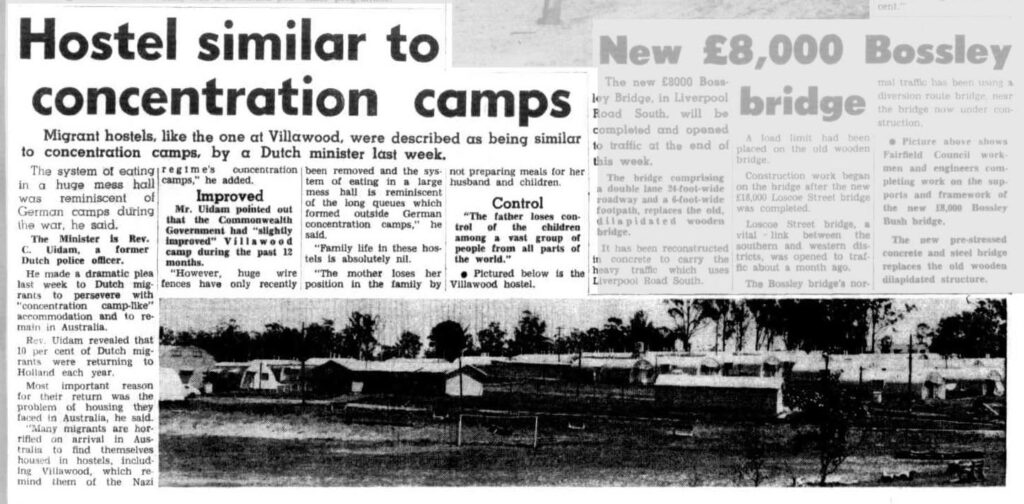
“Hostel similar to concentration camps.” Those were the controversial words used by Dutch Minister and former Dutch police officer Rev. C. Uidam following a visit to the Villawood Migrant Hostel in the early 1960s. His criticism of the institutional nature of Australia’s migrant hostels sparked considerable public debate and reflected the concerns of some newly arrived Dutch migrants about the living conditions they encountered. While many migrants later looked back on Villawood as the place where their Australian lives began, the hostel experience was often a complex mix of hope, uncertainty and adjustment. For thousands of Dutch families, Villawood became the first step in building a new future in Australia.