Among Australia’s many post-war migrant reception centres, Greta Migrant Camp occupies a special place. Located in the Hunter Valley of New South Wales, it was one of the country’s largest migrant camps and welcomed approximately 100,000 migrants between 1949 and 1960. For many newly arrived Europeans, Greta represented their first home in Australia and the beginning of a new life.
Although the Dutch Australian Cultural Centre has not yet identified individual Dutch migrants who passed through Greta, the camp undoubtedly formed part of the national network of reception centres used during the great post-war migration programme. As DACC research continues, this article will be expanded with Dutch family stories connected with Greta.
This article forms part of the DACC research series Dutch Gateways to Australia, documenting the migrant reception centres and hostels that played an important role in Australia’s post-war migration story.
From army camp to migrant reception centre
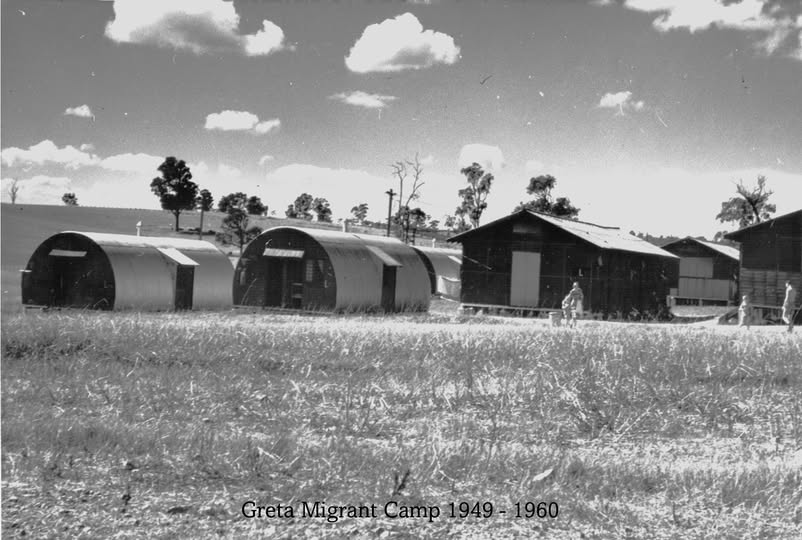
Greta Camp was originally established in late 1939 as one of Australia’s largest military training camps. During the Second World War, approximately 60,000 Australian soldiers trained there before serving in campaigns throughout the Pacific and elsewhere. The camp became known locally as “Chocolate City”, after its brown weatherboard buildings, and “Silver City”, after the corrugated iron Nissen huts that formed another section of the complex.
Following the war, part of the camp continued to be used for training troops destined for the British Commonwealth Occupation Force in Japan. In 1949, however, the site entered a completely new phase when it was transferred to the Department of Immigration and converted into one of Australia’s largest migrant reception centres. The extensive military infrastructure—accommodation huts, kitchens, dining halls, hospitals and service buildings—made Greta ideally suited to its new purpose.
Welcoming a new generation of Australians
The first migrants arrived at Greta in June 1949, many having been transferred from the Bathurst Migrant Camp. Others came directly from ships arriving in Newcastle before travelling by rail to the Hunter Valley. Over the next eleven years, around 100,000 migrants passed through Greta, making it one of Australia’s busiest reception centres.
Initially, many residents were Displaced Persons from war-torn Europe. Later arrivals included assisted migrants from a wide range of countries, including the Netherlands, Italy, Greece, Germany, Austria, Poland, Latvia, Lithuania, Estonia, Yugoslavia, Czechoslovakia and Hungary. Greta reflected the increasingly diverse nature of Australia’s post-war immigration programme.
Life at Greta
Like other reception centres, Greta provided temporary accommodation while migrants were allocated employment and, eventually, permanent housing.
The camp remained divided into its wartime sections. Silver City generally functioned as the reception area where newly arrived migrants were processed and accommodated in corrugated iron Nissen huts. Chocolate City contained the weatherboard barracks and often housed wives and children while husbands were sent to work under their compulsory two-year employment contracts. Many men worked on major national projects such as the steel industry, railway construction, sugar cane harvesting and the Snowy Mountains Hydro-electric Scheme.
Life was basic but organised. Families lived in former military accommodation with shared dining rooms, laundries and communal facilities. English language instruction, welfare services and employment assistance helped migrants begin adapting to Australian life. Friendships formed between people from many different countries, creating a vibrant multicultural community long before multiculturalism became official Australian policy.
Greta and the Hunter Valley
The arrival of thousands of migrants had a lasting impact on the Hunter region.
Many migrants remained in nearby towns after leaving the camp, contributing to the development of the coal mines, steelworks, engineering industries and agricultural enterprises that characterised the region’s economy during the post-war decades. Others moved elsewhere in Australia, taking with them the skills and determination that helped transform the nation’s workforce.
Today, many Hunter Valley families can trace their Australian beginnings to Greta Migrant Camp, making it an important part of the region’s social and cultural history.
Remembering Greta
Unlike Bonegilla, relatively little survives of the original camp. Following its closure in January 1960, many of the huts were sold, dismantled or relocated throughout the Hunter Valley. The Army briefly resumed use of the site before it was eventually sold in 1980. Today only foundations, road alignments and a small number of physical remnants remain.
Despite the loss of most of the buildings, Greta’s history has increasingly been recognised. Community organisations, historians and former residents have worked to preserve the memories of both the Army Camp and the Migrant Camp through reunions, exhibitions, publications and commemorative events. The significance of Greta was recognised nationally during anniversary commemorations attended by Australia’s Governor-General, highlighting its dual role in Australia’s wartime and migration history.
The Dutch connection
The Netherlands was among the countries whose migrants passed through Greta during the 1950s. However, unlike camps such as Bonegilla, Wacol and Villawood, the DACC has not yet identified individual Dutch family stories specifically connected with Greta.
This presents an opportunity for further research. As the DACC archive continues to expand, this article will be updated with biographies, photographs, oral histories and family memories relating to Dutch migrants who began their Australian journey at Greta.
Readers who have photographs, documents or recollections of Dutch families connected with Greta Migrant Camp are warmly invited to contact the Dutch Australian Cultural Centre. Their stories will help ensure that this important chapter of Australia’s migration history continues to grow.
Part of the Dutch Gateways to Australia series
Greta was one of the largest migrant reception centres in Australia and formed an essential part of the national network that welcomed hundreds of thousands of post-war migrants. Together with Bonegilla, Bathurst, Benalla, Villawood, Wacol, Woodside, Finsbury/Pennington and other reception centres, Greta helped shape modern Australia.
For the Dutch Australian Cultural Centre, documenting these places is about more than preserving the history of buildings. It is about understanding the experiences of the people who passed through them and recognising the contribution they made to Australian society. As new Dutch connections emerge, Greta will take its place within that broader national story.
Can you help us?
We are keen to receive stories, photographs, documents and memories from people who stayed at this migrant centre. With your permission, we would be delighted to include them in this article, helping to preserve this important chapter of Australia’s and the Dutch-Australian community’s migration history. Contac: dutchaustraliancc@gmail.com