During the Second World War, Dutch, Australian and Indonesian personnel worked together in a little-known series of clandestine operations against Japanese forces occupying the Netherlands East Indies.
Their activities were organised through the Netherlands East Indies Section of the Inter-Allied Services Department (IASD), a secret Australian-based organisation responsible for intelligence gathering, reconnaissance, sabotage and other special operations. IASD was an important predecessor of the Services Reconnaissance Department and the organisation popularly associated with Z Special Unit.
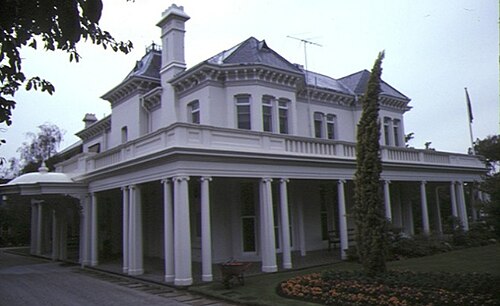
The Inter-Allied Services Department’s headquarters was initially organised from a small office at Victoria Barracks. On 17 May 1942, it moved into Airlie House, a large mansion at 260 Domain Road, South Yarra. Airlie became the organisation’s principal headquarters and administrative centre.
A substantial file held by the National Archives of Australia provides a rare account of the NEI Section’s organisation, personnel and operations. It also reveals the difficulties, disagreements and heavy losses that characterised this dangerous work.
The NEI Section of IASD
The NEI Section planned and supported clandestine operations in:
- Netherlands New Guinea, including Hollandia and the Wissel Lakes;
- Ambon and Ceram;
- Java;
- Celebes;
- the Aru Islands.
Its responsibilities included:
- gathering military intelligence;
- establishing secret wireless communications;
- reconnaissance of Japanese positions and installations;
- distributing Allied propaganda;
- recruiting local intelligence networks and resistance groups;
- sabotage and demolition;
- preparing the ground for future Allied operations.
The section was directed by Lieutenant-Commander J. J. Quéré of the Royal Netherlands Navy. Captain J. Jansen was responsible for wireless telegraphy and communications, not only for NEI operations but also for other IASD parties entering enemy-occupied territory.
Captain G. G. M. van Arcken served as the section’s personnel or administrative officer. The file describes him as a naturalised Australian of Dutch extraction who joined IASD as a civilian in June 1942 for operations in Java. He was subsequently appointed a temporary captain in the Australian Imperial Force.
A substantial Dutch and NEI presence
The NEI Section was not a minor adjunct to an otherwise Australian organisation.
In December 1942, IASD headquarters and training staffs included 40 Australians and 18 Dutch subjects. Its operational personnel numbered 80, comprising 27 Australians and 53 Dutch or NEI personnel.
A total of 71 NEI personnel were then attached to IASD. Of these, 53 were engaged in operations, undertaking training or awaiting an operational posting.
Personnel were stationed at several Australian locations, including:
- “Airlie”, the IASD headquarters in Melbourne;
- Darwin;
- Z Experimental Station near Cairns;
- other training and operational facilities.
They included Dutch and NEI naval and army officers, colonial police, sailors, wireless operators, mechanics, Indonesian operatives and the crews of traditional praus. Australian soldiers and communications specialists were also assigned to NEI operations.
Z Experimental Station at Cairns
One of the most important centres for this Dutch-Australian-Indonesian cooperation was the secret Z Experimental Station (ZES) at Fairview House, Mooroobool, near Cairns. Established in 1942 as a training, communications, holding and operational staging facility,
ZES initially accommodated Australians and personnel from the Netherlands East Indies in roughly equal numbers, with Indonesians forming a large proportion of the NEI contingent. Among its instructors was Ambonese KNIL officer Julius Tahija. Following the reorganisation of Allied intelligence in 1943, ZES increasingly became a NEFIS III facility, where Dutch and Indonesian agents were trained and prepared for clandestine missions into the Japanese-occupied Netherlands East Indies.
Read more: The Forgotten Dutch and Indonesian Story of Cairns’ Z Experimental Station
Intelligence or special operations?
The file reveals considerable disagreement over the administrative control of these operations.
IASD brought together two functions that were not always easily separated:
- special operations, including sabotage;
- field intelligence and reconnaissance.
Many missions in Dutch territory involved both. This created uncertainty over whether the parties belonged to IASD’s special-operations section or the Field Intelligence Section of the Allied Intelligence Bureau.
The file suggests that disagreements involving the NEI Section contributed to the disruption and eventual reorganisation of IASD. Funding was particularly contentious. General Headquarters reportedly directed that the NEI Section receive half of IASD’s financial allocation.
Following the reorganisation, the NEI Section passed to Field Intelligence. Its work subsequently developed within the Netherlands Forces Intelligence Service, better known as NEFIS, initially under Commander Brouwer and later when moved to Camp Columbia in Brisbane under Colonel Simon Spoor. The Services Reconnaissance Department no longer controlled these NEI operations.
The section’s records were transferred with it. Consequently, the Australian officer later attempting to write the history of IASD found that few documents or knowledgeable witnesses remained available. Much of the surviving file represents an attempt to reconstruct events from incomplete records.
Operations in New Guinea
One of the best-known missions involved NEI Sergeant H. N. Staverman, Australian signaller Sergeant Leonard G. Siffleet and Indonesian operatives.
The party travelled through New Guinea conducting reconnaissance, distributing Allied propaganda and seeking support among local communities. Staverman and Indonesian operative H. Pattiwael moved towards Hollandia in Netherlands New Guinea.
After learning that the Japanese had organised an expedition to capture them, Staverman and Pattiwael were ambushed south of Hollandia. Staverman was killed, while Pattiwael initially escaped.
Siffleet was subsequently captured and executed. He became widely known through the Japanese photograph showing his execution. The IASD file places his story within a broader Dutch-Australian-Indonesian intelligence operation and records the important participation of NEI and Indonesian operatives.
Operation FLOUNDER
FLOUNDER was an entirely NEI operation intended to establish a long-term intelligence presence on Ceram.
The eight-person party was led by Lieutenant H. P. Nygh and included NEI soldiers, a wireless signaller and members of the Dutch colonial police.
An American submarine inserted the party after departing from Perth, with the landing taking place during the night of 30–31 December 1942. The party was captured soon afterwards.
The file records that Nygh’s fate was uncertain. Reports available to the compiler indicated that the other members were executed. A submarine returned for a planned rendezvous on 5 May 1943 but found no trace of the party.
A proposed intelligence and sabotage mission to Ambon
Another major operation was planned for Ambon under Captain W. T. Jinkins.
Jinkins had previously served with the Australian forces defending the region. He became a Japanese prisoner of war but escaped and returned to Australia. His experience made him a logical choice to lead a long-term intelligence and sabotage mission.
The proposed party included Australians with expertise in explosives, fieldcraft and communications, together with Indonesian sailor B. J. Manupputy, whose name appears in several forms in the surviving documents.
Training was conducted at Z Experimental Station near Cairns. The party was fully equipped with stores and wireless equipment intended to support an extended deployment.
However, no submarine or other suitable transport could be obtained. The mission was abandoned after the NEI Section was transferred to Field Intelligence.
The detailed plan for Ambon
One of the most remarkable documents in the file is the “Appreciation of Project 23 A-2”, prepared at Cairns on 9 November 1942.
This was an ambitious plan to:
- establish a clandestine operational base near Ambon;
- conduct reconnaissance of Japanese installations;
- create an intelligence network;
- develop locally supported resistance;
- undertake sabotage;
- prepare for a future Allied attack.
The planners estimated that approximately 1,500 Japanese naval personnel were stationed in the area. They assessed Japanese airfields, wireless stations, shipping, coastal patrols, labour arrangements and the attitudes of different sections of the local population.
Possible bases were considered in:
- northern and southern Ambon;
- Ceram;
- Haruku;
- Saparua.
The plan recognised that the party would require detailed local knowledge and the support of trusted residents. It proposed including a Dutch or NEI member familiar with colonial policy who could speak Malay and communicate effectively with the local population.
The terminology used to describe ethnicity, physical appearance and local communities reflects the racial and colonial attitudes of the period. Nevertheless, the document illustrates how language skills, cultural knowledge, personal contacts and the ability to move through occupied territory were considered essential to clandestine operations.
The proposed demolition targets included:
- Ambon’s water supply;
- oil-storage facilities and pipelines;
- wireless and telephone communications;
- warships and merchant vessels in the harbour;
- the seaplane base, hangars and refuelling facilities;
- the land aerodrome;
- coastal and anti-aircraft defences;
- Japanese administrative headquarters.
The plan anticipated several months of preparation before major operations could begin. Its objective went far beyond reconnaissance: it envisaged creating a resistance organisation capable of supporting an eventual Allied return.
Operations in Java
Several missions to Java were organised under the codename TIGER.
The file records parties inserted by the Dutch submarine K XXI, including missions whose members disappeared after landing. In one case, wireless transmissions were suspected of being controlled by the Japanese. A proposed operation to extract that party was consequently cancelled.
Another operation, involving Captain Van Arcken, landed briefly on the south coast of Java. Because of the strength of the Japanese presence, the party evacuated almost immediately after collecting an individual named Schenau and subsequently returned to Darwin.
The records relating to the Java operations are fragmentary. Handwritten corrections throughout the file show that its compiler was still attempting to establish the correct composition, sequence and fate of several missions.
The Aru Islands operation
Captain C. R. Sheldon led an Australian party into the Aru Islands. Other personnel associated with the operation included R. W. Feetum, I. A. McMillan-Kerr, J. McCandlish, G. H. Dahlberg and Danish civilian N. P. Monsted.
The purpose of the mission was to investigate local conditions and gather intelligence. Communications with IASD were maintained by wireless through Darwin.
The file is critical of the operation’s planning. It claims that Sheldon had made enemies among sections of the local population and suggests that his appointment contributed to the difficulties encountered by the party.
After landing, the party reported that local conditions were hostile and infiltration would be difficult. Assistance was requested, and Monsted attempted to reach the party.
Sheldon was captured, and the party’s wireless equipment and supplies were seized. The surviving members wandered through the jungle before being overpowered by a Japanese patrol.
According to the file, Japanese interrogations produced important information about IASD, Z Special Unit and Australia’s secret-intelligence organisation. This illustrates the potentially serious consequences when clandestine parties were captured.
Other operations and projects
The file also contains references to a number of other missions:
- SCHNAPPER, involving two NEI sergeants;
- KENDARI 26, directed against the Japanese airfield at Kendari in Celebes;
- JAVA 4 and JAVA 5;
- MACKEREL;
- LION and APRICOT in Celebes;
- WALNUT and other operations in New Guinea and the Aru Islands;
- a proposed mission to the Wissel Lakes in Netherlands New Guinea.
In several cases, little more than the codename, destination and approximate composition of the party could be reconstructed. The loss or transfer of the original NEI operational records left significant gaps.
Dutch naval and aviation support
Transport was one of IASD’s greatest operational problems. Parties were frequently delayed or missions cancelled because submarines, aircraft and other vessels could not be made available.
The file records that Admiral Coster of the Royal Netherlands Navy placed an older Dutch submarine at the disposal of the NEI Section. He also assisted by supplying Dutch small craft for clandestine operations.
Dutch submarines, American submarines and Dutch Dornier flying boats were used to insert or support some of the parties.
This assistance was critical. The Dutch contribution consisted not only of personnel and local knowledge but also scarce naval and aviation resources without which many missions could not have proceeded.
A shared and dangerous secret war
The file presents a complex picture of wartime cooperation.
Australian personnel contributed military skills, training facilities, communications and organisational support. Dutch and NEI personnel supplied officers, sailors, police, wireless specialists, intelligence knowledge and transport. Indonesian operatives provided languages, cultural knowledge and essential familiarity with the territories into which the parties were sent.
Many of these missions ended in capture, execution or disappearance. Others were abandoned because transport could not be obtained or because the risk had become too great.
The document therefore reveals both the extent of Dutch-Australian-Indonesian cooperation and the enormous human cost of conducting intelligence operations inside Japanese-occupied territory.
It also broadens the familiar Australian history of Z Special Unit, Dutch, NEI and Indonesian personnel were not peripheral participants. They formed a substantial part of the secret organisation operating from Australia and were central to attempts to maintain contact with, gather intelligence from and organise resistance within the occupied Netherlands East Indies.
A document that requires careful interpretation
This archival file should not be treated as a complete or fully settled official history.
It contains:
- several versions of the same account;
- handwritten additions and corrections;
- uncertain spellings and identities;
- incomplete or sometimes contradictory information;
- explicit acknowledgement that important original records were unavailable;
- retrospective attempts to reconstruct operations and their outcomes.
It is nevertheless an exceptionally valuable primary source. It provides rare insight into the organisation, planning, personnel and operational difficulties of the NEI Section of IASD.
Individual names, dates and operational outcomes should be compared with NEFIS records, military service files and specialist historical research before being treated as definitive.
The original archival file
Researchers can consult the complete digitised file below:
National Archives of Australia: A3269, H7, “[SRD (Services Reconnaissance Department) HQ –] NEI [Netherlands East Indies] Section IASD [Inter-Allied Services Department]”, NAA item 235285.
The original file contains historical terminology and descriptions that may be considered inappropriate or offensive today. These reflect the attitudes and administrative language of the period.
Paul Budde August 2026