By Paul Budde
Australia and the Netherlands East Indies on the eve of war
This four-part series examines how Australia and the Netherlands East Indies moved from limited contact towards direct diplomatic, military, public and economic cooperation immediately before the Pacific War.
- From distant neighbours to regional partners: Australia and the Netherlands East Indies before the Pacific War
An introduction to the previously limited relationship and the growing connections through diplomacy, trade, aviation and shared strategic concerns. - Australia looks north: Australian missions to the Netherlands East Indies in 1941
Australian ministers, military officers and journalists travelled to the NEI as both neighbours developed direct defence planning and greater public awareness of their shared interests. - Australia and the Netherlands East Indies on the eve of war: the 1941 Press Delegation
Led by Charles van der Plas, the diverse NEI delegation toured Australian military establishments and industries only two months before Japan entered the war. - Trade, resources and the final mission before war: the NEI Economic Mission to Australia, 1941
The November mission sought increased Australian supplies and permanent purchasing arrangements, but its plans were overtaken within weeks by the outbreak of the Pacific War and the invasion of the NEI.
From distant neighbours to regional partners: Australia and the Netherlands East Indies before the Pacific War
Part 1 of a four-part series examining the growth of relations between Australia and the Netherlands East Indies immediately before the Japanese invasion.
Australia and the Netherlands East Indies were close geographical neighbours, but before the Second World War this proximity did not produce an equally close political relationship. Trade, shipping and personal connections existed, yet official contact remained limited. Australia principally viewed its international position through the British Empire, while the Netherlands East Indies was governed from Batavia within the wider Dutch colonial and commercial system.
This began to change during the 1930s and accelerated dramatically after Germany occupied the Netherlands in May 1940. Regional security was an important reason, but it was not the only one. Australia wanted closer economic relations with the NEI and access to its strategically important raw materials. The NEI increasingly looked to Australia for armaments, industrial products, food and other supplies.
A concentrated series of reciprocal missions during 1940 and 1941 reflected this changing relationship. Australian ministers, military officers and journalists travelled to the NEI. Dutch, Indonesian and Chinese-Indonesian representatives subsequently visited Australia. Their discussions covered defence, aviation, shipping, trade, industrial production and public information.
They were attempting to build a closer regional partnership, but very little time remained. Japan entered the Pacific War in December 1941, and the Netherlands East Indies surrendered in March 1942.
Geographical proximity but limited relations
The northernmost parts of Australia lie only a relatively short distance from the islands that formed the Netherlands East Indies. Dutch and NEI ships regularly visited Australian ports, while Australian businesses traded with the archipelago. Nevertheless, official relations were generally conducted within European imperial structures.
Australia had gradually acquired greater authority over its external affairs, but its independent diplomatic representation remained limited and British strategic interests continued to influence Australian policy. The NEI possessed its own substantial administration in Batavia, but sovereignty and ultimate authority remained with the Netherlands.
As a result, two neighbouring territories often communicated through governments and institutions situated on the other side of the world. Australia frequently relied on British diplomatic representation, while important decisions concerning the external relations of the NEI remained connected to the Netherlands Government.
Political and strategic engagement had therefore not kept pace with geography or with the growing importance of Southeast Asia to Australia.
The Australian Eastern Mission of 1934
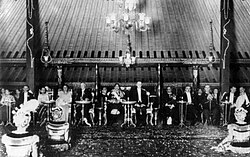
An early indication of change came in 1934, when Australian Minister for External Affairs John Latham led the Australian Eastern Mission through Asia. It was the first official Australian diplomatic mission sent beyond the British Empire and has subsequently been regarded as an important stage in the development of an Australian foreign policy more directly concerned with Asia.
The mission spent ten days in Java, from 1 to 11 April 1934, where its members were received by senior civil and military officials. Although publicly presented as a goodwill mission, it also investigated trade, diplomatic and strategic questions.
In his confidential report, Latham recommended closer cooperation between the Australian and Dutch navies. He even suggested that some Australian naval officers should learn Dutch. These recommendations indicate that at least some Australian policymakers were beginning to recognise the strategic importance of their northern neighbour well before the immediate crisis of 1940–41.
The mission also revealed how little independent representation Australia possessed in the region. British officials facilitated much of the journey because Australia had few diplomatic representatives of its own. Latham subsequently supported the expansion of Australia’s trade commissioner service as a practical way of combining commercial representation with a broader Australian presence overseas.[1]
Australian representation in Batavia
Charles Critchley was appointed Australian trade commissioner in Batavia in 1935, assisted by Clifton Carne. Their office provided Australia with a permanent and more direct channel for commercial relations with the NEI. Trade commissioners were also appointed in other Asian centres, including Tokyo and Shanghai.[2]
Trade commissioners did not possess the status or authority of ambassadors. Nevertheless, in places where Australia had no diplomatic mission, they performed functions extending beyond the promotion of Australian exports. They collected economic and political information, developed relationships with government officials and businesses, and helped bridge what historian Boris Schedvin described as the information gap separating Australia from its northern neighbours.
The Batavia appointment was therefore an early step towards a more direct Australian relationship with the NEI. It did not replace the wider British and Dutch imperial structures, but it gave Australia a representative who could observe developments and communicate with the NEI administration directly.
Aviation creates a practical connection
Civil aviation also began drawing the two neighbours together. In July 1938, the Koninklijke Nederlandsch-Indische Luchtvaart Maatschappij—KNILM—opened a regular service between Batavia and Sydney through northern and inland Australia.
The development of the service had not been straightforward. British and Australian authorities had resisted reciprocal operating rights for KNILM because of concerns about competition with Britain’s Imperial Airways and the protected British–Australian imperial aviation network.[3]
This episode illustrated the limitations within which Australia still operated. Australian external and transport policies remained strongly influenced by British imperial interests. KNILM’s attempts to establish an Australian service consequently became entangled in competition between Dutch and British aviation interests.
Once established, however, the KNILM route provided for the regular movement of passengers, mail and information between the NEI and Australia. Aviation was demonstrating the practical value of direct regional connections before political and military relations had fully caught up.
The DACC’s separate article, Royal Netherlands Indies Airline—KNILM and its link with Australia, provides a more detailed account of this aviation history.
The occupation of the Netherlands changes the relationship
Germany’s invasion and occupation of the Netherlands in May 1940 fundamentally changed the position of the NEI. The Netherlands Government and Queen Wilhelmina relocated to London, while the Governor-General and colonial administration continued to govern from Batavia.
The NEI now possessed even greater economic and strategic importance. Its oil, rubber, bauxite, tin and other resources were essential to the Allied war economy. These resources also made the archipelago a major target for Japan, whose continuing war in China and expansion into Southeast Asia required large supplies of oil and other raw materials.
Australia increasingly recognised that the defence of the NEI was closely connected with its own security. If Japan occupied the archipelago, the protective distance separating Australia from a major hostile power would disappear.
The Dutch and NEI authorities, meanwhile, faced the disruption of their traditional access to European military equipment and manufactured products. Australia’s developing munitions industry and its agricultural and industrial capacity consequently became more important.
The Dutch approach to Australia
In June 1940, shortly after the German occupation of the Netherlands, Dutch trade commissioner Gerard van Holst Pellekaan contacted William Hodgson, Secretary of the Australian Department of External Affairs. The Dutch wanted to send a military mission to discuss the supply of Australian arms and munitions to the NEI.[4]
The approach marked an important change. Before May 1940, the NEI could obtain military equipment through the Netherlands and other overseas suppliers. The loss of access to the occupied homeland increased the importance of Australia as a possible source of arms, industrial production and other supplies.
Discussions subsequently included the possibility of exchanging Australian armaments for raw materials from the NEI. The two economies possessed complementary strengths: the NEI held resources required by Australia and the wider Allied war economy, while Australia had agricultural products, industrial capacity and a rapidly expanding munitions sector.[5]
The defence negotiations and some of the difficulties surrounding Australian–Dutch cooperation are examined more fully in the earlier DACC series, Dutch–Australian wartime cooperation.
The question of direct dealings
Closer economic and military contact raised a larger constitutional and political question: to what extent could Australia deal directly with the NEI administration in Batavia?
Australian officials increasingly viewed the NEI as a neighbouring regional economy and strategic partner. Direct discussions appeared more practical than conducting arrangements through European authorities. Yet the NEI remained part of the Netherlands colonial system, and its authority over foreign, financial and commercial policy was not unlimited.
After the Netherlands Government relocated to London, the division of authority became more complicated. Batavia had to manage the immediate defence and economic requirements of the archipelago, while the Netherlands Government-in-Exile retained ultimate responsibility for the Kingdom’s foreign policy.
Questions concerning Batavia’s authority to negotiate directly with Australia, and the later wartime tensions between NEI representatives in Australia and the Netherlands Government-in-Exile in London, will be examined in the next article in this series, together with the relevant sources.
Cooperation and caution
Military cooperation advanced during 1940 and 1941, although not without difficulty. Australia wanted detailed information about Dutch defence planning and the capacity of NEI airfields, naval facilities and armed forces.
The Netherlands was already at war with Germany, but the NEI was not yet at war with Japan. The administration in Batavia had to prepare for a possible attack while remaining cautious about actions or public disclosures that might be interpreted as provocative. Dutch concern about secrecy and Australia’s growing sense of urgency sometimes produced frustration on both sides.
Nevertheless, the two governments began exchanging liaison officers, discussing naval communications, inspecting airfields and considering the supply of arms and raw materials. Australian ministers, military delegations and journalists travelled to the NEI, while NEI press and economic missions toured Australia.
An extraordinary concentration of visits
The pace of contact during 1941 was striking:
- Australian Army Minister Percy Spender visited Batavia in January.
- Australian naval, air force and munitions representatives held talks with Dutch authorities in February.
- Aviation inspections and military liaison arrangements followed.
- Minister for Information Harry Foll and a party of Australian journalists toured the NEI and Malaya in August.
- Further Australian–Dutch Army and RAAF discussions took place in Batavia.
- A Netherlands East Indies Press Delegation toured Australia in October.
- An NEI Economic Mission followed in November.
These were not simply ceremonial visits. Collectively, they demonstrated that Australia and the NEI were beginning to recognise their mutual economic and strategic importance.
However, the relationship was still being constructed when Japan entered the war. Arrangements that had been discussed through diplomatic, economic and military channels suddenly had to be implemented under conditions of invasion, military defeat and evacuation.
The fall of the NEI did not begin Dutch–Australian cooperation. Instead, it transformed an emerging relationship into an urgent wartime partnership conducted largely from Australian soil.
Sources
- John G. Latham, The Australian Eastern Mission, 1934: Report of the Leader of the Mission, Commonwealth Parliamentary Paper, 1934; National Library of Australia, Guide to the Papers of Sir John Latham; Honae Cuffe, The Genesis of a Policy: Defining and Defending Australia’s National Interest in the Asia-Pacific, 1921–57; Herman Theodore Bussemaker, “Australian-Dutch defence cooperation, 1940–1941”.
- Boris Schedvin, Emissaries of Trade: A History of the Australian Trade Commissioner Service, Department of Foreign Affairs and Trade; DFAT, Australia’s Trade Through Time.
- Marc Dierikx, “Struggle for Prominence: Clashing Dutch and British Interests on the Colonial Air Routes, 1918–42”, Journal of Contemporary History, vol. 26, no. 3/4, 1991.
- Herman Theodore Bussemaker, “Australian-Dutch defence cooperation, 1940–1941”, Australian War Memorial.
- Jack M. Ford, Allies in a Bind: Australia and the Netherlands East Indies in the Second World War, University of Queensland; Bussemaker, “Australian-Dutch defence cooperation, 1940–1941”.
Related DACC series
A three-part series examining constitutional authority in London and the development of the Netherlands East Indies administration in wartime Australia.
This six-part series continues the story by examining how the displaced Netherlands East Indies administration was reconstructed in Australia, how it worked with Australia and the Allied command, and how wartime cooperation was affected by the political transformation of Indonesia after 1945.
Dutch–Australian wartime cooperation
This six-part thematic series explores particular political, administrative and practical issues within the wartime relationship, including neutrality, tensions between London and the Indies administration, constitutional reform, Indonesian voices, wartime purchasing and the development of Dutch–Australian diplomatic relations.