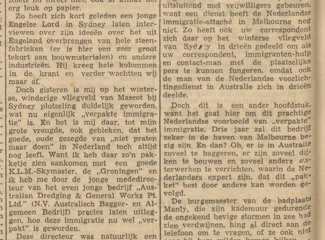
Australian Dredging and General Works Pty Ltd was established in 1950 to bring Dutch dredging expertise, equipment and skilled personnel to Australia.
Initially based in Williamstown, Victoria, the company was an Australian subsidiary jointly associated with two established Dutch civil-engineering businesses: Adriaan Volker’s Maatschappij tot het Uitvoeren van Openbare Werken of Sliedrecht and Van Hattum & Blankevoort of Beverwijk.
Its first major undertaking was a harbour and dock project in Melbourne. However, the company survived well beyond that initial contract. It subsequently became involved in dredging, marine construction and other infrastructure work around Australia and, for a time, New Zealand.
Over the following six decades, Australian Dredging and General Works reflected the mergers and restructuring of its Dutch parent companies. It later became part of the Volker Stevin Group and ultimately the international VolkerWessels organisation.
Its history demonstrates how Dutch engineering companies established lasting operations in Australia by combining specialist technology, international project management and the migration of skilled employees.
Establishing an Australian company
Dutch dredging companies had operated internationally for generations, but the Williamstown undertaking required a continuing Australian corporate presence.
Australian Dredging and General Works was established as a relatively small Australian joint-venture subsidiary. Research by economic historian Associate Professor Pierre van der Eng records that its approved capital in 1950 was £10,000 Australian.
This modest capital should not be confused with the value of the work it undertook. Contemporary Dutch newspapers valued the initial Australian project at approximately 11 million guilders. The Australian company principally provided the local corporate structure through which the Dutch participants could undertake the contract, employ workers and operate imported dredging equipment.
The two Dutch companies brought complementary experience.
Adriaan Volker was based in Sliedrecht, the centre of the Netherlands dredging industry. Van Hattum & Blankevoort, headquartered at Beverwijk, had extensive experience in civil engineering, hydraulic construction and major public works.
Contemporary reports identified Marinus Stigter and Hans Ferwerda as leading company representatives in Australia. They appeared before Williamstown Council in May 1950 and received an official welcome to the city.
Stigter subsequently became closely identified with the company’s Australian operations, while Ferwerda was described in Dutch reporting as a director or technical representative of the new enterprise.
The first Australian contract
The company’s initial project involved the construction or development of a dock near the entrance to the Yarra River, on the Port Melbourne side of the river.
The precise contractual scope still requires further archival research. Contemporary accounts variously described the work as dredging a new basin, deepening a natural bay and creating facilities that could be used by seagoing vessels.
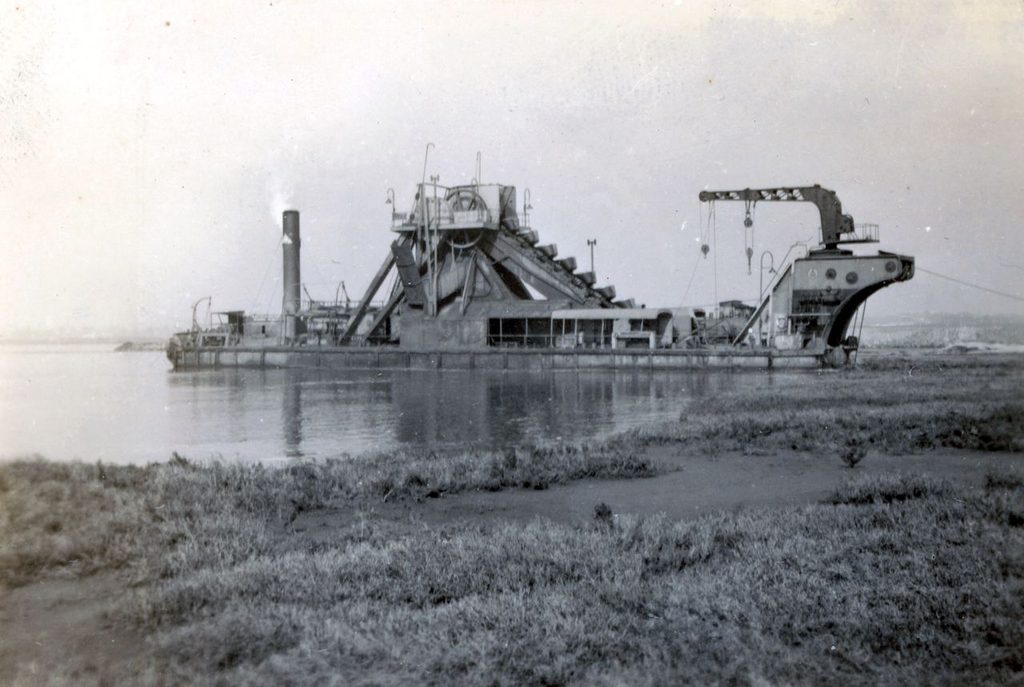
The project was expected to take approximately two and a half years. It required a complete working fleet rather than a single dredger.
Dutch newspapers reported that the equipment sent to Melbourne included:
- a bucket dredger;
- three seagoing hopper vessels;
- bottom-dumping barges;
- several tugboats;
- a possible suction dredger; and
- additional support equipment.
The fleet was assembled in the Netherlands and dispatched in stages. Two large seagoing barges, each carrying a small tugboat, departed from Vlaardingen. They were towed by the hopper vessels Amsterdam IV and Amsterdam V.
L. Smit & Co’s Internationale Sleepdienst organised the approximately 11,000-mile ocean transfer. The voyage through the Suez Canal was expected to take about 100 days.
This mobilisation was a substantial undertaking in its own right. It transferred an integrated Dutch dredging operation—vessels, machinery, management and specialist workers—to the other side of the world.
Importing skills as well as equipment
The company could not operate its Dutch machinery without an experienced workforce.
Approximately 900 people reportedly applied to join the Australian undertaking. Around 60 workers were initially selected, many of them from Sliedrecht and other communities associated with the Dutch dredging and maritime industries.
The employees included dredge operators, engineers, fitters and turners, stokers, skippers, tugboat crews and other maritime specialists.
Most travelled to Australia on two organised KLM flights departing Schiphol on 22 June and 22 July 1950. Their wives, children and other relatives made up part of the passenger groups.
The company paid travel costs, arranged employment and provided initial accommodation. A hostel with a Dutch cook was provided for unmarried workers, while houses were made available to families. Employees who did not remain in Australia could reportedly receive return travel.
Dutch newspapers described this comprehensive arrangement as verpakte emigratie—“packaged migration”.
The migration and family history of these workers is examined separately in:
From Sliedrecht to Williamstown: Dutch dredging workers and their families in post-war Australia
A company community in Williamstown
Australian Dredging and General Works initially established its headquarters and operational base in Williamstown, then one of Victoria’s most important maritime and shipbuilding centres.
The company purchased a two-storey bluestone building in Lyons Street and planned an additional residence for its Dutch employees. It also proposed subdividing Pollock’s Paddock into 17 residential allotments.
The land fronted The Strand and Douglas Parade between Dowman and Peel streets. Plans submitted to Williamstown Council included the construction of a private street, for which the council invited the company to propose a Dutch name.
The extent to which this complete housing proposal was implemented remains uncertain. Nevertheless, it demonstrates that the company’s responsibilities extended beyond the worksite. It was importing an operational community and needed to house both single employees and families.
The Williamstown base helped workers adjust to Australia while continuing to work among Dutch-speaking colleagues using familiar equipment and practices.
Expansion beyond Melbourne
The company soon began pursuing work elsewhere.
By April 1951 it was undertaking dredging work at Geelong. A detailed report published in Trouw in November 1953 described the Dutch employees working on a major project in the harbour there.
The same report indicated that Australian Dredging and General Works had grown to more than 160 employees. It also referred to activities in Sydney and Western Australia.
A surviving Australian newspaper report shows that two Dutch directors of the company inspected Newcastle Harbour in June 1951 in connection with possible dredging work. Newcastle’s continuing need for harbour maintenance made it an obvious location for a specialist dredging contractor.
The company’s movement between projects also affected its employees. Henk Korporaal and his family, for example, moved from Melbourne to Sydney in 1953 after he was transferred by the company.
These transfers gradually dispersed the original Williamstown group. Dutch workers and their families became established in Melbourne, Geelong, Sydney and other parts of Australia.
The people operating the fleet
The 1953 Trouw report identifies several people employed in the Australian operation.
Marinus Stigter was described as the company’s director. L.H. Brouwer of Rotterdam was skipper of the Loevestein. A. Noels was associated with the tug or hopper vessel Amsterdam IV, while Adriaan Middelkoop of Sliedrecht worked as a machinist aboard a dredger.
The report also mentioned C. Jol of Scheveningen, who was living in Australia with his wife and five children.
These names show that the company workforce extended beyond the approximately 60 people originally recruited in 1950. By 1953, Australian personnel were also being employed and trained alongside the Dutch specialists.
This was important to the longer-term survival of the business. What began as a largely Dutch workforce supporting imported equipment gradually developed into an Australian operation that retained strong technical and corporate connections with the Netherlands.
Work beyond conventional dredging
Australian Dredging and General Works was not confined to the excavation and maintenance of shipping channels.
During 1970–1972, the company worked with Australian Pipeline Construction on the Western Port–Altona ethane pipeline in Victoria. The project required a difficult marine crossing and became known for industrial and environmental disputes surrounding its construction.
Its involvement demonstrates that the company’s dredging, marine-construction and underwater engineering capabilities could be applied to infrastructure beyond traditional harbour works.
The company also continued to own or operate specialised dredging equipment. One later vessel, originally built in 1976 as Sliedrecht 32, subsequently operated under the name A.D. Australia. Records associate the cutter-suction dredger with Australian Dredging and General Works and the wider Volker Stevin organisation.
The use of a vessel carrying the initials “A.D.” reflected the continuing identity of the Australian business within the international Dutch group.
An Australian and New Zealand presence
Australian Dredging and General Works also established a business presence in New Zealand.
A notice published in the New Zealand Gazette in 1974 recorded that the Australian company intended to cease having a place of business in New Zealand. This did not mark the end of the Dutch group’s dredging activities there.
By the 1980s, Australian Dredging and General Works was closely associated with New Zealand Dredging and General Works. Both were part of the Netherlands-based Volker Stevin Group.
Heini Evers, who worked for Volker Stevin for more than 30 years, served as managing director of both companies from 1982 until 1992.
During this period, the associated companies participated in changing the way New Zealand ports organised maintenance dredging. Ports including Tauranga, Taranaki and Timaru investigated alternatives to operating their own ageing dredgers.
A cooperative contract-dredging arrangement reportedly reduced their combined annual dredging costs by more than NZ$1 million. Australian Dredging and General Works contracts manager Hadyn Pike contributed to the development of the arrangement.
This later history demonstrates how a company created for one Australian project evolved into part of a regional dredging organisation operating across Australasia.
Changes in Dutch ownership
The ownership of Australian Dredging and General Works followed the major consolidation of the Dutch construction and dredging industry.
The company began in 1950 as a joint venture associated with:
- Van Hattum & Blankevoort; and
- Adriaan Volker’s Maatschappij tot het Uitvoeren van Openbare Werken.
Van Hattum & Blankevoort subsequently became part of Stevin Groep. In 1978, Stevin and Volker merged to create Volker Stevin.
Australian Dredging and General Works consequently became a subsidiary within the combined Volker Stevin Group. The company’s Dutch parents were no longer separate partners but components of the same international organisation.
Further corporate restructuring followed:
- in 1997, Volker Stevin combined with Kondor Wessels to form Volker Wessels Stevin;
- the group later adopted the shorter name VolkerWessels; and
- Australian Dredging and General Works remained associated with this corporate group during its final years.
Research compiled by Pierre van der Eng records the Australian company as operating from 1950 until 2011.
The circumstances in which the Australian legal entity ceased operating require further investigation. Its closure nevertheless ended a corporate history extending for approximately 61 years—far longer than the two-and-a-half-year project for which it had originally been created.
The significance of Australian Dredging and General Works
Australian Dredging and General Works is significant in several interconnected areas of Dutch-Australian history.
From a business perspective, it was an early example of Dutch engineering firms establishing a permanent Australian subsidiary to undertake major infrastructure projects.
From a technological perspective, it transferred dredging vessels, machinery, operating practices and specialist expertise from the Netherlands to Australia.
From a labour perspective, it brought together Dutch and Australian employees and contributed to the development of local maritime and engineering skills.
From a migration perspective, it organised the movement of skilled workers and their families. Some returned to the Netherlands, but others remained and established Australian families.
From a corporate perspective, the company survived successive mergers among its Dutch owners and became part of one of the Netherlands’ largest international construction groups.
Its history therefore cannot be understood solely as the story of a dredging contractor. The company was also a vehicle for transferring technology, people and business relationships between the Netherlands and Australia.
Distinguishing company history from wider Dutch dredging activity
Dutch dredging companies participated in numerous Australian harbour and industrial projects during the second half of the twentieth century. Not all of this work can be attributed to Australian Dredging and General Works.
A Dutch newspaper report of December 1954, for example, described Dutch involvement in developing the new industrial harbour at Kwinana in Western Australia. However, the available report appears to refer to a different Dutch contracting organisation.
Until further company or contractual records are located, Kwinana should be treated as part of the broader history of Dutch dredging in Australia rather than as a confirmed Australian Dredging and General Works project.
This distinction is important because mergers, joint ventures, shared vessels and similar company names can otherwise create the impression that all Dutch dredging work in Australia was undertaken by a single business.
An archival history still being reconstructed
The complete business history of Australian Dredging and General Works has not yet been assembled.
Potential sources include:
- Australian company-registration records;
- files held in Dutch company archives;
- Williamstown and other municipal records;
- port-authority contract files;
- company records held by former employees;
- vessel registers and dredging-industry publications;
- the Nationaal Baggermuseum in Sliedrecht;
- the University of Melbourne Archives; and
- Australian and Dutch newspaper collections.
The University of Melbourne Archives catalogue identifies material relating to Australian Dredging and General Works within records originating from the financial firm J.B. Were & Son. These records may provide further evidence about the company’s Australian financing and corporate development.
The DACC welcomes contact from former employees, their families and anyone holding company correspondence, photographs, project records or information about the vessels operated by Australian Dredging and General Works.
Contemporary newspaper collection
The DACC has assembled Australian and Dutch newspaper reports covering the company’s formation, the mobilisation of its fleet, recruitment of its workforce and early Australian activities.
Sources and further reading
- De Telegraaf, “Baggeraars naar Australië”, 3 February 1950.
- Het Vrije Volk, “Sleep vertrekt naar Melbourne voor ‘karweitje’ van 2½ jaar”, 3 February 1950.
- De Telegraaf, “Volker’s gaat baggeren in Melbourne”, 15 February 1950.
- Williamstown Advertiser, “Dutch Community in Williamstown”, 5 May 1950.
- Het Vrije Volk, “Baggeraars door de lucht naar een ver land”, 23 June 1950.
- Nieuwe Apeldoornsche Courant, “Oud Nederlands bedrijf naar Australië”, 14 July 1950.
- “Dredging of Newcastle Harbour”, 13 June 1951, Trove.
- Trouw, “Brok Hollands Glorie in Australië”, 17 November 1953.
- Heini Evers and Roy Weaver, “Privatisation of Ports in New Zealand”, Terra et Aqua, No. 60, September 1995.
- Australian Dredging and General Works Pty Ltd, University of Melbourne Archives.
- New Zealand Gazette, No. 50, 1974, notice of intention to cease having a place of business in New Zealand.
- Research database compiled by Associate Professor Pierre van der Eng concerning foreign companies operating in Australia.
- DACC, “From Sliedrecht to Williamstown: Dutch dredging workers and their families in post-war Australia”.
The DACC acknowledges the research assistance of Associate Professor Pierre van der Eng and the contributions of Glenda Korporaal, Kees van der Sluijs, Fred Stuij, the Historische Vereniging Sliedrecht and the families of the Dutch dredging workers.