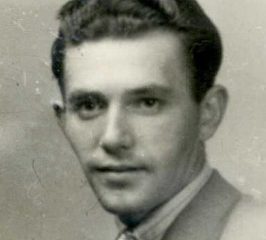
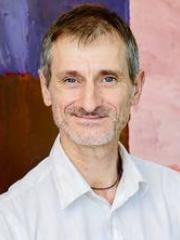
Pieter Brandwijk was born in Sliedrecht on 1 May 1901. He was the son of Gerardus Brandwijk, a ship’s captain, and Neeltje Vuijk. On 15 November 1924, he married Arina Ariaantje de Vroomen, who had been born in Sliedrecht on 4 October 1905.
The couple lived at 13 Wilhelminastraat in Sliedrecht. They had at least three children: Dingena Maaike “Dinnie” Brandwijk, born in 1925; Neeltje “Nel” Brandwijk, born in May 1934; and a son whose first name has not yet been established. Dinnie was already married by 1950 and did not accompany her parents to Australia.
Pieter and Arina travelled to Australia with their two younger children as part of the organised movement of Dutch dredging workers and their families. Arina departed from Schiphol aboard the KLM Skymaster Groningen on 22 July 1950 and arrived in Sydney on 26 July.
The passenger information also identifies Pieter, “Master Brandwijk” and “Miss Brandwijk”, apparently representing their son and daughter Nel. One reconstruction assigns the family seats J1 to J4. However, another account associates seat J1 with Mattheus “Theo” Bons, so the precise allocation still requires verification against the original seating plan.
The family’s Australian stay was connected with the dredging operations undertaken by Dutch companies, including Adriaan Volker and Van Hattum & Blankevoort through Australian Dredging and General Works. Pieter’s precise occupation, employer and place of work in Australia have not yet been established.
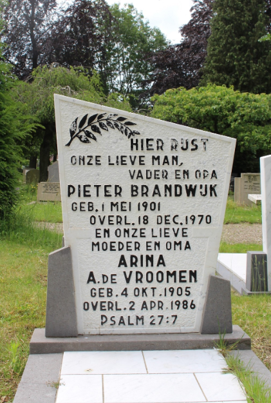
After the dredging work was completed, Pieter and Arina returned to the Netherlands and resumed their lives in Sliedrecht. Pieter died there on 18 December 1970, and Arina died there on 2 April 1986.
Their experience illustrates that not every participant in the 1950 project became a permanent migrant. For some families, Australia represented a temporary overseas assignment within the internationally active Dutch dredging industry.
This account is based on family-history and migration research undertaken by Fred Stuij. Gravestone photograph: Online Begraafplaatsen.
For the wider history of this organised migration project, see From Sliedrecht to Williamstown: Dutch dredging workers in post-war Australia.
More related company histories, archival sources and personal stories are available through the Dutch Dredging in Australia Research Portal.