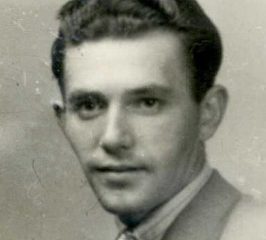
Rias Nicolaas Spee was born in Gouda on 28 May 1926. He was the son of Cornelis Bastiaan Spee and Johanna Hendrika Maria Nederhoed.
His father was born in Gouda on 13 July 1901 and operated a hat and cap shop at 229 Voorstraat in Dordrecht. His mother was born in Makassar, in the former Netherlands East Indies, on 22 September 1902.
On 22 June 1950, Rias departed from Schiphol aboard the KLM flight carrying Dutch workers to Australia. He travelled as an unmarried man, occupied seat D4 and arrived in Melbourne. The available records do not establish what prompted him to join the group or what work he undertook in Australia.
His initial stay was brief. Rias returned to the Netherlands later in 1950, where his fiancée, Alida van Kersen, was waiting for him. Alida had been born in Dordrecht on 8 March 1929 and was the daughter of tugboat captain Arie van Kersen and Guurtje Blom.
Rias and Alida married in early January 1951. Their first son, Harry, was born in Dordrecht on 23 June 1951, followed by their second son, Charley, on 21 June 1952.
On 8 December 1952, Rias returned to Australia, this time accompanied by Alida and their two young sons. Their second journey was intended as permanent migration, and the family subsequently established its life in Australia.
Rias was described on his Dutch personal record card as a hat maker. This occupation corresponded with his father’s hat and cap business, although it is not known whether Rias had worked in the family shop before emigrating or whether he continued this trade in Australia.
Alida died at Elizabeth Vale, South Australia, on 11 March 2000, aged 71. Rias died on 28 November 2014 at Red Cliff Islands, Queensland, aged 88. Their eldest son, Harry, died on 1 January 2023.
This account is based on family-history and migration research undertaken by Fred Stuij. Source documents and images: National Archives of Australia. Rias Nicolaas Spee.pdf
For the wider history of this organised migration project, see From Sliedrecht to Williamstown: Dutch dredging workers in post-war Australia.
More related company histories, archival sources and personal stories are available through the Dutch Dredging in Australia Research Portal.