The Koninklijke Paketvaart-Maatschappij (KPM), or Royal Packet Navigation Company, became one of the largest and most influential shipping enterprises operating across the Netherlands East Indies and the surrounding region. Its extensive network connected hundreds of islands and ports and eventually extended to Australia, China, Southeast Asia, the Indian Ocean and South Africa.
Established in 1888, the KPM commenced operations in the Netherlands East Indies on 1 January 1891. Over the following half-century, it developed the ships, crews, navigational knowledge and administrative organisation that would later make it an important maritime connection between the Netherlands East Indies and Australia—and an indispensable source of shipping for the Allies during the Pacific War.
Establishing an inter-island shipping network
The KPM was founded by two major Dutch shipping companies, the Stoomvaart Maatschappij Nederland and the Rotterdamsche Lloyd. Both operated services between the Netherlands and Java but depended on smaller vessels to collect and distribute passengers, mail and cargo throughout the Indonesian archipelago.
Before the creation of KPM, many subsidised inter-island services were operated by the Nederlandsch-Indische Stoomvaart Maatschappij, which was associated with the British India Steam Navigation Company. Its routes centred substantially on Singapore, strengthening that British-controlled port’s position as the principal commercial gateway to the archipelago.
The establishment of KPM was therefore both a commercial and colonial project. The Dutch government and shipping interests wanted to redirect inter-island trade towards Batavia and other ports under Dutch control, while providing regular communications across the widely dispersed Netherlands East Indies.
KPM took over vessels and routes from the Nederlandsch-Indische Stoomvaart Maatschappij. It began operations with 29 steamships: 16 inherited vessels and 13 newly built ships. Its fleet carried passengers, mail, government officials, troops, agricultural produce, machinery and general cargo between islands that otherwise had limited regular transport.
The company’s shipping network helped integrate the colonial economy and administration. It connected Java with Sumatra, Borneo, Celebes, the Moluccas, New Guinea and the smaller islands of the archipelago. For many communities, the arrival of a KPM vessel provided their principal regular connection with regional centres and the outside world.
This network also served the expansion and consolidation of Dutch colonial authority. KPM ships did not simply facilitate commerce: they transported government personnel and military forces and helped bind distant territories to the administrative centre in Batavia.
Ships designed for an archipelago
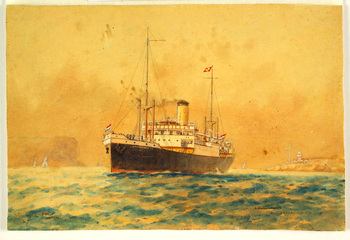
Most early KPM vessels were comparatively small. They were designed for inter-island work rather than long ocean passages, enabling them to enter shallow harbours and operate where port facilities were limited. Reliability, cargo flexibility and manoeuvrability were generally more important than speed or luxury.
These characteristics eventually made the ships particularly valuable in the difficult coastal waters around New Guinea. Their wartime importance was not accidental: it resulted from decades of experience operating among islands, reefs, narrow passages and poorly serviced ports.
KPM’s expansion also supported Dutch shipbuilding. The company ordered many of its new vessels from shipyards in the Netherlands, contributing to the development of Dutch expertise in constructing specialised passenger and cargo ships for tropical and inter-island service.
Although KPM was a Dutch-owned and Dutch-managed company, its operations depended on a multinational workforce. Senior officers and engineers were generally Dutch or European, while much of the everyday work aboard the ships was undertaken by Indonesian seafarers, particularly Javanese crew members. Indo-European personnel also occupied positions within the company and its maritime network.
This workforce reflected the colonial hierarchy of the Netherlands East Indies. Pay, accommodation, conditions and opportunities were not equal. Nevertheless, the accumulated knowledge and practical experience of Indonesian and Indo-European seafarers were fundamental to KPM’s operation. Their role would become especially important when the surviving ships were called upon to support Allied military operations during the Pacific War.
Growth beyond the Netherlands East Indies
KPM’s services gradually extended beyond the Indonesian archipelago. Its ships sailed to Singapore, Malaya, Indochina, the Philippines, China, New Guinea, Australia and New Zealand, while longer-distance services eventually reached the Indian Ocean and South Africa.
By around 1920, the company operated approximately 92 vessels across 50 services, calling at some 300 ports. At the beginning of the Second World War, this had grown to 146 vessels operating more than 70 services and serving over 400 ports.
KPM had become the second-largest Dutch steamship company and one of the most extensive regional shipping operations in Asia. Its fleet ranged from small coastal vessels to passenger liners exceeding 10,000 tons.
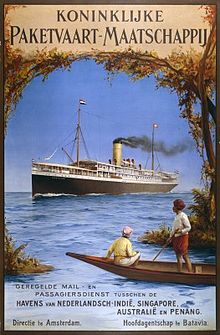
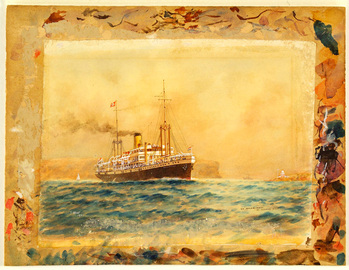
The company also promoted travel and tourism. Its passenger services and publicity presented the Netherlands East Indies as an interconnected maritime world. KPM developed organised tours and, during the late 1920s, established tourist facilities in Bali. Its brochures, posters, postcards, menus and ship models became part of the visual culture of travel between Europe, Asia and Australia.
The Australian connection
Regular maritime contact between Australia and the Netherlands East Indies existed before KPM entered the trade, but the company gave this connection greater continuity. In 1908, KPM established a monthly steamer service between Batavia and Sydney.
The route linked ports in the Netherlands East Indies with Brisbane, Sydney, Melbourne and, on some services, Adelaide. It carried passengers and cargo between Australia and Southeast Asia and connected Australian travellers and businesses with KPM’s much larger inter-island network.
These services brought tropical produce and manufactured goods to Australia while carrying Australian exports northwards. They also provided a route for government officials, businesspeople, tourists, migrants and families travelling between Australia, the Netherlands East Indies and other parts of Asia.
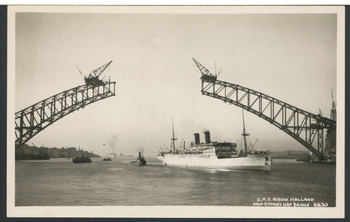
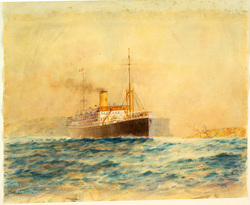
The connection expanded during the interwar period. KPM introduced larger ships to its international routes while retaining its extensive fleet of smaller inter-island vessels. The passenger ships Nieuw Holland and Nieuw Zeeland, completed in 1928, became particularly closely associated with the Australian service.
A contemporary KPM brochure in the DACC archives described their route as extending from Penang through Belawan, Singapore, Batavia, Semarang, Surabaya and Makassar to Brisbane, Sydney and Melbourne. The two white passenger ships became familiar visitors to Australian ports and were sometimes described as KPM’s “great white yachts.”
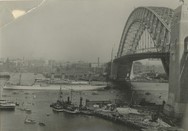
Their arrival in Sydney Harbour provided striking images of the growing maritime connection between Australia and the Netherlands East Indies. Photographs show Nieuw Holland and Nieuw Zeeland passing through the harbour during the period in which the Sydney Harbour Bridge was being constructed and opened.
Paketvaart House in Sydney
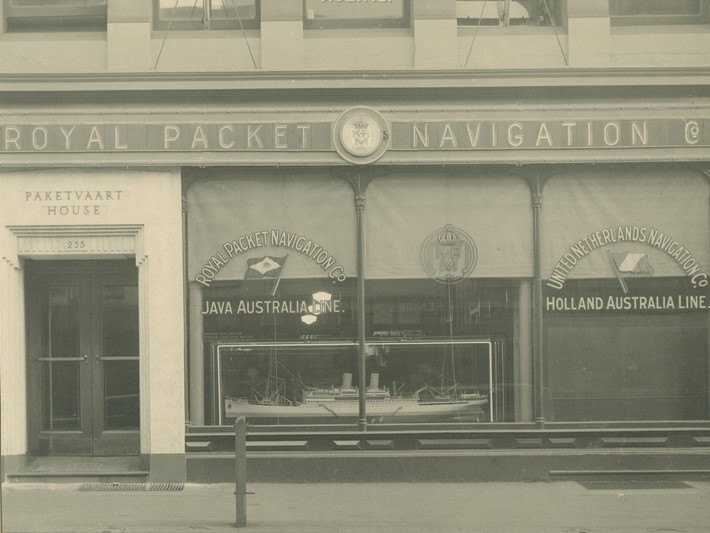
KPM’s Australian presence was represented by its Sydney office and agency, known as Paketvaart House. By the early 1930s it was located at 255 George Street, close to Sydney’s commercial and shipping centre.
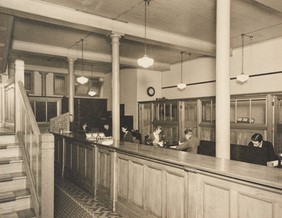
Photographs from 1931 show the Paketvaart House entrance, its public office and a shop window displaying a model ship and travel publicity. The agency did more than administer freight and passenger bookings. It promoted travel through the Netherlands East Indies and connected Australian customers with KPM’s extensive Asian network.
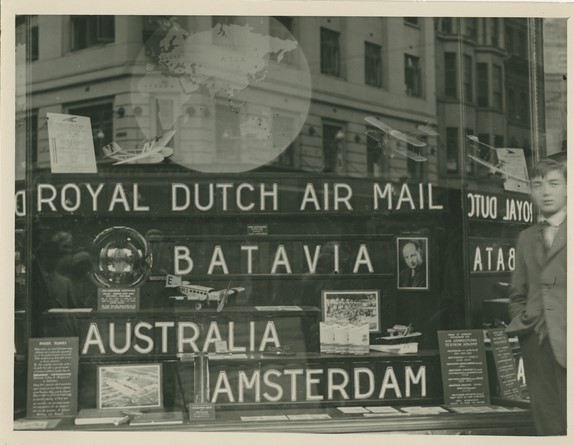
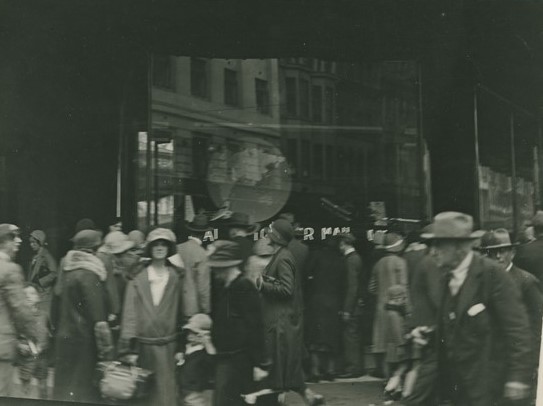
The office also advertised associated Dutch transport services. One photograph shows publicity for Dutch airmail, illustrating how maritime, aviation and postal connections were beginning to combine into a broader communications system linking Australia, the Netherlands East Indies and Europe.
An important figure in KPM’s Australian organisation was Anton Bakker. He joined the company as a purser in 1912 and came to Australia in 1922, where he was appointed assistant manager. He subsequently became KPM’s Australian general manager. Bakker and his family lived in Sydney, making him part of the small but growing Dutch business community in Australia.
Paketvaart House would assume much greater importance after the Japanese invasion of the Netherlands East Indies. It became the Australian centre of a company whose ships, personnel and normal operating network had been scattered by war..
A maritime connection transformed by war
By the beginning of the Pacific War, KPM had spent half a century building a shipping system adapted to the geographical conditions of the Netherlands East Indies and surrounding region. It possessed a large fleet, an experienced administrative organisation and crews familiar with difficult tropical and archipelagic waters.
The Australian connection established before the war meant that KPM already had offices, commercial relationships and management personnel in Sydney. When surviving ships and personnel escaped from the Netherlands East Indies in early 1942, they were therefore not arriving in a country entirely unfamiliar to the company.
The commercial network that had carried passengers, mail and cargo between the Netherlands East Indies and Australia was about to be transformed into part of the Allied wartime transport system. Paketvaart House would become a centre for managing ships and personnel, while KPM’s inter-island vessels would be redirected towards the defence of Australia and General Douglas MacArthur’s first campaigns in New Guinea.
That transition—from a colonial and commercial shipping network to an Allied maritime lifeline—is the next part of the KPM story.
Sources and further reading
Australian National Maritime Museum, photographic collection relating to KPM ships in Sydney Harbour.
Edward Duyker, “Dutch,” Dictionary of Sydney, 2008.
Jonathan Ford, “The Netherlands Merchant Navy in the Pacific War,” Journal of Australian Naval History, Vol. 6, No. 1, 2009.
National Library Board Singapore, “Koninklijke Paketvaart-Maatschappij,” Singapore Infopedia.
Stichting Maritiem-Historische Databank, records of KPM vessels.
Contemporary KPM passenger and route brochures (DACC archive).
See also:
Dutch merchant fleet delivered major contribution to the war in the Pacific.
Steam Shipping Lines Australia – Netherlands – starting in 1864
Dutch immigrant ships to Australia
From steam to cruise: the legacy of Dutch shipping lines in Australia