The MS Willem Ruys was one of the most important Dutch passenger liners of the post-war period. Originally designed for the service between Rotterdam and the Netherlands East Indies, she became the flagship of the Koninklijke Rotterdamsche Lloyd.
From 1959 until 1964, Willem Ruys operated a round-the-world service connecting the Netherlands with Australia and New Zealand. Together with Johan van Oldenbarnevelt and Oranje, she offered Dutch emigrants an alternative to the British liners traditionally dominating the Australian passenger trade.
Her later career under the name Achille Lauro became internationally famous, but her place in Dutch-Australian history belongs principally to the years in which she carried passengers and emigrants between Europe and Australia.
A ship delayed by war
The Rotterdamsche Lloyd ordered the vessel in 1938 to replace ageing ships on its Netherlands East Indies service. Her keel was laid at the Koninklijke Maatschappij De Schelde shipyard in Vlissingen on 25 January 1939.
Construction was still at an early stage when Germany invaded the Netherlands in May 1940. The German authorities ordered work on the vessel to continue, intending to use the ship for their own purposes.
Progress was repeatedly delayed by material shortages, Allied air raids and acts of obstruction and sabotage by Dutch shipyard workers and resistance members. The incomplete hull remained on the slipway throughout the occupation.
After the liberation of the Netherlands, completing the ship became an important symbol of national and maritime recovery. She was finally launched on 1 July 1946 and completed in November 1947.
Willem Ruys
The ship was named after Willem Ruys (1894–1942), a director of the Rotterdamsche Lloyd and grandson of the company’s founder. German occupation authorities arrested him as a hostage in July 1942 and executed him the following month.
By the time the ship entered service, the company had received the designation “Royal” in recognition of its wartime service and became the Koninklijke Rotterdamsche Lloyd.
Willem Ruys was approximately 193 metres long and measured more than 21,000 gross register tons. Eight diesel engines drove two propellers and gave her a service speed of approximately 22 knots.
She could originally accommodate about 900 passengers in several classes. Her design included distinctive lifeboats positioned low within the sides of the upper superstructure rather than on high, exposed boat decks. This arrangement gave the vessel an unusually clean and modern appearance.
Netherlands East Indies service
Willem Ruys departed Rotterdam on her maiden voyage to Batavia on 2 December 1947. She sailed through the Mediterranean and Suez Canal to Southeast Asia and Indonesia.
The ship had been designed specifically for this route, but the political world for which she had been constructed was already disappearing. Indonesia proclaimed its independence in August 1945, and the Netherlands formally transferred sovereignty in December 1949.
Nevertheless, passenger traffic between the Netherlands and Indonesia continued for several years. The ship carried colonial officials, businesspeople, military personnel, families and people relocating between Europe and the newly independent Indonesia.
As political and economic connections changed, passenger numbers declined. A vessel completed for the Netherlands East Indies service therefore required a new role little more than a decade after entering service.
Collision with Oranje
On 6 January 1953, Willem Ruys collided with the Oranje in the Red Sea, near Port Sudan.
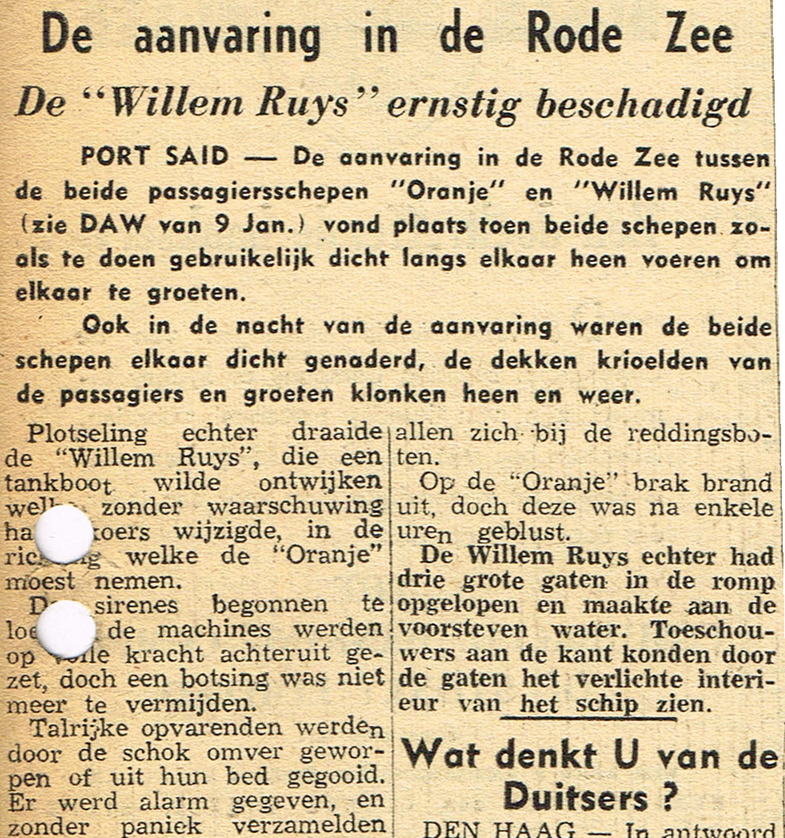
The two ships were travelling in opposite directions. It had become customary for rival Dutch liners to pass at close range, allowing passengers aboard both vessels to watch and greet one another. On this occasion, manoeuvres and communication between the ships were misjudged.
Oranje suffered serious damage to her bow, while Willem Ruys was less severely damaged. There was no loss of life, and both vessels remained afloat and continued to port for repairs.
Because Willem Ruys had to be withdrawn temporarily, Johan van Oldenbarnevelt was chartered to replace her for one return voyage between Europe and Jakarta.
The collision became one of the best-known incidents in Dutch passenger-shipping history. Ironically, both vessels were later sold to the same Italian shipping company.
Preparing for the Australian service
In 1958, the Rotterdamsche Lloyd withdrew Willem Ruys from the Indonesia route. She briefly operated services to New York and Canada before entering the Wilton-Fijenoord shipyard at Schiedam for an extensive reconstruction.
The Rotterdamsche Lloyd and Stoomvaart Maatschappij Nederland had agreed to cooperate in a joint round-the-world service promoted under the name Royal Dutch Mail Ships. The service brought together:
- Willem Ruys of the Koninklijke Rotterdamsche Lloyd;
- Johan van Oldenbarnevelt of Stoomvaart Maatschappij Nederland;
- Oranje of Stoomvaart Maatschappij Nederland.
During her refit, the former four-class arrangement aboard Willem Ruys was reduced to first and tourist class. Approximately one hundred additional cabins were created, air-conditioning was extended throughout the passenger accommodation and stabilisers were installed to improve comfort at sea.
After reconstruction, the ship could accommodate approximately 275 first-class and 770 tourist-class passengers, with additional berths available in convertible cabins.
Round-the-world service to Australia
On 7 March 1959, Willem Ruys departed Rotterdam on her first round-the-world voyage serving Australia and New Zealand.
The eastbound route generally included:
- Rotterdam;
- Southampton;
- the Mediterranean and Suez Canal;
- Colombo;
- Singapore;
- Fremantle;
- Melbourne;
- Sydney;
- Wellington.
The ship returned to Europe across the Pacific, through the Panama Canal and across the Atlantic. Individual itineraries could also include North American ports such as Miami, Bermuda or New York.
A complete round-the-world voyage took approximately 63 days. The timetable initially provided for as many as five voyages each year.
For Dutch emigrants, the service offered a direct connection between the Netherlands and Australia aboard a modern Dutch passenger liner. Passengers could disembark at Fremantle, Melbourne or Sydney, while those travelling to New Zealand continued across the Tasman Sea.
Life aboard a Dutch flagship
Conditions aboard Willem Ruys differed considerably from those on the converted Victory ships. She had been designed as a major passenger liner and offered more extensive public rooms, dining facilities and deck space.
Tourist-class passengers nevertheless lived within a regulated shipboard routine. Meals were served at scheduled times, while films, concerts, church services, deck games and children’s programmes provided entertainment during the long voyage.
The route also allowed passengers to experience different ports and climates as the ship travelled from northern Europe through the tropics and into the Southern Hemisphere.
For emigrants, the comfort of the ship did not remove the emotional significance of the journey. They were leaving relatives, communities and familiar surroundings in the Netherlands and travelling towards a country most knew principally from government information, letters and photographs.
The voyage aboard Willem Ruys became the physical and emotional transition between those two worlds.
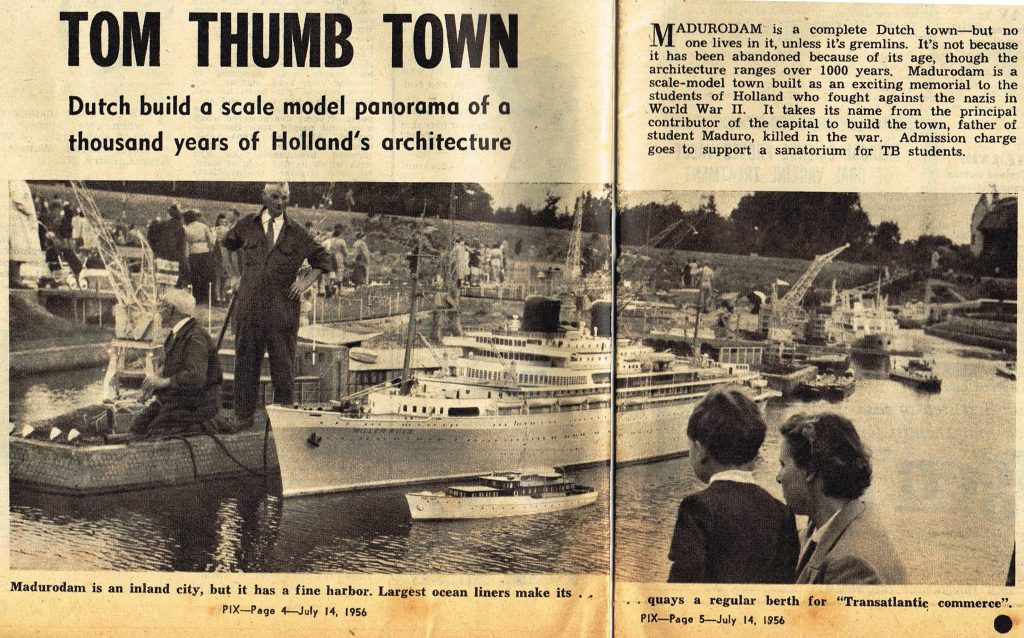
Retain the existing photograph of the Willem Ruys model in Madurodam here.
Decline of sea migration
The round-the-world service initially competed successfully with established British passenger lines. However, international travel was changing rapidly.
By the early 1960s, increasing numbers of migrants and travellers chose aircraft rather than ships. At the same time, economic recovery in the Netherlands reduced the number of people seeking to emigrate.
Passenger numbers fell, making ships such as Willem Ruys increasingly expensive to operate. At the end of 1964, she was withdrawn from service, laid up in Rotterdam and offered for sale.
The existing DACC article states that she made five round-the-world voyages annually for nine years. This is incorrect: the Australian round-the-world service operated from 1959 until 1964, although five voyages per year were included in the early timetable.
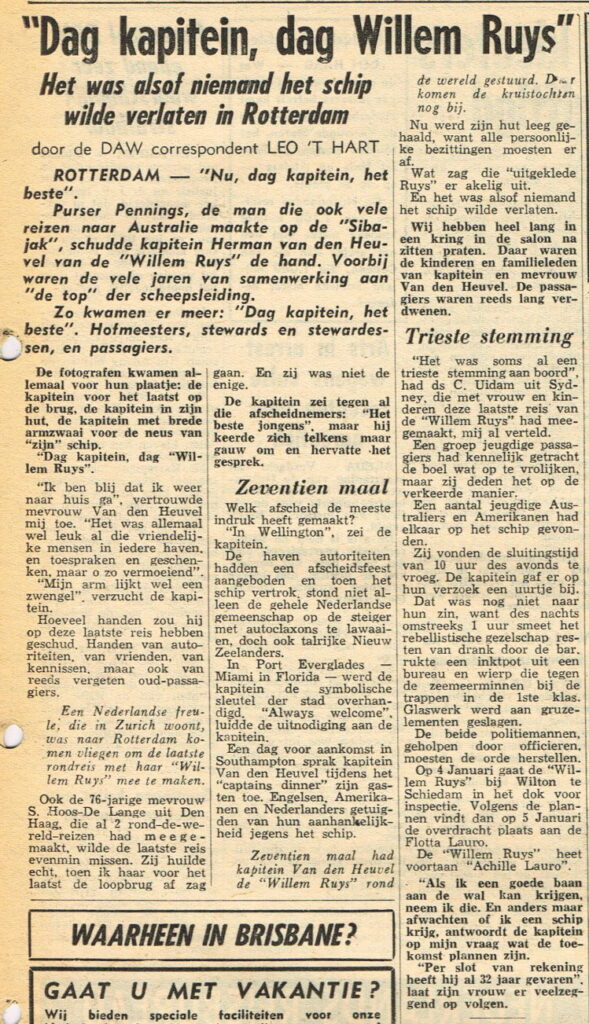
From Willem Ruys to Achille Lauro
The Italian Flotta Lauro purchased Willem Ruys in 1964. She was transferred to the company in January 1965 and renamed Achille Lauro after the shipping line’s owner.
An extensive reconstruction changed both her appearance and internal accommodation. An explosion and fire during the work delayed her return to service until 1966.
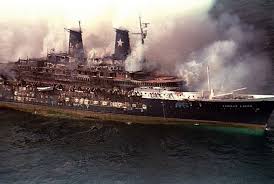
As Achille Lauro, the ship again operated to Australia and New Zealand before later becoming a full-time cruise ship.
In October 1985, Palestinian militants hijacked the vessel in the eastern Mediterranean. During the hijacking, American passenger Leon Klinghoffer was murdered. The incident made the ship internationally notorious, but it occurred more than twenty years after her Dutch service had ended.
On 30 November 1994, a major engine-room fire broke out while Achille Lauro was sailing in the Indian Ocean. Passengers and crew abandoned the vessel. Two people died during the evacuation, and the ship sank on 2 December 1994.
A Dutch-Australian maritime connection
The dramatic later history of Achille Lauro has sometimes overshadowed the ship’s earlier identity. As Willem Ruys, she represented Dutch post-war reconstruction, the final phase of the Netherlands–Indonesia passenger service and the development of Dutch round-the-world travel.
Between 1959 and 1964, she also played an important role in Dutch emigration to Australia. Alongside Johan van Oldenbarnevelt and Oranje, she carried families across the world at a time when the sea voyage remained an essential part of the migration experience.
For Dutch Australians who travelled aboard her, she was not primarily the later Achille Lauro. She was the Willem Ruys—the Dutch flagship that carried them towards their new homeland.
Related DACC articles
- Dutch emigration ships to Australia – Portal
- Dutch emigration ship Johan van Oldenbarnevelt
- MS Sibajak – From Netherlands East Indies mail ship to Dutch emigration ship
- MS Oranje – Dutch hospital ship in Australian service
Sources and further reading
- Company of Master Mariners of Australia – MV Willem Ruys
- SS Maritime – MS Willem Ruys, 1947–1965
- Derby Sulzers – Willem Ruys: construction, engines and service history
- Cruise Ship Odyssey – Willem Ruys and Achille Lauro
Related DACC articles
- Dutch emigration ships to Australia – Portal
- Dutch emigration ship Johan van Oldenbarnevelt
- MS Sibajak – From Netherlands East Indies mail ship to Dutch emigration ship
- MS Oranje – Dutch hospital ship in Australian service