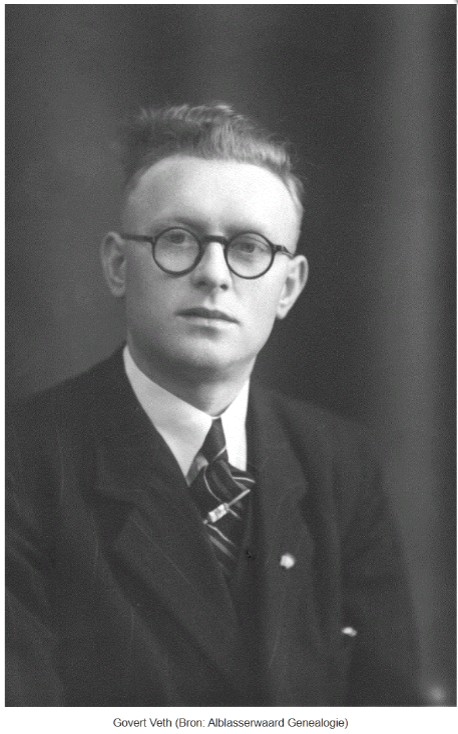
Govert Veth was one of the Dutch workers who travelled to Australia in 1950 in connection with the major post-war dredging project at Williamstown. The wider history of the project is described in From Sliedrecht to Williamstown: Dutch dredging workers in post-war Australia.
Govert was born in Sliedrecht on 24 March 1919, the son of Gerrit Cornelis Veth, dekknecht (1887-1963) and Teuntje Spruijt (1888-1985). According to the 1921 tax register, the family was living at Wijk C 375 in Sliedrecht that year. They later lived at 17 Trompstraat in Sliedrecht.
Growing up in a community closely connected with the river and dredging industries, Govert became a skipper.
Arrested during the German occupation
Govert’s life was dramatically disrupted during the German occupation of the Netherlands. On 16 May 1944, at the age of 25, he was arrested during a German reprisal raid in Sliedrecht.
He became one of the men later known as the Merwedegijzelaars—the Merwede hostages. The men arrested in Sliedrecht and the surrounding area were transported that same day to the Polizeiliches Durchgangslager Amersfoort, the German police transit camp at Amersfoort. Govert was registered there as prisoner number 1207.
His wartime record is preserved by the Merwedegijzelaars Foundation.
Departure for Australia
On 22 June 1950, Govert left the Netherlands by air for Melbourne. His seat number was recorded as C4 (See: KLM seating illustration). The journey marked the beginning of an entirely new chapter in his life, far removed from both his home town and his wartime experiences.
In Australia, Govert became part of the group of Dutch dredging workers whose employment brought specialist Dutch maritime skills to post-war infrastructure projects.
On 27 February 1954, he married Maartje van Brederode at Kurnell in New South Wales. Maartje had been born in Velsen in the Netherlands on 20 November 1920. No children of the marriage have so far been identified.
The couple eventually settled in Perth, Western Australia. Maartje died there on 1 April 1972, after eighteen years of marriage. Govert remained in Australia and died in Perth on 9 September 1989, aged 70.
Govert had spent almost four decades in his adopted country. His life took him from the waterways of Sliedrecht and imprisonment under German occupation to a new beginning in Melbourne and, ultimately, a permanent home in Perth.
For the wider history and related company, project and personal stories, see the Dutch dredging in Australia – Research Portal.
This summary is based on research supplied by the Historische Vereniging Sliedrecht. The complete Dutch account is attached below.