From the Netherlands to Australia
Peter (Piet, also referred to as Pieter) van Wees was a Dutch butcher who migrated to Australia with his Belgian-born wife, Siep, and their daughters following the Second World War. He subsequently established Van Wees Smallgoods in North Geelong, producing traditional Dutch sausages, smoked meats and other smallgoods.
According to recollections provided by Ben Scheelings, whose family were neighbours of the Van Wees family in Geelong, Piet had been an accomplished water polo player in the Netherlands and may have been associated with the Dutch Olympic team before the Second World War. This sporting connection has not yet been independently confirmed.
Wartime experiences
Ben Scheelings recalls being told that Piet had been imprisoned by the Germans during the Second World War and subjected to experimental injections.
Ben remembers Piet as an exceptionally large and powerful man. He understood from family conversations that Piet’s physical size was attributed to the effects of treatment he had received during his imprisonment.
Piet apparently did not discuss these experiences with the children. Ben believes that Siep mentioned them to his mother during one of their regular neighbourly coffee mornings.
These recollections suggest that Piet may have endured significant wartime hardship. However, the circumstances of his reported imprisonment and medical treatment have not yet been independently documented.
Migration and settlement in Victoria
Following the war, Piet and Siep migrated to Australia with their family. They initially settled in Hepburn Springs, Victoria, before moving to Geelong, where they became part of the local Dutch migrant community.
The couple had five daughters: Kitty (Miller), Claire (Timmermans), Mary (Broekman), Monique (Tersteeg) and Huguette (Harkin). Their names are confirmed in Siep’s obituary, published in August 2001.
An independent recollection published by Timothy Tol in 2022 identifies Pieter van Wees as an immigrant from Amsterdam who became friends with members of Tol’s Dutch family during the 1950s.
The Van Wees family lived in North Shore, Geelong, near the Scheelings family at 31 The Esplanade, with whom they developed a close friendship.
Establishing Van Wees Smallgoods
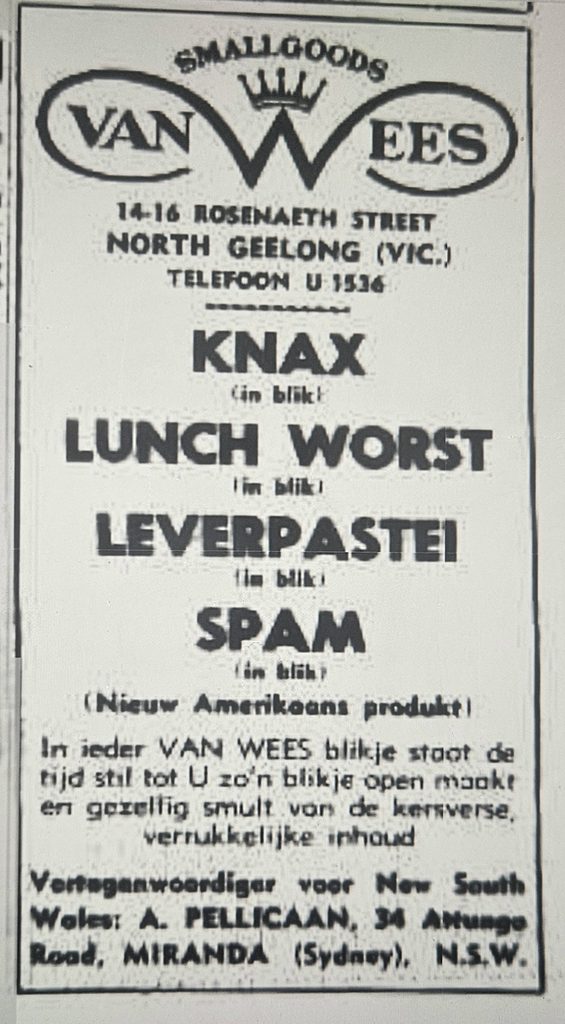
Drawing on his experience as a butcher in the Netherlands, Piet established Van Wees Smallgoods in North Geelong.
The business manufactured traditional Dutch and European smallgoods, including rookworst (Dutch smoked sausage), rookvlees (smoked beef), liver pâté, canned knakworstjes (small cooked sausages) and carbonaatjes (pork chops).
The business supplied shops in Geelong and Melbourne, helping Dutch immigrants maintain familiar food traditions while also introducing these products to the wider Australian market.
Timothy Tol recalls that his grandfather helped construct much of Van Wees’s shop in Douro Street, North Geelong, during the late 1950s.
An official Victorian Government Gazette notice dated 9 May 1978 lists Van Wees Smallgoods at 10–12 Roseneath Street, North Geelong.
These references indicate that the business operated for many years, although the chronology of the two premises has not yet been established.
Memories of the smallgoods factory
Ben Scheelings has provided particularly valuable firsthand recollections of the factory’s operations.
As a young man, he regularly helped Piet during weekends, manually attaching labels to tins of liver pâté and canned knakworstjes. He also checked the smoking cabinets, ensuring that sufficient sawdust was available to maintain the smoke needed for preparing rookvlees and smoked sausages.
Rather than receiving money, Ben was often rewarded with carbonaatjes or a rookworst to take home for dinner.
These memories provide a glimpse of a small, family-operated manufacturing business in which traditional Dutch butchering techniques were maintained in post-war Australia.
Siep van Wees – the public face of the business
Siep played an important role in the success of Van Wees Smallgoods.
According to Ben, she was the public face of the enterprise, regularly driving the company’s small delivery truck to Melbourne to promote its products and deliver orders to smallgoods retailers.
Her contribution extended beyond the family business. Ben remembers that she helped him with his French studies when he was preparing for his matriculation examinations.
Siep was Belgian-born and spoke French, a language that also featured prominently in the family’s social gatherings.
Siep died peacefully in Geelong on 18 August 2001, surrounded by her family. Her obituary, published on 20 August 2001, described her as the much-loved wife of Peter for 65 years and the mother of their five daughters.
Family life and the Dutch community in Geelong
The Van Wees and Scheelings families were neighbours in North Shore, Geelong, and maintained close social ties.
Ben recalls that Piet and Siep regularly took their younger daughters, the Scheelings children and their friends on outings to swim in the Barwon River.
The children travelled in the back of Piet’s smallgoods delivery van, singing the French song Alouette, led by Siep.
Piet was remembered as an exceptionally strong swimmer. Ben recalls that the children would try unsuccessfully to push him underwater.
There were also occasional family outings to Hepburn Springs for picnics, swimming in the mineral waters and barbecues featuring carbonaatjes from Piet’s factory.
These memories illustrate the close personal relationships that developed among Dutch migrant families in regional Victoria.
Ben also recalls that Piet sometimes expressed regret that he had no sons to take over the business.
A possible connection with DON Smallgoods
A potentially significant aspect of Piet’s business history emerges from a recollection published by Timothy Tol in February 2022.
Tol states that the Australian smallgoods manufacturer DON acquired its rookworst recipe from Pieter van Wees.
If confirmed, this would suggest that Van Wees contributed not only to the Dutch migrant food market but also to the wider development of European-style smallgoods manufacturing in Australia.
The reported transfer of the recipe has not yet been independently verified.
Preserving the Van Wees family story
The story of Piet and Siep van Wees reflects the contribution of Dutch and Belgian migrants to Australia’s post-war economic, social and cultural development.
Their business brought traditional European food products to Victoria, while their family became part of the Dutch migrant community in Geelong.
The personal recollections of Ben Scheelings provide a valuable record of the family’s life and business. Further information from the Van Wees family may eventually help establish Piet’s sporting achievements, wartime experiences, migration history and the subsequent development of his smallgoods business.
The Dutch Australian Cultural Centre welcomes additional family photographs, documents and recollections that could help preserve this history.
Sources and acknowledgements
- Ben Scheelings, personal recollections and correspondence with the Dutch Australian Cultural Centre, November 2026.
- Victoria Government Gazette, 9 May 1978, p. 1253, listing Van Wees Smallgoods, North Geelong. Government Gazette PDF.
- Timothy Tol, Food Glorious Food, 26 February 2022. Read article.
- Siep Van Wees Obituary, Legacy Remembers, published 20 August 2001. Obituary text supplied to the DACC, confirming her death on 18 August 2001 and identifying her five daughters.
The Dutch Australian Cultural Centre thanks Ben Scheelings for bringing the Van Wees family story to its attention and for sharing his personal memories of the family and their business.