On 18 May 1942, four ships of the Koninklijke Paketvaart-Maatschappij departed Sydney carrying 4,735 members of the Australian 14th Brigade and their equipment to Port Moresby.
The KPM vessels Bantam, Bontekoe, Van Heemskerk and Van Heutsz formed the transport component of Convoy ZK8. They were initially escorted by the Royal Netherlands Navy light cruiser HNLMS Tromp and the newly commissioned Australian destroyer HMAS Arunta.[1]
The operation was one of the first major demonstrations of the military value of the KPM fleet that had escaped from the Netherlands East Indies. Only weeks after being placed under Allied control, Dutch-owned ships with Dutch officers and predominantly Indonesian crews were transporting a large Australian formation towards a strategically vulnerable part of New Guinea.
Convoy ZK8 did not involve a battle, and it reached its destination without loss. Its significance lay in demonstrating that the surviving KPM fleet could turn the troops and supplies accumulating in Australia into an operational force north of the continent.
Australia’s vulnerable northern approaches
The convoy sailed during a period of considerable uncertainty. Japanese forces had conquered most of Southeast Asia and the Netherlands East Indies and had occupied Rabaul on New Britain. Port Moresby was an obvious strategic objective because of its position on the southern coast of Papua, facing Australia across the Coral Sea.
Japanese possession of Port Moresby would have strengthened Japan’s control of the surrounding seas, threatened Allied communications and made the defence of Australia’s northern approaches considerably more difficult. The port and its airfields were also essential to any future Allied attempt to halt and reverse the Japanese advance.
The Battle of the Coral Sea, fought from 4 to 8 May 1942, had prevented the Japanese from capturing Port Moresby by seaborne invasion. It did not remove the threat. Japanese forces still controlled bases to the north and would later attempt to reach Port Moresby overland through the Owen Stanley Range.[2]
Australia therefore needed to reinforce the garrison and develop Port Moresby as a major Allied base.
The Australian 14th Brigade
The 14th Brigade was a Militia formation consisting principally of the 3rd, 36th and 55th Infantry Battalions, together with supporting personnel and equipment. Its deployment formed part of the continuing reinforcement of Port Moresby following the Japanese advance into the region.
A total of 4,735 troops were embarked aboard the four KPM transports. This figure included brigade and supporting personnel rather than only front-line infantry.[3]
The deployment illustrates the scale of the task assigned to the ships. KPM vessels originally designed for passenger and commercial service in the Netherlands East Indies were now being used as military transports carrying an Australian brigade towards an area exposed to possible Japanese attack.
Four KPM ships
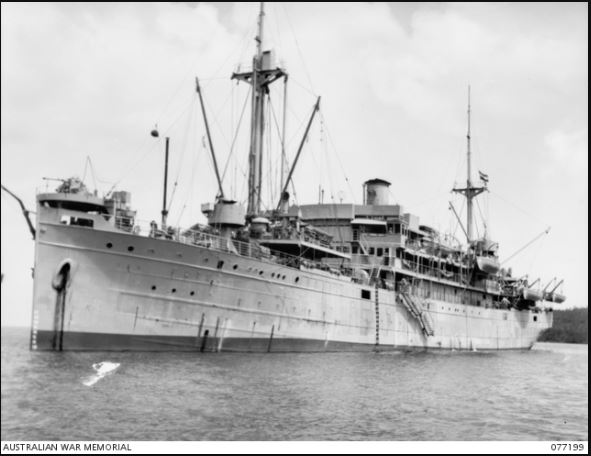
The merchant vessels forming Convoy ZK8 were:
- Bantam, built in 1930;
- Bontekoe, built in 1922–23;
- Van Heemskerk, built in 1909; and
- Van Heutsz, built in 1926.
All four had been part of KPM’s pre-war shipping network. They were among the vessels that came under United States Army control in Australia following the collapse of the Netherlands East Indies.
The ships remained Dutch-owned and Dutch-registered. Their senior officers were generally Dutch, but many of the crew members responsible for operating them were Indonesian, particularly Javanese seafarers.
This multinational workforce had experienced upheaval following the fall of the Netherlands East Indies. Some crew members had been separated from their families, while disagreements over pay, clothing and conditions had produced a major industrial dispute in Australian ports during April 1942.
Only weeks later, KPM crews were carrying Australian troops towards New Guinea.
Dutch and Australian escorts
The convoy has sometimes been described as an “all-Dutch” operation. The four transports were Dutch, and HNLMS Tromp provided a major part of the initial naval escort. Nevertheless, Royal Australian Navy vessels also played an important role, making it more accurate to describe ZK8 as a combined Dutch-Australian operation.
Tromp and HMAS Arunta escorted the convoy northwards from Sydney. On 23 May, they transferred responsibility for the convoy to the Australian ships HMAS Swan, HMAS Goulburn and HMAS Cessnock. Tromp and Arunta then returned to Sydney.[4]
The change of escorts demonstrates that ZK8 was part of a coordinated Allied convoy system rather than an independently operated Dutch mission. Dutch merchant ships, the Royal Netherlands Navy and the Royal Australian Navy each contributed to the safe movement of the brigade.
The use of Tromp was particularly significant. The cruiser had survived the disastrous Netherlands East Indies campaign and reached Australia after undergoing repairs at Fremantle and Sydney. Like the KPM vessels, it had been incorporated into the Allied naval system developing around Australia.
From Sydney to Port Moresby
Convoy ZK8 departed Sydney on 18 May and proceeded north along the Australian coast before continuing towards Port Moresby. The passage took place at a time of increasing Japanese submarine activity off eastern Australia.
Japanese submarines were operating near Sydney and elsewhere along the coast. The attack by Japanese midget submarines on Sydney Harbour followed on the night of 31 May–1 June, shortly after the convoy had passed through these waters.
The convoy reached Port Moresby safely towards the end of May. The troops and equipment were disembarked without enemy interference.[5]
Its successful arrival reinforced the garrison and contributed to the continuing development of Port Moresby as an Allied base. The troops delivered by ZK8 subsequently became part of the larger force defending Papua as the fighting moved towards the Kokoda Track, Milne Bay and the northern coast.
It would be misleading to claim that Convoy ZK8 alone secured Port Moresby or determined the outcome of the later campaigns. Its importance was logistical: it transported a substantial Australian formation to the theatre at a time when suitable shipping was scarce and the Japanese threat remained immediate.
The first demonstration of a larger role
Convoy ZK8 showed that the surviving KPM vessels could be organised and protected as a military transport group. They could carry thousands of troops and their equipment from Australian ports to operational areas in New Guinea.
This capability was especially valuable because the United States and Australia had not yet assembled enough smaller transports suitable for coastal and inter-island operations. KPM’s ships and crews provided an existing maritime organisation that could be put to work immediately.
The four ships did not return to normal commercial operations after completing the convoy. They continued transporting troops and supplies between Australian and New Guinea ports.
Several later participated in the reinforcement of Milne Bay and the supply of the Buna–Gona campaign. Bantam, Bontekoe, Van Heemskerk and Van Heutsz would all become associated with the much larger series of operations known as Operation Lilliput.
Their later service came at considerable cost. Bantam and Van Heemskerk were lost to Japanese air attacks, while Van Heutsz was damaged at Oro Bay. Their officers and Indonesian crew members repeatedly operated in waters where air cover, harbour facilities, firefighting equipment and salvage capacity were inadequate.
A practical Dutch-Australian partnership
Convoy ZK8 was important not because it represented a formal political alliance created for a single operation, but because it demonstrated practical cooperation under wartime pressure.
Australia supplied the troops. KPM supplied the transports and their experienced officers and crews. The Royal Netherlands Navy and Royal Australian Navy shared escort responsibilities. American authorities exercised operational control over the KPM vessels within the emerging South West Pacific command structure.
The operation also demonstrated that the Dutch contribution after the fall of the Netherlands East Indies would not be limited to conventional combat units. Shipping was one of the most valuable capabilities the Dutch and NEI authorities could still offer the Allies.
Convoy ZK8 was an early example. The importance of the KPM vessels would become even clearer as the Allies began establishing and supplying bases at Milne Bay and along the north coast of Papua.
Endnotes
[1] Jonathan Ford, “The Netherlands Merchant Navy in the Pacific War,” Journal of Australian Naval History, Vol. 6, No. 1, 2009, p. 86; G. Hermon Gill, Royal Australian Navy 1942–1945, Australian War Memorial, Canberra, 1968.
[2] Dudley McCarthy, South-West Pacific Area—First Year: Kokoda to Wau, Australian War Memorial, Canberra, 1959; Australian War Memorial, “Battle of the Coral Sea.”
[3] Ford, “The Netherlands Merchant Navy,” p. 86; Gill, Royal Australian Navy 1942–1945.
[4] Operational record of HNLMS Tromp, 18–24 May 1942; Gill, Royal Australian Navy 1942–1945.
[5] Ford, “The Netherlands Merchant Navy,” p. 86; Gill, Royal Australian Navy 1942–1945.
Further reading
- Jack Ford, Allies in a Bind: Australia and the Netherlands East Indies in the Second World War, CQU Press, 2001.