Accounts of the Koninklijke Paketvaart-Maatschappij’s contribution to the Pacific War frequently refer to “Dutch ships.” This is correct in terms of company ownership, registration and command, but it tells only part of the story.
KPM vessels were generally commanded by Dutch officers, while much of the everyday work aboard them was performed by Indonesian seafarers, particularly Javanese crew members. Indo-European personnel and seafarers from other parts of the Netherlands East Indies also formed part of the company’s workforce.
These crews had developed specialist experience operating throughout the Indonesian archipelago. After escaping to Australia in 1942, they served aboard ships carrying Australian and American troops, tanks, ammunition, fuel and supplies into the New Guinea war zone.
They worked under the threat of bombing, strafing, shipwreck and death. At the same time, they experienced racial inequality, disputes over pay and conditions, imprisonment following industrial action, and growing political tensions over the future of Indonesia.
The KPM wartime story was therefore not simply a Dutch contribution to the Allied war effort. It was a shared but unequal contribution involving Dutch officers and a much larger group of Indonesian seafarers whose role has often received less recognition.
A colonial maritime workforce
KPM operated within the political and racial structure of the Netherlands East Indies. Senior positions aboard its vessels—including captains, navigating officers and engineers—were generally reserved for Dutch or other European personnel. Indonesian employees occupied most lower-ranking positions and performed much of the physical work required to operate and maintain the ships.[1]
The term “Indonesian” encompasses a diverse population. Crew members came from Java, Sumatra, the Moluccas, Sulawesi and other parts of the archipelago. Contemporary Australian and American records frequently described them collectively as “Javanese,” “Malay” or “native crews,” whether or not those descriptions accurately reflected their individual origins.
There were also Indo-European personnel—people of mixed European and Indonesian ancestry—within KPM and the wider maritime system. Their legal status, education, employment opportunities and position within the colonial hierarchy could differ from those of both European and Indigenous Indonesian employees.
KPM’s Indonesian crews were not unskilled labourers. They possessed practical knowledge acquired through years of inter-island service. They handled cargoes, maintained machinery, worked on deck, navigated local waters and kept vessels operating in tropical conditions and inadequately developed ports.
This experience became critically important in the coastal and island waters of New Guinea.
Escape and separation
When the Japanese invaded the Netherlands East Indies, KPM’s workforce was scattered. Some crew members escaped aboard their ships, while others were killed, captured or left behind in occupied territory.
Those who reached Australia often did not know what had happened to their families. Communications with Java and the other occupied islands were largely severed. They had escaped immediate Japanese control but had no certainty about when—or under what political circumstances—they would return home.
They also arrived in a country governed by the White Australia policy. Many Australians had little direct knowledge of the Netherlands East Indies or its peoples. Indonesian arrivals encountered curiosity, paternalism and racial prejudice, as well as friendship and support from sections of the Australian community and trade-union movement.[2]
The seafarers’ legal position was unclear. They were employees of a Dutch company, subjects of the Netherlands East Indies, temporary arrivals in Australia and members of crews whose ships were being placed under Allied military control.
Dutch and NEI authorities also treated merchant seafarers as personnel who could be subjected to military discipline. This position would become important when disagreements arose over their conditions and willingness to work.[3]
Pay and working conditions
The differences between the conditions of Indonesian and Australian seafarers became immediately apparent.
Jonathan Ford records that Indonesian crew members received approximately £2 a month, compared with about £22 a month for Australian seafarers. More recent research describes Indonesian wages as sometimes amounting to only one-tenth of those paid to Australian or European personnel undertaking comparable work.[4]
The figures may have varied according to rank, allowances and the terms under which individuals were employed. Nevertheless, the underlying inequality is clear. Wages set within the colonial economy of the Netherlands East Indies were inadequate when crew members had to meet Australian living costs.
Clothing was another concern. Many seafarers had arrived from tropical conditions without suitable clothing for an Australian winter. They sought warmer clothes as well as improved pay and conditions.
Australian maritime unions became aware of the disparity. The Seamen’s Union of Australia and waterfront activists argued that Indonesian crew members working from Australian ports should receive conditions closer to Australian standards.
Dutch and NEI officials feared that these contacts would undermine discipline and delay the ships’ return to service. They believed Australian unionists were encouraging demands that could not be accommodated within the existing KPM and colonial wage structures.
The April 1942 strike
Indonesian seafarers began industrial action in Australian ports in early April 1942. They demanded better pay, warmer clothing and improved conditions.
The precise number involved is uncertain. Ford states that approximately 2,000 Indonesian crew members went on strike on 1 April. Julia Rozeboom’s more recent examination of Australian and Dutch archival records refers to closer to 1,000 Indonesian merchant seafarers becoming involved and subsequently being detained or interned. Variations in the figures may reflect different definitions of who was on strike, arrested, interned or still attached to ships.[5]
The timing made the dispute particularly sensitive. Australia and the United States urgently needed the KPM vessels for military transport, and Japanese forces appeared capable of advancing further south. Allied authorities regarded anything preventing the ships from sailing as a threat to the war effort.
Dutch and NEI officials also referred to instances during the fall of Java when crew members had left ships during Japanese air raids. Such examples were used to question the crews’ reliability, although they arose under the extreme conditions of military collapse, bombing and the imminent capture of the vessels.[6]
Rather than being treated solely as an industrial dispute, the strike became a question of immigration control, military discipline and wartime security.
Arrest and internment
Australian authorities arrested many of the striking seafarers. Some were initially held in local gaols, including Long Bay in Sydney, before being moved to Liverpool camp. Others were transferred to Loveday in South Australia and later to Cowra in New South Wales.[7]
Ford states that approximately 800 strikers were imprisoned before being transferred to internment camps. Rozeboom’s research demonstrates that the number, location and legal classification of those detained varied over time and that some Indonesian seafarers passed through several Australian prisons and camps.[8]
The detention arrangements exposed the ambiguity of their position. The men came from an Allied territory and were not enemy nationals. Nevertheless, they were confined under Australian immigration and wartime security provisions, while the NEI authorities remained financially responsible for their maintenance.
Their imprisonment was supported by Dutch and NEI officials who wanted the ships returned to service. Australian authorities were uncomfortable about detaining seafarers from an Allied territory but were also unwilling to allow the dispute to interfere with military operations.
Australian unionists objected to the incarceration of workers whose principal demands concerned pay and conditions. Negotiations therefore involved KPM, the NEI Commission, Australian government departments, unions and Allied military authorities.
Returning the ships to service
The Allies could not operate the KPM vessels without their experienced crews. Replacing them at short notice would have been extremely difficult. The ships had unfamiliar machinery, and their operation depended upon the knowledge and established working relationships of the KPM personnel.
This gave the seafarers’ dispute a strategic dimension. Their importance was demonstrated by the efforts made to secure their return rather than permanently replace them.
Negotiations continued for several months. Improvements were made to pay, clothing, accommodation and messing conditions. Australian authorities also assisted in refitting some ships with better facilities. Medical support became another responsibility of the NEI administration.[9]
Not all Indonesian KPM seafarers had joined the strike, and many continued working aboard vessels operating from Australian ports. Others eventually returned to service after the dispute was resolved or their detention ended.
By mid-1942, KPM ships and their crews were sailing between Australia and New Guinea. Their operations would soon place them under direct Japanese attack.
Service in the New Guinea war zone
The conditions faced by KPM crews in New Guinea were exceptionally dangerous. The vessels sailed through reefs and poorly charted waters, frequently moving at night to reduce the risk of detection. They operated with limited harbour facilities, inadequate air protection and few salvage or firefighting resources.
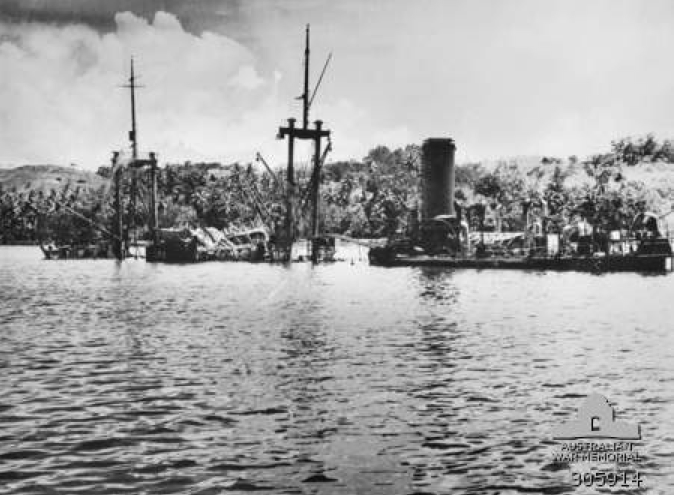
During Operation Lilliput, KPM ships transported troops and supplies between Milne Bay and Oro Bay in support of the Allied campaigns at Buna, Gona and Sanananda.
The United States Army’s official history of the Buna campaign described the vessels as commanded by experienced Dutch officers and crewed largely by Javanese seafarers. It emphasised their reliability under air attack and the exhausting nature of voyages during which the ships navigated reefs at night and avoided Japanese bombing and strafing during daylight.[10]
The Australian official naval history described the Dutch ships as “invaluable” and “irreplaceable” during Operation Lilliput. Significantly, it also noted the strain that air attacks and shipping losses placed upon their “native crews.”[11]
Crew members were killed and wounded when ships including Van Heutsz, ’s Jacob, Bantam, Van Heemskerk and Van Outhoorn were attacked. Indonesian seafarers worked alongside Dutch officers, Allied military personnel and Australian naval gunners to fight fires, assist wounded men and attempt to save damaged vessels.
The ships’ survival often depended upon the combined actions of everyone aboard, regardless of the racial hierarchy that otherwise structured their employment.
Welfare and medical care
The Netherlands East Indies Commission was responsible for the welfare of merchant-marine personnel in Australia. KPM’s existing administrative organisation undertook much of the practical work.
The Princess Juliana Hospital at Turramurra, on Sydney’s North Shore, treated Dutch and Indonesian patients from 1942. Its staff had to accommodate different languages, diets and cultural needs. Wounded KPM personnel were among those transported back from New Guinea for treatment there.[12]
Accommodation, recreation and contact with the wider community also became important. Indonesian seafarers spent periods in Sydney, Melbourne, Brisbane and other ports between voyages. Their relationships with Australian workers and political activists exposed them to ideas and forms of organisation that differed significantly from the colonial society they had known.
From industrial protest to political change
The 1942 strike was primarily concerned with wages, clothing and working conditions. Over time, however, the presence of Indonesians in Australia acquired a wider political significance.
Indonesian seafarers met Australian unionists, communists, students and supporters of Indonesian independence. They also came into contact with Indonesian political exiles who had been transported to Australia from the Dutch internment camp at Tanah Merah in New Guinea.
Not every Indonesian seafarer was politically active or supported the same objectives. Some remained loyal to KPM or the Dutch administration; others concentrated on surviving the war and supporting their families. Political attitudes changed as news about Indonesian nationalism and the occupation reached Australia.
After the Indonesian declaration of independence in August 1945, Indonesian seafarers and Australian maritime unions participated in the boycott of Dutch ships that became known as the Black Armada. Some men who had served the Allied war effort aboard KPM vessels refused to crew ships that they believed would be used to restore Dutch colonial authority in Indonesia.[13]
That post-war conflict should not be projected backwards onto every action taken by Indonesian crews during the war. It nevertheless demonstrates how their experiences in Australia contributed to a changing political awareness.
Recognising the complete KPM contribution
The ships employed in the South West Pacific were Dutch-owned, Dutch-registered and generally Dutch-commanded. Their service forms an important part of Dutch-Australian wartime history.
But the vessels could not have operated without their Indonesian and Indo-European personnel. These seafarers worked in engine rooms, on deck and in cargo holds; navigated dangerous waters; endured bombing and strafing; fought fires; rescued wounded men; and kept supplies moving to the New Guinea battlefront.
Their contribution should be recognised without overlooking the unequal colonial system within which they served. The history encompasses both cooperation and conflict: shared danger at sea, racial and economic inequality ashore, participation in the Allied war effort and growing demands for better conditions and political freedom.
Understanding the people aboard the ships allows the KPM story to be presented in its full Dutch, Indonesian and Australian context.
The next article follows four of these vessels and their crews as they departed Sydney in May 1942 carrying the Australian 14th Brigade to Port Moresby in Convoy ZK8.
See also:
Samanuddin (1906–1943): A seaman of the Dutch merchant fleet buried in Brisbane
Indonesian War Graves at Cowra (Netherlands East Indies)
Endnotes
[1] Jonathan Ford, “The Netherlands Merchant Navy in the Pacific War,” Journal of Australian Naval History, Vol. 6, No. 1, 2009, pp. 79–80 and 86–89; Julia M. Rozeboom, Merdeka Down Under? Indonesian Civilians and Military Personnel in Australia, 1942–1947, PhD thesis, University of Sydney, 2022.
[2] Jan Lingard, Refugees and Rebels: Indonesian Exiles in Wartime Australia, Australian Scholarly Publishing, Melbourne, 2008; Rozeboom, Merdeka Down Under?, pp. 64–82.
[3] Rozeboom, Merdeka Down Under?, pp. 85–109; Ford, “The Netherlands Merchant Navy,” pp. 84–85.
[4] Ford, “The Netherlands Merchant Navy,” p. 85; Rozeboom, Merdeka Down Under?, pp. 142–143.
[5] Ford, “The Netherlands Merchant Navy,” p. 85; Rozeboom, Merdeka Down Under?, pp. 77–78 and 142–143.
[6] Ford, “The Netherlands Merchant Navy,” pp. 81 and 85.
[7] Rozeboom, Merdeka Down Under?, pp. 142–148; Lingard, Refugees and Rebels, pp. 9–34.
[8] Ford, “The Netherlands Merchant Navy,” p. 85; Rozeboom, Merdeka Down Under?, pp. 142–148.
[9] Ford, “The Netherlands Merchant Navy,” pp. 85–86.
[10] Samuel Milner, Victory in Papua, United States Army in World War II: The War in the Pacific, Office of the Chief of Military History, Washington, 1957; cited in Ford, “The Netherlands Merchant Navy,” p. 89.
[11] G. Hermon Gill, Royal Australian Navy 1942–1945, Australian War Memorial, Canberra, 1968, cited in Ford, “The Netherlands Merchant Navy,” p. 89.
[12] Ford, “The Netherlands Merchant Navy,” pp. 85–86.
[13] Lingard, Refugees and Rebels; Heather Goodall, “Port Politics: Indian Seamen, Australian Unions and Indonesian Independence, 1945–1947,” Labour History, No. 94, May 2008.