Plans for a second Dutch bomber squadron
No. 119 (Netherlands East Indies) Squadron RAAF was formed in Canberra in September 1943 as a proposed second Dutch–Australian B-25 Mitchell bomber squadron.
It was intended to reinforce No. 18 (Netherlands East Indies) Squadron RAAF and expand Dutch participation in Allied air operations against Japanese forces in the Netherlands East Indies. However, shortages of trained personnel, ground crews and aircraft prevented the new squadron from becoming operational.
The squadron existed for only three months before being disbanded in December 1943. Its personnel and limited resources were then used to strengthen other Dutch units, particularly No. 18 Squadron.
The original plan
On 7 June 1943, Dutch authorities presented plans for a new Mitchell bomber squadron designated No. 119 Squadron.
No. 18 Squadron had suffered serious aircrew losses during the first half of 1943. The original proposal envisaged No. 119 Squadron gradually replacing it. Newly trained crews were expected to arrive from the Royal Netherlands Military Flying School at Jackson, Mississippi, in several groups:
- two flights between 15 and 30 September 1943;
- two further flights during October; and
- the remaining personnel during November.
No. 119 Squadron was initially expected to be based in Sydney, where its crews would undertake maritime reconnaissance and anti-submarine training.
Differences over the squadron’s role
The proposed replacement of No. 18 Squadron did not receive Australian support.
By 8 July 1943, the RAAF was insisting that No. 18 Squadron should remain operational in the North-Western Area. No. 119 Squadron would instead be formed as an additional unit and eventually deployed to northern Australia.
On 13 July, Major E.J.G. te Roller, representing the Netherlands East Indies authorities, met Air Vice-Marshal William Bostock to discuss the organisation of the Dutch squadrons.
The Dutch hoped to operate both Mitchell squadrons from northern Australia so they could attack Japanese positions and shipping in the occupied Netherlands East Indies. They also proposed forming a third auxiliary or reserve squadron in Sydney to train replacement crews for the two operational units.
Bostock preferred the proposed reserve organisation to be based at Canberra, where the other Dutch aviation organisations were being assembled.
Formation at Canberra
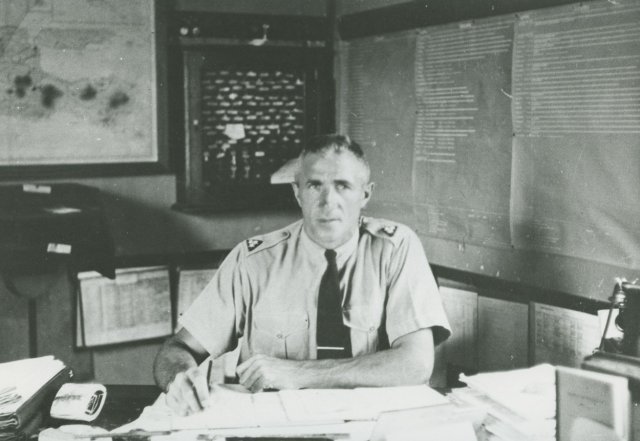
No. 119 (Netherlands East Indies) Squadron was formally established at Canberra on 1 September 1943.
Lieutenant-Colonel M. van Haselen became its commanding officer. Squadron Leader E.C. Rutter commanded its RAAF component.
The squadron’s initial aircraft allocation consisted of only:
- two North American B-25 Mitchell bombers; and
- one Lockheed Lodestar transport aircraft.
The Dutch planned to transfer experienced No. 18 Squadron crews temporarily to Canberra to assist with the formation of the new unit. Those personnel would subsequently be replaced by newly trained crews returning from the United States.
It was initially hoped that No. 119 Squadron would be ready to move to the North-Western Area by 30 November 1943.
Proposed operational training
The RAAF wanted No. 119 Squadron to become operational as quickly as possible without reducing the combat strength of No. 18 Squadron.
One proposal was to send the new squadron to Darwin for operational acclimatisation. Lieutenant W.F.A. “Gus” Winckel, an experienced No. 18 Squadron pilot, was to be attached to the unit to teach its crews the anti-shipping and low-level attack techniques developed during operations over the Netherlands East Indies.
These plans were never realised. Throughout its brief existence, No. 119 Squadron waited for the aircraft, aircrew and ground personnel required to become an effective operational unit.
Too many units and too few personnel
The central problem was not a lack of ambition. Dutch authorities were simultaneously attempting to create several aviation organisations in Australia:
- No. 18 Squadron, which was already conducting combat operations;
- the proposed No. 119 Mitchell bomber squadron;
- No. 120 Netherlands East Indies Squadron, equipped with P-40 Kittyhawks;
- a reserve training organisation; and
- the Netherlands East Indies Aircraft and Personnel Pool.
These plans required more trained aircrew, technicians and ground personnel than were available.
Although Dutch students were being trained at the Royal Netherlands Military Flying School in Jackson, Mississippi, insufficient numbers were returning to Australia to staff all the proposed units.
Training itself had imposed a heavy human cost. Dr Jack Ford records that 38 Dutch trainees were killed in accidents during the war. No. 18 Squadron was also suffering operational casualties and required replacement personnel.
Van Oyen’s inspection
On 10 November 1943, Lieutenant General Ludolph Hendrik van Oyen, senior commander of the Military Aviation Service of the Royal Netherlands East Indies Army, inspected No. 119 Squadron in Canberra.
Van Oyen met some of his former flying-school trainees who had returned from the United States. He also saw that the squadron still possessed few aircraft and insufficient personnel.
His inspection provided an opportunity to assess whether the Dutch plans remained realistic. It had become clear that there were not enough aircrew—and particularly not enough trained ground crews—to operate all the proposed squadrons.
Maintaining No. 18 Squadron’s operational strength and completing the formation of No. 120 Squadron consequently took priority.
Disbandment
No. 119 Squadron was disbanded on 10 December 1943, only three months after its formation.
Some of its aircraft and aircrew were transferred to No. 18 Squadron as reinforcements. Eleven RAAF ground personnel who had been sent to Jackson for specialist training connected with the new squadron were recalled.
The failure to establish No. 119 Squadron was therefore not principally the result of financial or political opposition. It reflected wartime operational realities: too few personnel, delayed aircraft deliveries, continuing losses and the urgent need to keep the existing squadrons effective.
The proposed Mitchell allocation
Dr Jack Ford records that the Dutch had paid for 39 B-25 Mitchells intended for No. 119 Squadron, including 18 aircraft expected to arrive during 1944.
The DACC has not yet located sufficient information to establish the eventual allocation of all 39 aircraft. Resolving this question will require further examination of aircraft delivery records, individual serial numbers and the operational records of the Netherlands East Indies squadrons.
Some aircraft and aircrew assigned or intended for No. 119 Squadron were transferred to No. 18 Squadron following the new squadron’s disbandment. However, the subsequent history of every aircraft in the planned allocation has not yet been established.
Historical significance
Although No. 119 Squadron never flew an operational mission, its brief existence reveals the scale of Dutch plans to rebuild their air power from Australia.
It also illustrates the practical limitations faced by a displaced military organisation. Aircraft could be ordered and new units proposed, but trained pilots, navigators, technicians and ground crews could not be produced quickly enough to meet every operational requirement.
The squadron’s history is therefore an important bridge between the stories of No. 18 Squadron, the Royal Netherlands Military Flying School in the United States and the formation of No. 120 Squadron.
Sources and further reading
DACC Air Force Research Portal
Dr Jonathan M. Ford—Allies in a Bind: Australia and the Netherlands East Indies in the Second World War
University of Queensland—Allies in a Bind doctoral thesis record
Australian War Memorial—Allies in a Bind catalogue record
No. 119 Squadron Operations Record Book and associated RAAF records, National Archives of Australia
Peter Dunn, “119 (NEI) Squadron,” Oz at War