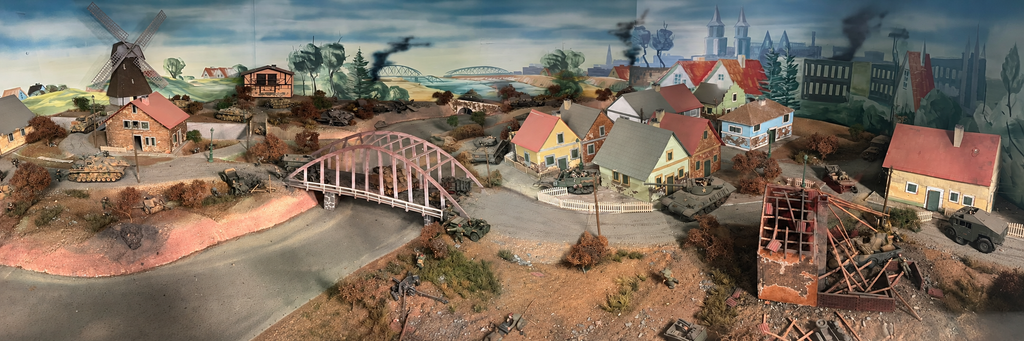
A large diorama at the Gold Coast War Museum in Mudgeeraba depicts one of the most famous battles fought in the Netherlands during the Second World War: the struggle for the bridge at Arnhem in September 1944.
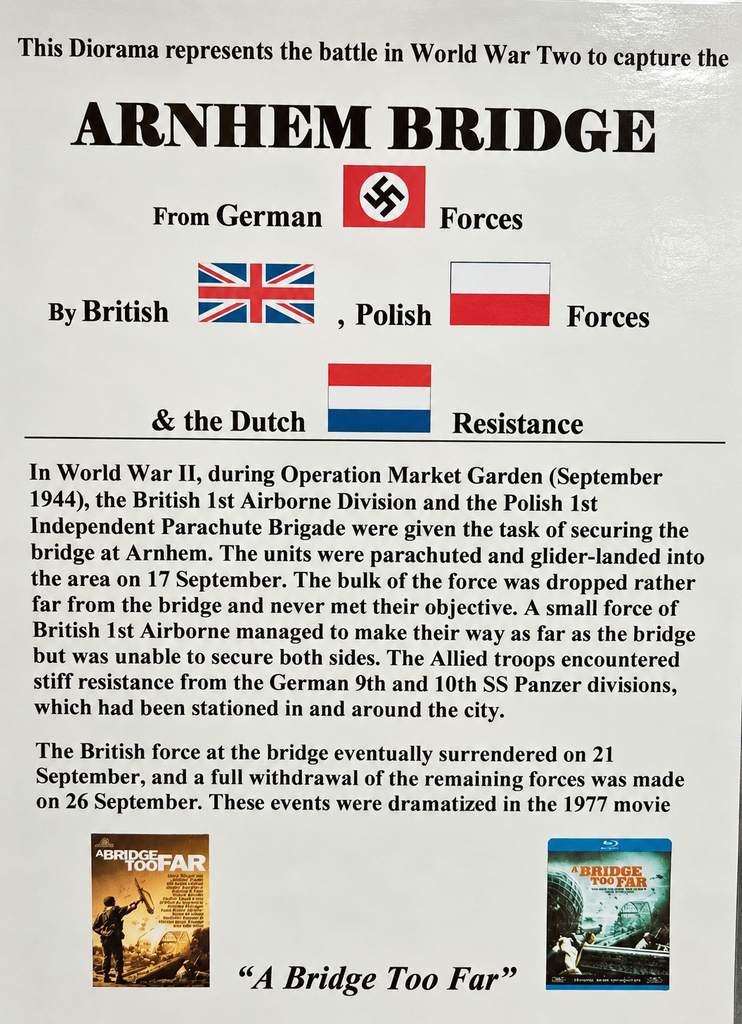
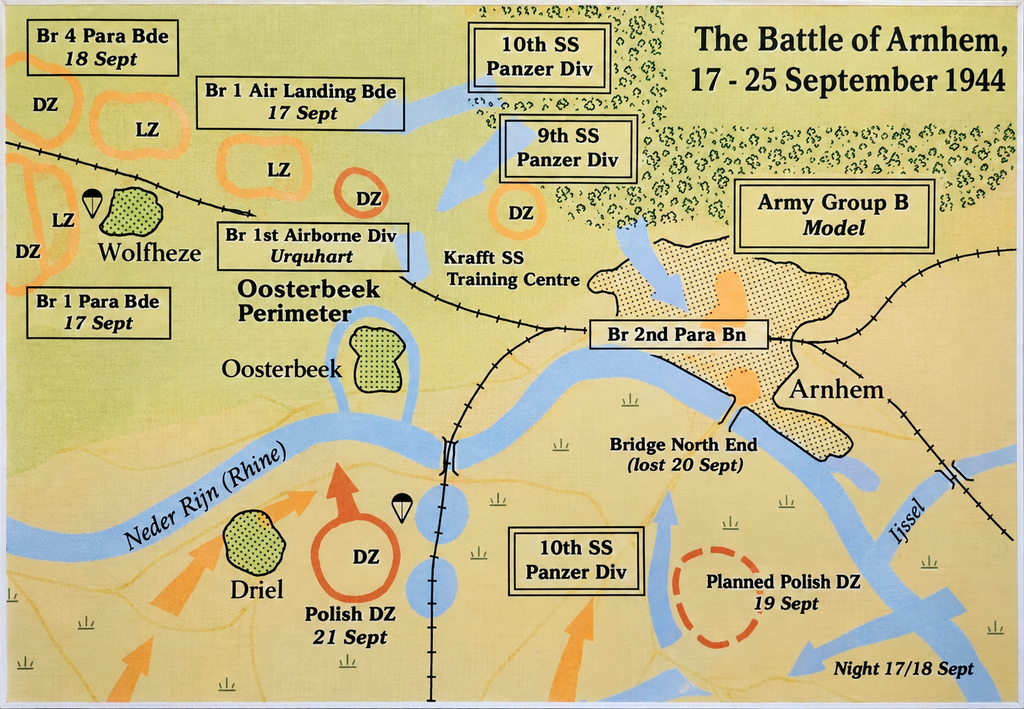
The model shows a Dutch town devastated by fighting, with the bridge, damaged houses, armoured vehicles and German and Allied troops. An accompanying map identifies the British and Polish airborne forces, the German 9th and 10th SS Panzer Divisions, the landing and drop zones around Oosterbeek and the bridge at Arnhem.
For a Dutch-Australian visitor there is another dimension to the display that is easy to overlook: Australians also fought in the Battle of Arnhem and the wider Operation Market Garden.
The Gold Coast War Museum and its dioramas
The museum was established at Mudgeeraba in 1975 by Vic Coote and developed an unusual approach to presenting military history. Rather than relying solely on collections of uniforms, weapons and other artefacts, large dioramas became an important part of its interpretation.
The museum records that artist and signwriter Wally Bruns, himself a former German Wehrmacht soldier, produced much of its early diorama backdrop and sign work. His son Brenton Bruns later founded the military modelling and re-enactment group The Standard Bearers, whose displays at the museum include what the museum describes as “world-class dioramas”. The museum does not, however, identify the maker or date of the Arnhem diorama on its website, so its precise provenance still needs to be established.
The Arnhem model therefore forms part of a much longer tradition of using three-dimensional displays to bring military history to life at this Queensland museum.
Operation Market Garden
The battle represented in the diorama began on 17 September 1944 as part of Operation Market Garden, an ambitious Allied attempt to advance rapidly through the Netherlands and establish a bridgehead across the Rhine.
Airborne forces were to capture a succession of bridges while a British ground force advanced north to link up with them. Arnhem was the furthest objective.
The British 1st Airborne Division landed around Arnhem and Oosterbeek, while the Polish 1st Independent Parachute Brigade subsequently joined the battle. The presence nearby of substantial German armoured forces, including elements of the 9th and 10th SS Panzer Divisions, contributed to much heavier resistance than the Allies had anticipated.
The British troops who reached the Arnhem road bridge were eventually overwhelmed, while other airborne forces became trapped in a shrinking perimeter around Oosterbeek. The survivors were withdrawn across the Lower Rhine during the night of 25–26 September.
Arnhem consequently became the “bridge too far” immortalised by Cornelius Ryan’s book and the 1977 film of the same name.
Where were the Australians?
There was no Australian army formation fighting at Arnhem. This probably helps explain why the Australian connection is relatively little known.
But Australians were there in the air.
RAAF personnel serving in RAF transport, bomber and fighter units participated throughout Operation Market Garden. They transported airborne troops, flew supply missions to the increasingly desperate forces around Arnhem and Oosterbeek, and attacked German positions. Australian fighter crews also provided support. The Australian War Memorial specifically identifies Australian participation throughout the operation.
There was even a RAAF unit involved. No. 456 Squadron RAAF, equipped with Mosquito fighters, supported British forces around Arnhem during Market Garden before continuing operations over the Netherlands and Belgium.
For the Arnhem diorama on the Gold Coast, however, one Australian story has a particularly strong Queensland connection.
Keith Prowd – from Queensland to Arnhem
Warrant Officer Keith Prowd, RAAF, was a Queenslander serving as a pilot with No. 196 Squadron RAF, part of 38 Group Transport Command.
During the Arnhem battle his squadron used four-engined Short Stirlings to carry supplies to the airborne troops.
Prowd was flying Stirling EF248 on a supply mission over the Arnhem area when the aircraft was hit by German anti-aircraft fire. Another Australian, Pilot Officer John Wherry, was serving as its wireless operator.
The Stirling was badly damaged and Prowd ordered the crew to abandon the aircraft. Wherry was wounded during the descent but survived, while Prowd was captured after landing. Both became prisoners of war.
Prowd’s story is especially appropriate for a Queensland museum display of Arnhem: an Australian from Queensland was actually flying into the battle represented by the model.
Maurice McHugh – supplying the surrounded troops
Another Australian was Pilot Officer Maurice McHugh, a 21-year-old RAAF pilot from Victoria serving with No. 620 Squadron RAF.
His squadron had converted its Stirling bombers to airborne-support operations, including carrying paratroopers, towing gliders and dropping supplies.
On 20 September McHugh was flying supplies to the British 1st Airborne Division at Arnhem when his Stirling was shot down.
These supply missions became extraordinarily dangerous. The aircraft had to approach the drop zones at relatively low altitude and on predictable courses while German forces increasingly controlled the ground surrounding the British perimeter.
For the men inside the Oosterbeek pocket, however, the supplies carried by aircraft such as those flown by Prowd and McHugh were desperately needed.
Bruce Williams and Thomas Lennie – Australians over Arnhem to the end
Australians were still flying over Arnhem on 25 September, as preparations were being made to evacuate the surviving airborne troops.
Flight Sergeant Bruce Llewellyn Williams, RAAF, was flying a B-25 Mitchell of No. 98 Squadron RAF in a formation sent to attack German positions around Arnhem. His navigator was another Australian, Pilot Officer Thomas John Lennie, a Queenslander from Maryborough.
After completing its bombing run, their Mitchell was attacked by German Focke-Wulf Fw 190 fighters. Lennie was killed aboard the aircraft and the Mitchell was fatally damaged.
Williams ordered the surviving crew to bail out. He subsequently parachuted towards Arnhem bridge, which by then was again under German control, and was shot and killed while descending.
What happened next introduces the Dutch civilian population into this Australian story.
A Dutch resident, Fritz Baars, witnessed Williams’s death. When it became safe, Baars recovered the Australian’s body and buried him nearby, wrapped in his parachute. After the war Williams was reinterred alongside Lennie at Arnhem Oosterbeek War Cemetery.
Their graves and the wider Dutch tradition of remembering Australian servicemen deserve a separate DACC story.
Australians hidden inside British units
The Australian involvement in Arnhem illustrates a broader problem in telling Australia’s European wartime history.
Many Australians served not in formations bearing an Australian name but within British squadrons and other Allied units. Looking only at the order of battle can therefore make them almost invisible.
Recent research into Australians at Market Garden has identified Australians serving across RAF Transport, Bomber and Fighter Commands. They carried paratroopers, delivered supplies and attacked German forces along the Market Garden corridor.
There were Australian-born men on the ground as well. John Winthrop Hackett, born in Perth and educated partly in Australia, commanded the British 4th Parachute Brigade at Arnhem, while Sydney-born journalist and soldier Alan Wood reported from the battle. Their circumstances were different from those of RAAF servicemen such as Prowd, McHugh, Williams and Lennie, but they provide another indication of the Australian presence in the battle.
A Dutch battlefield remembered in Queensland
The Arnhem diorama at the Gold Coast War Museum therefore represents more than a famous British airborne battle.
It depicts a battle fought on Dutch soil involving British and Polish airborne troops, German forces, Dutch civilians and resistance members—and Australians whose participation is easily missed because many wore RAAF uniforms while serving in RAF squadrons.
For Queensland there is an especially tangible connection. Keith Prowd came from Queensland and flew a supply aircraft into the Arnhem battle, while Thomas Lennie was born in Maryborough and lost his life over Arnhem on the final day of the operation.
More than eight decades later, their battlefield has been recreated in miniature in a museum in their home state.
Paul Budde September 2026, after having visited the museum and made the pictures of the diorama.
Sources and further reading
- Australian War Memorial – 75th anniversary of Operation Market Garden — particularly useful for the overall operation and the Australian involvement, including Bruce Williams, Thomas Lennie and Dutch civilian Fritz Baars.
- Australian War Memorial – Maurice McHugh, No. 620 Squadron RAF — biographical information and McHugh’s Arnhem supply mission of 20 September 1944.
- Australian War Memorial – Bruce Llewellyn Williams, No. 98 Squadron RAF — detailed account of the 25 September bombing mission over Arnhem and the loss of Williams’s Mitchell.
- Australian War Memorial – Joseph Deglish Stevenson, No. 196 Squadron RAF — another Australian who transported airborne forces and flew Arnhem resupply missions during Market Garden.
- Australian War Memorial – Russell George Tickner, No. 196 Squadron RAF — another useful example of an Australian pilot flying airborne and resupply operations to Arnhem.
- Pegasus Archive – Warrant Officer Keith Prowd RAAF — particularly important for our Queensland connection; includes Prowd’s 196 Squadron Stirling, its loss over Arnhem and his Dutch Vliegerkruis.
- Pegasus Archive – Pilot Officer Maurice McHugh RAAF — detailed reconstruction of McHugh’s loss and the assistance given to surviving crew members by the Dutch Resistance.
- Virtual War Memorial Australia – No. 456 Squadron RAAF — records the Australian squadron’s support for British forces around Arnhem during Operation Market Garden.
- Military History & Heritage Victoria – Untold stories of Australians in Operation Market Garden — useful overview identifying Australians involved, including Keith Prowd, John Hackett, Alan Wood and other Australian aircrew.
- Gold Coast War Museum – History of the Museum — background on the museum, its development and its tradition of military modelling and large dioramas.